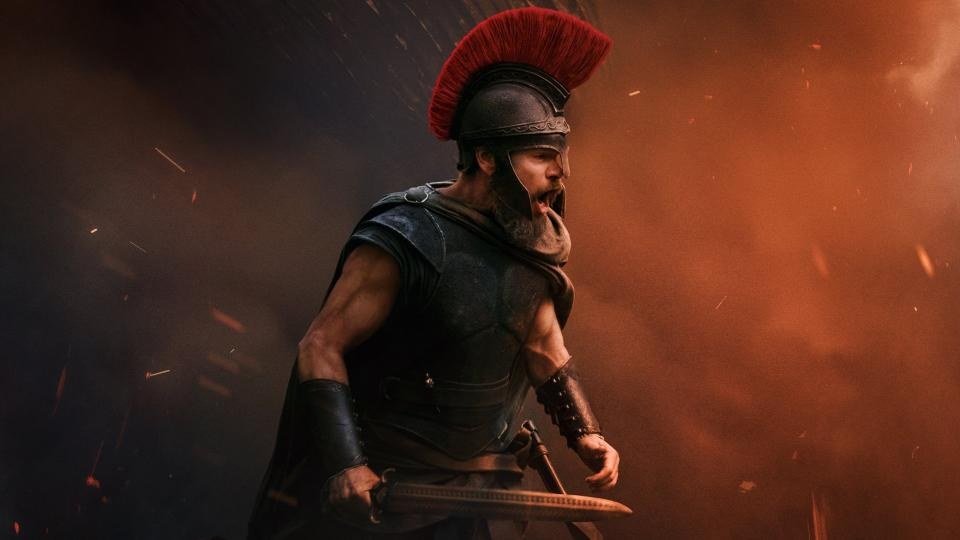
I saw it last night. I mention that first because it is the only credential a review actually needs, and — as I will argue — the one that most of the noise around this film has been missing. What follows is long, because the film is long and the poem behind it is longer still, and because honesty about a work this ambitious cannot be delivered in a verdict of stars. Christopher Nolan has made something genuinely large here. Large enough to admire, and large enough that its flaws are worth taking seriously rather than either forgiving or weaponizing.
Let me take the film from the outside in: first the way it was received before anyone had seen it, then what it does well, then where it falters, then the argument about its cast that everyone wants to have and few want to have carefully.
I. You cannot review a film you have not seen
For months before release, the internet had already decided. There was a trailer, a handful of stills, a cast list, and — that was enough — a verdict. The film was denounced as a capitulation to a “woke agenda,” its directorial choices condemned, its politics diagnosed, all on the strength of a two-minute trailer and a Wikipedia cast page. I watched people write paragraphs of confident analysis about a three-hour film they had not watched a single frame of.
I learned, more than twenty years ago, when I started writing film criticism, the one rule that separates criticism from opinion: you do not analyze what you have not seen. It sounds trivial. It is not. It is the whole discipline in a sentence. To criticize is to give an account of an encounter, and you cannot give an account of an encounter that never happened. Everything else — taste, erudition, theory — is downstream of that. A critic who reviews the idea of a film rather than the film has not been rigorous or brave; he has simply skipped the part of the job that requires humility.
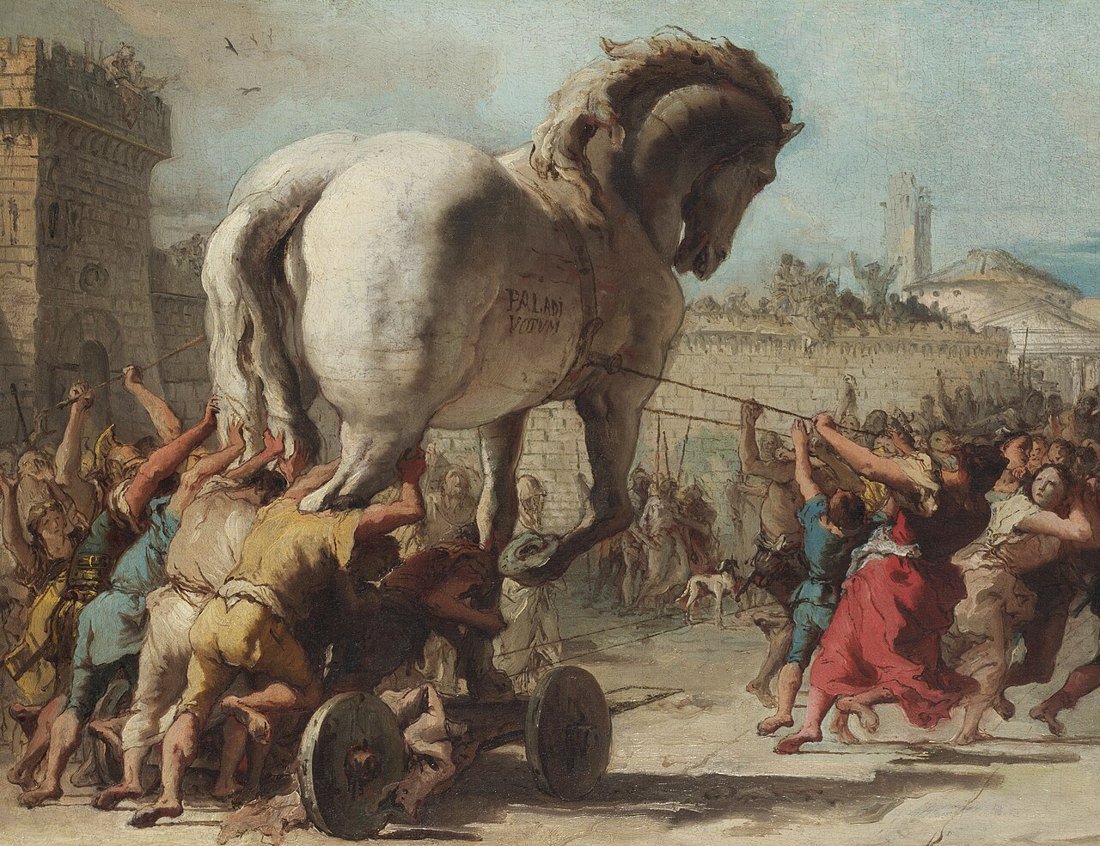
What made the pre-release wave so revealing was that it was structurally identical on both sides. Those who denounced the film unseen and those who defended it unseen were making the same error in opposite directions. Both had substituted the discourse about the film for the film. And the discourse is always more convenient than the work, because the discourse asks nothing of you — no three hours in the dark, no suspension of your prior conclusions, no risk that the thing might change your mind. (I wrote about this reflex when the casting backlash first broke; the trailer, at the time, was doing the same work a mask does — letting people rehearse an argument without meeting a face.)
So the first honest thing to say about Nolan’s Odyssey is this: almost everything said about it before July was worthless, in the precise sense that it was uncosted. Now the film exists, and can be met. Let us meet it.
II. The achievement, and it is real
Begin with the plain fact, because I have no interest in the contrarian’s pose: the film is very good, and the acclaim it is receiving is largely earned. The reviews have been strong — Rotten Tomatoes has it certified, the trade press is already treating it as a serious awards contender, and it broke the year’s preview box-office record. That consensus is not hype inflating a mediocrity. It is roughly correct.
What Nolan has attempted is, without exaggeration, a Homeric undertaking — to compress the ancient world’s most influential narrative into a single evening and make it move. The astonishing thing is that it moves. Three hours is a long time to sit, and the film earns nearly all of it; the pacing is taut where the poem is episodic, and Nolan’s instinct for structure — the thing he has always had — keeps the machine turning. Several performances rise above the spectacle. Anne Hathaway, in particular, does the kind of work that a lesser film would have buried under set-pieces.
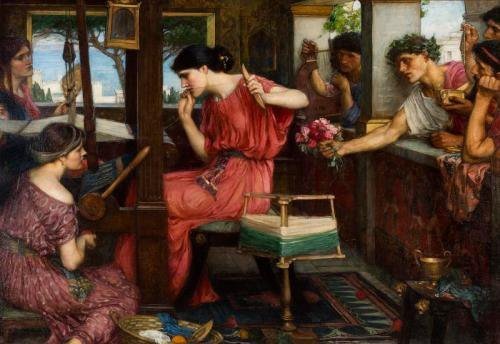
And here is the observation that surprised me most, the one I did not expect to be writing: Penelope’s drama is often more compelling than Odysseus’s journey. The voyage is a sequence of marvels — monsters, storms, enchantments — and marvels, however well staged, are external. What happens in Ithaca is internal, and therefore harder, and therefore richer. Penelope’s twenty-year siege is not fought with a sword; it is fought with patience, cunning, grief managed in public, and a fidelity that has curdled into something closer to endurance than to hope. The loom she weaves by day and unpicks by night is a better image of the human condition than any whirlpool. Nolan, perhaps without fully intending it, has made a film in which the waiting is more dramatic than the wandering — which is, incidentally, a very old and very sophisticated reading of the poem. I have written before about why Penelope, not Odysseus, may be the epic’s true center of gravity, and the film, to its credit, keeps stumbling into that truth.
III. Where the light went out
Now the harder part, and I want to be precise rather than merely negative.
My central reservation is not about fidelity. It is about light — or rather its absence. The film is shot almost entirely in a register of gloom: greys, browns, a muddy and overcast palette that swallows the image. And here I am not alone; even critics inclined to admire it have called the look murky and underwhelming, and one of the sharpest dissents complained that the film, even projected in IMAX, looks muddy. This is not a quibble about color grading. It is a claim about the soul of the material.
When we imagine ancient Greece and its mythology, there is something irreducibly solar about it. This is the quality Nietzsche named Apollonian — the principle of light, form, clarity, the bright dream-surface of the world. Greek myth happens under a Mediterranean sun; its gods are radiant; its sea is wine-dark but also dazzling; its tragedy is terrible precisely because it unfolds in full daylight, with nothing hidden. To film all of this in perpetual overcast is to translate it into a foreign key. The darkness reads as seriousness — Nolan’s default idiom — but it costs the material its native brightness. The film has gravity. What it lacks is life. It is a magnificent thing seen through smoked glass, and I kept wanting someone to open a window. (If you want the argument for why that solar quality is inseparable from the poem’s power, I made it here.)
Then there are the omissions, and one in particular that I cannot let pass. Nolan chose not to stage the “Nobody” episode — the moment when Odysseus, trapped in the Cyclops’s cave, tells Polyphemus that his name is Outis, “No man,” so that when the blinded giant roars for help and his neighbors ask who has hurt him, he answers “Nobody,” and no one comes. Nolan has said the line would be hard to translate for a contemporary audience. I understand the difficulty. I think the decision is a mistake.
It is a mistake because that pun is not a decoration. It is one of the two or three most recognizable moments in all of Homer, and — more importantly — it is a hinge of the entire plot. The blinding of Polyphemus is what draws down the wrath of Poseidon, the Cyclops’s father, and Poseidon’s wrath is the engine of everything that follows: the storms, the delays, the ten lost years, the whole long agony of the homecoming. Remove the scene and you have not merely cut a famous line; you have quietly unplugged the machinery that makes the story necessary rather than merely eventful. The wandering stops being a punishment and becomes a travelogue. (I set out how that cause-and-chain works in the piece on the monsters of the Odyssey, and on the gods who drive the plot.)
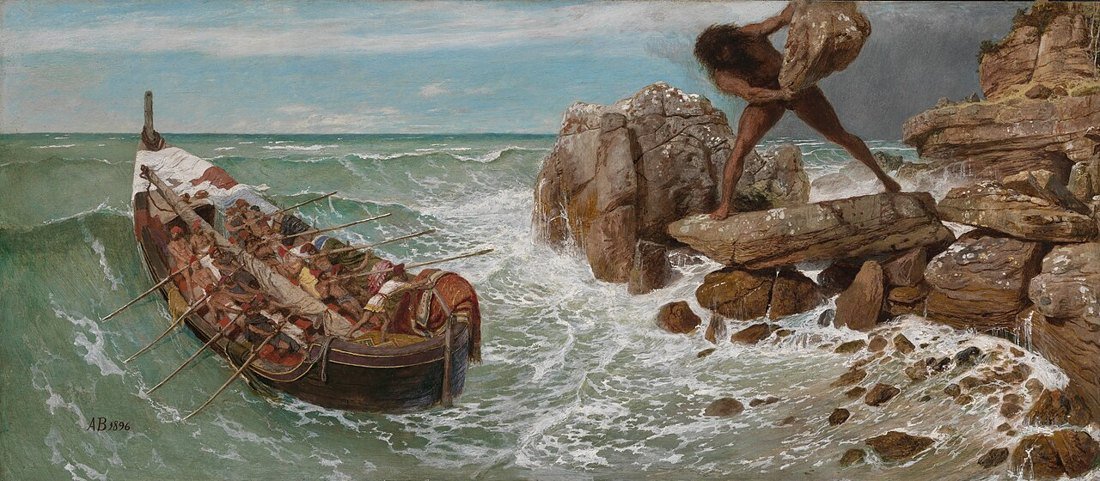
I want to be fair about the stakes of this. For a viewer who knows the poem, these deviations register as small wounds — you feel each absence, because you carry the original in your head and the film keeps failing to rhyme with it. For a newcomer, they will make almost no difference; you cannot miss what you never had. That asymmetry is worth naming honestly, because a great deal of the disappointment circulating among literate viewers is really the ache of the initiated, and it is not quite the same thing as the film being bad. It is the film being unfaithful in ways only the faithful can feel.
IV. The question of the cast — asked carefully
And now the argument nobody conducts calmly, which is exactly why it is worth conducting calmly.
Let me be as clear as I can. I have no objection to the diversity of this cast. None. Elliott Page has a minimal role and is fine in it; the ensemble is talented; casting is not a census, and the idea that a Greek myth must be performed only by actors of a particular appearance is both historically naive and artistically sterile. Myth is not ethnography. It belongs to whoever picks it up. On the principle, I am entirely untroubled.
But I want to notice something, coldly, and I include the coldness on purpose, because the observation only works if I refuse to let my own sympathies decide it in advance. Suppose the mythology in question were not Greek but something else — an African cosmology, an Indigenous tradition, a Chinese or Japanese epic. Suppose a major studio cast it with the same principle of visible diversity: a white or Black actor as a central Chinese hero, say. Does anyone seriously believe the reaction would be symmetrical? There would be an outcry — and much of it would come from precisely the quarters now most delighted by a Black Helen, a rhapsode of African descent, an actor of Chinese ancestry among the men in the Trojan horse, a Latino Eumaeus. The defense of open casting, in other words, is applied with a striking selectivity. It is treated as enrichment when the source is European and as erasure when the source is not.
I am not making the reactionary’s point. I am making the opposite point, which is harder: the principle should be consistent. Either myth is common property, open to any face — in which case that must hold for every people’s myth, including those we have been taught to handle with special care — or it is the patrimony of its origin, in which case that must hold for the Greeks too. What I distrust is the middle position that no one will state out loud: that European myth is fair game precisely because it is coded as the default, the unmarked, the tradition that belongs to no one because it is assumed to belong to power. That is not respect for Homer. It is a quiet condescension toward him, dressed as universalism.
None of which, I should say plainly, damaged my experience of the film. The casting gives ample material for argument — and I have just given some — but the story survives it easily, because the story is stronger than any decision made about who tells it. A Black Helen is still Helen; the face that launched a thousand ships was always a metaphor before it was a face. The argument about the cast is real and worth having. It is simply not the argument about whether the film works. Those are different films, and only one of them was showing last night.
Coda: the poem outlives the picture
Here is the paradox that every adaptation of Homer eventually teaches, and that Nolan’s teaches again: the film sends you back to the book. Whatever it gets right, whatever it dims or drops, its final effect on anyone paying attention is to reawaken the hunger for the source — to make you want the “Nobody” scene it withheld, the sunlight it muted, the full weight of Poseidon’s grudge it left implied. A good adaptation is not a replacement for the poem. It is an advertisement for it. Three thousand years on, the Odyssey remains the thing no camera can exhaust.
So let me end where a review from a press like ours should end: with an invitation to the original.
If the film has stirred you, read the poem it comes from. Erato Press publishes it in several forms, and this is the moment for them:
 Homer: The Complete Worksthe Iliad, the Odyssey, and the Homeric Hymns in one annotated critical volume, for readers who want the whole of Homer in a single hand.
 The Iliadthe war that the film only glances at: the wrath of Achilles, and everything that made the homecoming necessary.
 The OdysseyHomer’s epic in a clear prose translation, including the scene Nolan chose not to film.
 The Trojan War: The Complete Sagathe whole cycle, from the golden apple to the horse, for the story the movies always tell in fragments.
 The AeneidVirgil’s answer to Homer, the Trojan war seen from the losing side.
 The Odyssey: A Retellingthe complete journey, from the fall of Troy to the shores of Ithaca, in a single continuous narrative.
And if you would rather read your way toward the film — or away from it — a few of our essays make good companions: the complete guide to the Odyssey before you see Nolan’s film, the difference between the Iliad and the Odyssey and which to read first, which translation of Homer to choose, the full story of the Trojan War, and, for afterward, where to go next in the Greek classics.
The film will win its awards, and mostly deserve them. Then it will fade, as films do. The poem will still be there — bright, cruel, sunlit, and patient as Penelope at her loom — waiting for the next century to come and fail to capture it, and to be sent, once more, back to the words.
Enjoyed this piece?
Get the next one — our essays on the classics and news of each new Erato Press edition — straight to your inbox.