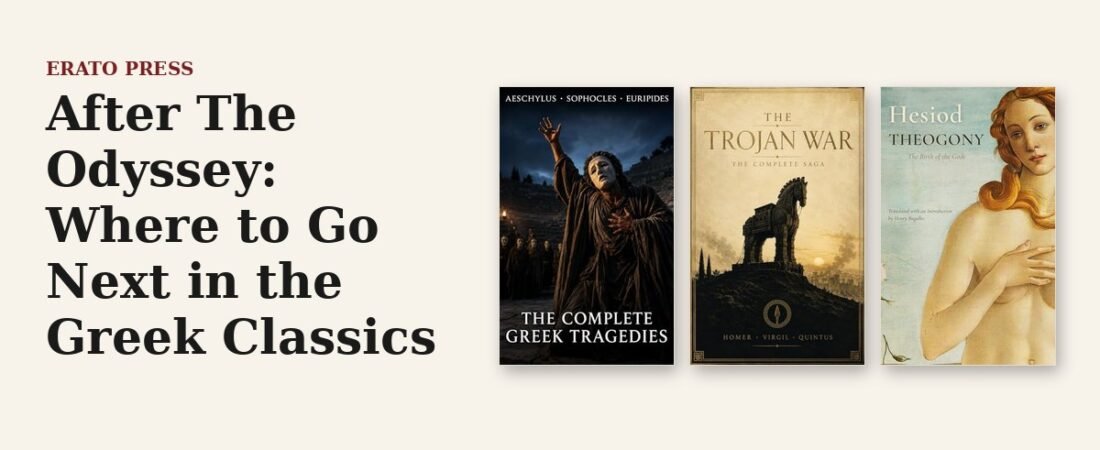
Short answer: Finished the Odyssey — or just seen Nolan’s film — and want more? Go in this order: the war that came before it (the Trojan saga), the drama that answered it (Greek tragedy), the gods behind it (Hesiod), and the great Christian epic that inherited it (Dante). Here is a roadmap through the Greek classics and beyond, with where each one leads.
1. The Iliad — the war that made the wanderer
The most natural next step is Homer’s other epic. The Iliad is the war the Odyssey is the aftermath of — the wrath of Achilles, the death of Hector, and a vision of force and grief so unflinching that the philosopher Simone Weil called it “the poem of force.” It is the harder, sadder, greater poem, and the Odyssey is the perfect training for it. Start with our guide to reading the Iliad.
2. The complete Trojan War saga — the whole arc
Homer’s two poems together cover only a sliver of the Trojan War — a few weeks of fighting and one homecoming. The rest lived in six lost epics. The complete Trojan War saga reconstructs the entire story from the surviving fragments: the golden apple, the sacrifice at Aulis, the death of Achilles, the wooden horse, the fall of the city, and the scattered, disastrous returns that lead straight into the Odyssey. If the film leaves you wanting the full story, this is it.
3. The Greek tragedies — the same myths, harder questions
The other pillar of the Greek imagination. Aeschylus, Sophocles, and Euripides took the very gods and heroes Homer sang and put them on trial — Agamemnon murdered at his own homecoming, Antigone destroyed by an impossible duty, the women of conquered Troy mourning in the ruins. The Complete Greek Tragedies gathers all thirty-three surviving plays, and there is no richer way to deepen what Homer began.
4. Hesiod — the gods, from the beginning
To understand the gods who help and hunt Odysseus, go to Hesiod, Homer’s near-contemporary. The Theogony is the birth of the gods and the origin of the cosmos — Chaos, Gaia, the castration of Uranus, the rise of Zeus — the oldest Greek story about power. Its companion, the Works and Days, turns from the cosmos to the farm: the first poem in Western literature to make ordinary working life its subject. Our introduction to Hesiod and the birth of the gods is the place to begin.
5. Dante’s Divine Comedy — the inheritance
Then leap forward two thousand years to see what the tradition became. Dante’s Divine Comedy is the great medieval Christian epic, and it is unthinkable without Homer and Virgil — indeed Dante puts Odysseus himself (as Ulysses) in Hell, and makes Virgil his guide. Like the Odyssey, it is a journey: not home across the sea, but down through Hell and up to Paradise. Our map of Dante’s afterlife shows how the Greek epic tradition flows into the Christian one.
Where to actually begin
If all of this feels like a lot, it is — three thousand years of literature reaching back to one blind singer. The good news is that it connects. Read the Odyssey, then follow whichever thread pulls hardest: the war (the Iliad and the Trojan saga), the gods (Hesiod), the drama (the tragedies), or the inheritance (Dante). Our guide to the Greek and classical epics lays out the whole map, and our essay on why the Odyssey still matters explains why it is worth the journey.
Nolan’s Odyssey will, this summer, send a whole new audience looking for the books behind the film. This is the path they lead to — and the Odyssey is only the first door.
Start with the Erato Press Odyssey →
Related reading: Greek Classics: Where to Begin · Reading Homer: The Iliad · Dante’s Divine Comedy: A Map of the Afterlife
This article contains affiliate links; as an Amazon Associate, Erato Press earns from qualifying purchases.
Enjoyed this piece?
Get the next one — our essays on the classics and news of each new Erato Press edition — straight to your inbox.