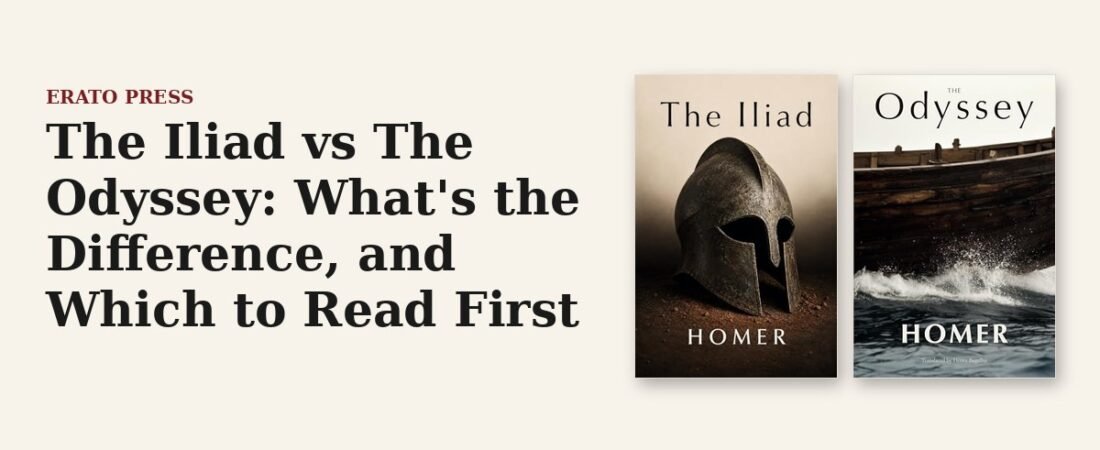
Short answer: The Iliad is a poem of war, wrath, and death; the Odyssey is a poem of homecoming, cunning, and survival. They were paired in antiquity but feel like the work of different temperaments. Most readers should start with the Odyssey — it is the better story for a beginner — but the Iliad is the deeper book, and if Nolan’s film sends you to Homer, you will eventually want both.
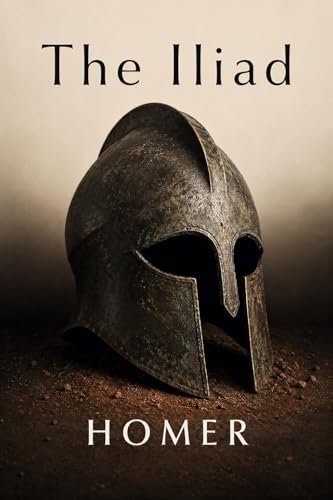
Two poems, one tradition, two temperaments
The ancients themselves argued about whether one poet wrote both. The Separatists — the chorizontes — held that the two poems were simply too different in style and sensibility to be the work of one hand. As our Odyssey essay frames the contrast: “The Iliad is a poem of war, of wrath, of men dying in the dust before the walls of Troy. The Odyssey is a poem of homecoming, of cunning, of a man who survives by his wits and returns to reclaim what is his.” Whether that difference means different authors is undecidable. But the difference itself is real, and it is the most useful thing a new reader can hold onto.
The Iliad: a poem about force
The Iliad‘s first word, in Greek, is menis — wrath — a word reserved in Homer for gods and for Achilles. The whole poem is the story of one man’s anger and its catastrophic cost: insulted by Agamemnon, the greatest Greek warrior withdraws from battle, and thousands die for it. But its true subject, as the philosopher Simone Weil argued in her great 1940 essay written under German occupation, is force — “force that turns a human being into a thing.” Homer names his dead: again and again he stops the narrative to give a dying man his name, his father, his city, one detail of his life — and then kills him in a line. Those thirty words are all that man gets in all of literature. We unpack this in our essay on reading the Iliad as the first epic of war.
And the Iliad is morally symmetrical in a way that still startles readers: the Greeks are not heroes and the Trojans are not villains. Both sides suffer; both commit atrocities. The poem’s emotional climax is not a Greek victory but Trojan grief — old King Priam crossing the battlefield at night to beg, from the man who killed his son, the body of Hector. It is one of the most extraordinary scenes in literature, and it is the opposite of a triumph.
The Odyssey: a poem about mind
Where the Iliad stares at death, the Odyssey studies survival. Its hero wins not by force but by wits — lying, disguising, calculating, enduring his way across ten years and an ocean of temptation. Where Achilles chooses a short, glorious life, Odysseus chooses home over the immortality Calypso offers him. The Iliad is a single concentrated rage compressed into a few weeks of the war’s tenth year; the Odyssey is a sprawling voyage of monsters, witches, and one disguised king reclaiming his house. One is a tragedy of youth and glory; the other is a comedy, in the old sense — a story that ends in reunion and restoration.
Which should you read first?
Start with the Odyssey. It is the more welcoming book — episodic, propulsive, full of the monsters and marvels everyone half-remembers, and structured like the adventure novel it secretly is. Read it, fall for Homer’s voice, learn how epic works, and then turn to the Iliad, which asks more of you and gives more back. The Iliad is the harder, sadder, greater poem; the Odyssey is the one that teaches you how to read it. If you want a fuller roadmap through the whole tradition, our guide to the Greek classics is built for exactly this question.
Chronology vs. reading order
One useful caution: the chronological order of the story is not the best reading order. The Iliad comes first in the plot (the war), the Odyssey second (the journey home). But the Iliad itself begins nine years into the war and never explains how the conflict started — that material lived in poems now lost. If you want the full arc from the golden apple to the fall of Troy, the complete Trojan War saga reconstructs it. Read for pleasure, though, and the Odyssey-then-Iliad order wins every time.
The Nolan connection
Christopher Nolan is filming the Odyssey, not the Iliad — the voyage, not the war. But the two are halves of one story, and Hollywood keeps mining both: Troy (2004) was the Iliad; Nolan’s film is its sequel. Read the Odyssey before July and the Iliad after, and you will understand the whole world the film is reaching into — the war that made the wanderer.
Related reading: Reading Homer: The Iliad · Why the Odyssey Still Matters · Greek Classics: Where to Begin
This article contains affiliate links; as an Amazon Associate, Erato Press earns from qualifying purchases.
Enjoyed this piece?
Get the next one — our essays on the classics and news of each new Erato Press edition — straight to your inbox.