Christopher Nolan’s The Odyssey lands in July, the latest trailer dropped yesterday, and the internet is already at war over the casting. Here’s your reassurance and your warning in one sentence: nobody is ever happy — they were furious when Troy cast Brad Pitt as Achilles too — and the only adaptation of the Odyssey that was ever guaranteed to be faithful is three thousand years old and made of words.
The outrage machine, right on schedule
Every time a beloved classic gets adapted, the same ritual unfolds: the trailer drops, and within hours a thousand people who have never opened the poem are certain that this actor is too short, too modern, too something to play a hero Homer described mostly in terms of cunning and endurance, not cheekbones. We have seen this movie before — literally. When Wolfgang Petersen’s Troy put Brad Pitt in Achilles’ sandals in 2004, the reaction was scorn: too pretty, too Hollywood, a blasphemy against the Iliad. Two decades later, plenty of those same people quote that film fondly. The outrage is perennial, and it is almost always louder than it is informed.
This isn’t a defense of any particular casting choice — argue about it all summer, that’s half the fun. It’s an observation about the ritual itself. The fury is a kind of love, displaced. People care this much because the Odyssey belongs to them, and a film feels like a stranger rearranging the furniture in a house they grew up in.
What a film can give you — and what it can’t
Nolan will give us the things cinema does best: the wine-dark sea, the Cyclops’ cave, the storm, the scale, the spectacle of a man very small against a very large and hostile world. If anyone can make the gods feel physically present, it’s him. Go see it. It will be extraordinary to look at.
But here is the thing no film — not Nolan’s, not anyone’s — can photograph. The Odyssey is not, at its heart, an action movie. It is a poem about a mind — about the cleverest man alive lying, disguising, calculating, and enduring his way home across ten years and an ocean of temptation. Its greatest scenes are interior: the ache of homesickness, the test of a wife’s patience, the long restraint of a man who must not reveal who he is. Cunning doesn’t film. Irony doesn’t film. The texture of the verse — the thing that has kept this story alive for three millennia — doesn’t film. A movie can show you the journey. Only the poem can put you inside the traveler.
The one Odyssey that will never disappoint you
So here’s the unfashionable advice: before the lights go down in July, read the thing. Not a summary, not a YouTube explainer — Homer. In a translation that actually moves, the Odyssey is not homework; it’s the original adventure story, still one of the best ever told, and it reads like a novel you can’t put down. Our guide to why the Odyssey still matters is a good place to start thinking about it, and the guide to the Greek classics maps the whole tradition the film is reaching back into.
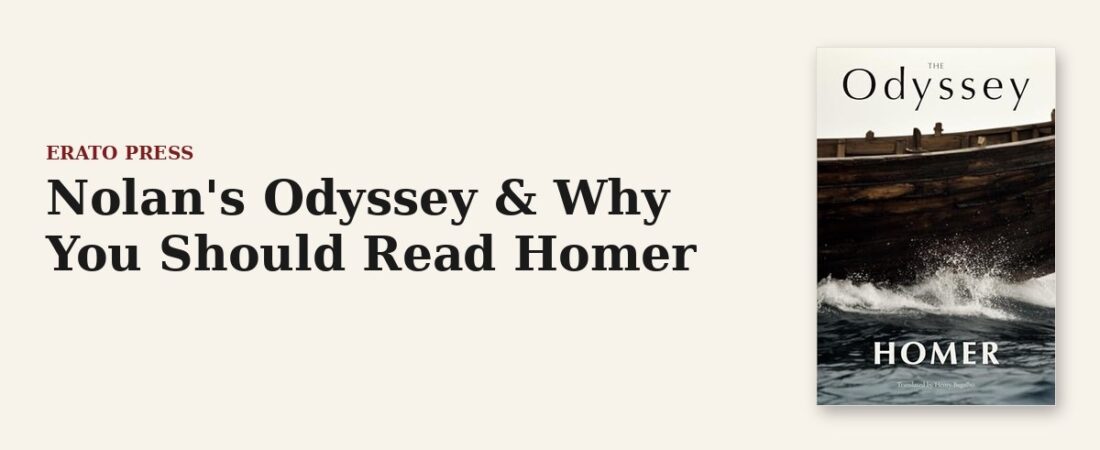
And if you want the real thing in your hands, the Erato Press edition gives you Homer in clear, propulsive prose with the context that makes the unfamiliar names and the world of bronze-age Greece legible — the edition to read first.
Read the Erato Press Odyssey before the film →
Want the war that comes before the voyage? The Iliad and the complete Trojan War saga are the other half of the story Hollywood keeps mining.
Cast whoever you like. Fight about it until July. But the one Odyssey that was always going to be faithful is the one Homer wrote — so go read it, and then enjoy the movie for what it is.
Related reading: The Odyssey: Why Homer Still Matters · Reading Homer: The Iliad · Greek Classics: Where to Begin
This article contains affiliate links; as an Amazon Associate, Erato Press earns from qualifying purchases.
Enjoyed this piece?
Get the next one — our essays on the classics and news of each new Erato Press edition — straight to your inbox.