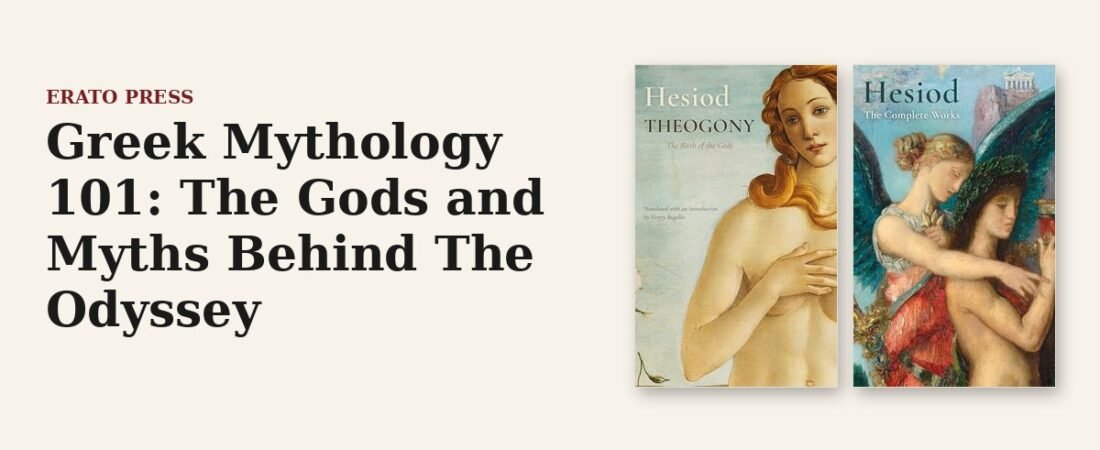
Short answer: The gods Odysseus prays to and runs from — Zeus, Poseidon, Athena — did not spring from nowhere. Their family tree, their wars, and the violent logic of who rules the cosmos were set down by another early Greek poet, Hesiod, in the Theogony. If Homer tells you what the gods do, Hesiod tells you where they came from — and reading him is the fastest way to make the divine machinery of the Odyssey make sense before you see Nolan’s film.
Two founding voices, two different jobs
Greek myth has two great early sources, and they do different work. Homer dramatizes the gods as characters — squabbling, scheming, taking sides at Troy and on the wine-dark sea. Hesiod, a Boeotian shepherd-poet roughly contemporary with Homer, does something stranger and more fundamental: he writes the gods’ genealogy. The Theogony — literally “the birth of the gods” — traces the entire cosmos back to its origins. As our edition’s essay puts it, “every entry carries the logic of the whole, and the order of listing is itself the argument.” For the archaic Greek mind, to know what something was, you asked what it was born from. Genealogy was the first theory of everything.
In the beginning was Chaos
Here is the most consequential sentence in pre-philosophical thought, and it could not be less like Genesis: “First of all, Chaos came into being. And then Gaia of the broad breast… and Eros, the fairest among the immortal gods.” Four entities. No creator. No design, no “let there be.” The cosmos does not begin with an act of will but with an emergence. First the gap (Chaos), then the Earth (Gaia), then desire (Eros) — the force that will drive everything else into being. The Greek universe is not made; it is born.
The succession myth: fathers, sons, and the body
What follows is a drama of brutal simplicity: fathers fear their sons, sons overthrow their fathers, and the instrument of power is always the body. Uranus, the first sky-god, terrified of his own children, stuffs them back into the Earth — until Gaia arms her youngest, Cronus, who castrates his father with a sickle. Cronus then swallows his own children whole to avoid the same fate. And his youngest, Zeus, smuggled to safety, forces him to disgorge them and leads the war that makes Zeus king. This is the violent backstory behind every calm Olympian scene in Homer: the gods who casually decide Odysseus’s fate sit on a throne won by overthrowing two generations of fathers.
Why Zeus wins — and what that has to do with Odysseus
Hesiod’s deepest political insight is in how Zeus breaks the cycle. He does not simply defeat his father by raw strength; he integrates. He frees the imprisoned Cyclopes, who forge his thunderbolt, and the Hundred-Handers, who become his decisive allies. Zeus wins through coalition, through the art of binding former enemies into a stable order. That is the same Zeus who, in the Odyssey, presides over xenia — the sacred law of hospitality — as Zeus Xenios, protector of strangers. The god of guest-friendship is the god who learned that order is built by integration, not annihilation. Odysseus, the man who survives by making allies of Phaeacians and swineherds, is a deeply Zeus-shaped hero.
The gods you’ll meet in the Odyssey, and their place in the tree
- Zeus — king of the gods, guardian of hospitality and oaths; the final authority behind Odysseus’s homecoming.
- Poseidon — Zeus’s brother, lord of the sea, who hunts Odysseus for blinding his son the Cyclops.
- Athena — born, in myth, from Zeus’s own head; goddess of wisdom and craft, Odysseus’s tireless protector.
- Hermes, Helios, Calypso, Circe — messenger, sun, and the goddesses of the islands, all of whom trace back through Hesiod’s genealogies to the first powers of the world.
For more on how this birth-of-the-gods material works, see our introduction to Hesiod and the birth of the gods. And Hesiod’s other great poem, the down-to-earth Works and Days, is the companion piece — the same poet turning from the cosmos to the farm, from how the gods were born to how a mortal should live.
The film tie-in
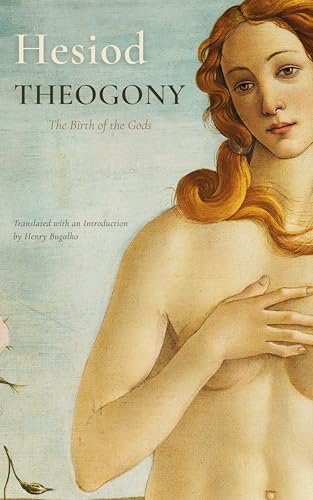
When Nolan’s Odyssey puts gods on screen this July, they will arrive as characters — faces, voices, interventions. Hesiod gives you the family they belong to: the castrations and swallowings and wars that lie three generations behind every serene Olympian command. Read the Theogony and the gods of the film stop being decoration and become the oldest story we have about power.
Read the Erato Press Theogony →
Related reading: Greek Mythology 101: Hesiod and the Birth of the Gods · Why the Odyssey Still Matters · Greek Classics: Where to Begin
This article contains affiliate links; as an Amazon Associate, Erato Press earns from qualifying purchases.
Enjoyed this piece?
Get the next one — our essays on the classics and news of each new Erato Press edition — straight to your inbox.