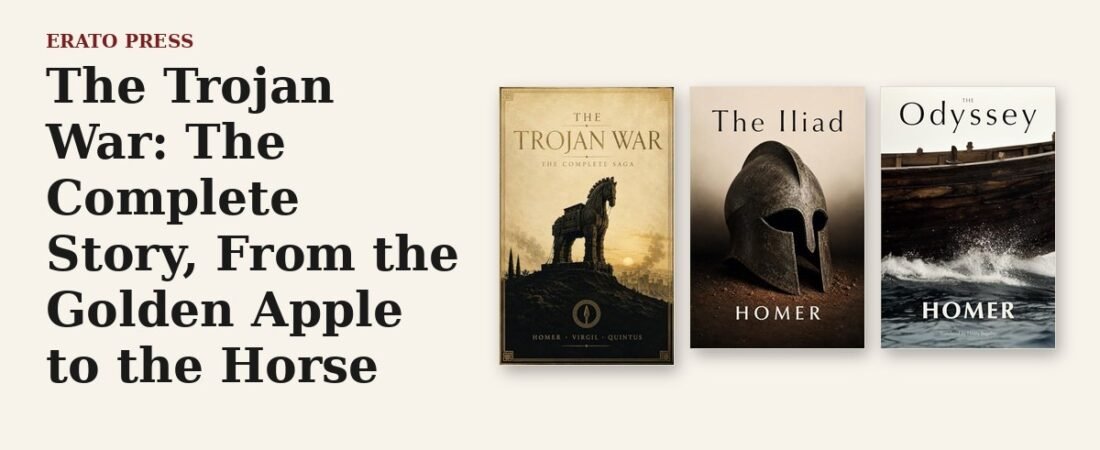
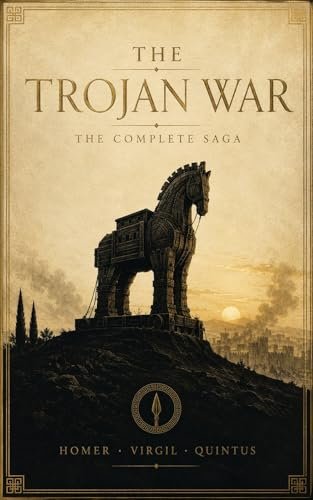
Short answer: The Trojan War runs from a single act of vanity — a golden apple thrown at a wedding — to the night a wooden horse swallows a city. The Iliad tells only a few weeks of it and the Odyssey only the aftermath; the rest lived in six epic poems that are now lost. Here is the complete arc, the way the ancients knew it — and the way the complete saga reconstructs it from the surviving fragments.
The most famous story we only half-have
Here is a fact that surprises most readers: the story of the Trojan War is the oldest continuous narrative in Western literature — and one of the most radically incomplete. The Iliad and the Odyssey were never meant to stand alone. They were two poems within a larger framework of eight, collectively the Epic Cycle, which covered the whole war from the wedding that caused it to the death of the last hero. Of those eight, only Homer’s two survive. The other six — the Cypria, the Aethiopis, the Little Iliad, the Sack of Troy, the Returns, and the Telegonia — are lost, surviving only as fragments, summaries, and paraphrase. The complete story has to be reconstructed.
The golden apple: how a wedding started a war
The cause was not, at first, Helen. At the wedding of the mortal Peleus and the sea-nymph Thetis — the future parents of Achilles — the goddess of strife, Eris, uninvited, rolls a golden apple inscribed “to the fairest” into the hall. Hera, Athena, and Aphrodite each claim it, and Zeus, too wise to judge, hands the choice to a Trojan prince, Paris. Each goddess bribes him; Aphrodite offers the most beautiful woman in the world, and Paris chooses her. The trouble is that the woman, Helen, is already married — to Menelaus, king of Sparta. Paris carries her off to Troy, and Menelaus’s brother Agamemnon raises the largest army Greece has ever assembled to get her back.
But the ancient sources hint at a darker cause beneath the human one. As the saga records, the war may have been the will of Zeus all along — arranged so that “the race of the demigods might be exalted,” or simply to thin a human population grown too heavy for the earth to bear. The golden apple is the spark; the kindling was laid by the gods.
Aulis: the price of sailing
The fleet gathers at Aulis and cannot sail — the winds will not come. The price the goddess Artemis demands is monstrous: Agamemnon must sacrifice his own daughter, Iphigenia. He does it. This single act poisons everything that follows; it is the reason his wife Clytemnestra will be waiting with an axe when he finally comes home, and it is where the Greek tragedians, centuries later, found some of their most harrowing drama. The war is barely begun and it has already cost a father his daughter.
Ten years, and the wrath of Achilles
The war grinds on for nine years before the Iliad even begins. Homer’s poem covers only a few weeks of the tenth year, and its subject is not the war itself but a quarrel inside the Greek camp: Agamemnon insults Achilles, the greatest warrior, who withdraws in rage and lets his own side bleed. Only when his beloved companion Patroclus is killed by the Trojan prince Hector does Achilles return — and he returns as something close to a force of nature, killing Hector and dragging his body around the walls. The Iliad ends not with the city’s fall but with old King Priam begging back his son’s body, a scene of grief so complete it needs no victory to finish it. We go deeper into this in our essay on reading the Iliad.
The death of Achilles and the fall of Troy
What the Iliad leaves out is what the lost poems carried. After Hector’s death come the Amazon queen Penthesilea and the Ethiopian king Memnon, both killed by Achilles — and then Achilles himself, brought down by an arrow from Paris guided to his one vulnerable heel. Ajax and Odysseus contend for his armor; Ajax, losing, goes mad and falls on his own sword. And then the war’s defining trick: the wooden horse, built on Odysseus’s cunning, left as a false offering. The Trojans drag it inside their own walls; in the night the hidden Greeks climb out and open the gates. Troy burns. The city that held for ten years falls in a single night because it trusted a gift — a violation of the very hospitality the Odyssey holds sacred, inverted into a weapon.
The returns — and the bridge to the Odyssey
Victory was not the end. The Returns — the Nostoi — told how the homecoming broke the victors. Ajax of Locris dragged the princess Cassandra from Athena’s temple, and the sacrilege infected the whole army with divine wrath; the fleet was scattered by storms, shipwrecks, and treachery. Agamemnon reached home only to be murdered by his wife. And one commander’s return took ten more years and became its own poem: the Odyssey. The Trojan saga does not end at the fall of Troy — it pours directly into the voyage Nolan is bringing to the screen.
Christopher Nolan’s Odyssey begins where this war ends. Read the complete Trojan War saga and you arrive at the film already knowing the ten years of slaughter the wanderer is trying to leave behind.
Read the complete Trojan War saga →
Related reading: Reading Homer: The Iliad · Why the Odyssey Still Matters · Greek Classics: Where to Begin
This article contains affiliate links; as an Amazon Associate, Erato Press earns from qualifying purchases.
Enjoyed this piece?
Get the next one — our essays on the classics and news of each new Erato Press edition — straight to your inbox.