Short answer: Start with the tales, not the poems. Read “The Tell-Tale Heart,” “The Fall of the House of Usher,” and “The Cask of Amontillado” first; then “The Murders in the Rue Morgue,” which invented the detective story. But know what you are reading: not a cabinet of cheap shudders but the work of a radically modern thinker who understood, before nearly anyone, that reason itself is a fragile construction erected over an abyss — and who could not stop staring into it.
The man the critics got wrong
There is a conventional way of reading Poe, and it is almost entirely wrong. The Anglophone tradition spent decades shrinking him to a minor genius — T. S. Eliot called his the mind of “a brilliant adolescent” — while across the Atlantic Baudelaire recognized himself in Poe and built modern poetry partly out of him. The whole Symbolist movement, and with it poetic modernity, is unthinkable without him. The rift is revealing: Poe unsettles the Anglo-Saxon tradition because he refuses its premises — empiricism, moralism, faith in progress, the subordination of art to social use. His work does not teach, edify, or console. It opens a wound in the ordered surface of reality and invites you to look inside. What you find there is not “the macabre” but a genuinely philosophical terror.
Where to start: the tales of terror
Begin with the horror that made him famous — but read it as the laboratory it is, each tale carrying a specific hypothesis about the mind to its last consequence. “The Tell-Tale Heart” is the unreliable narrator pushed to paroxysm: the murderer insists on his sanity and the very insistence dismantles it, yet he never lies — he truly hears the heart beneath the floorboards, and Poe’s real question is not “is this man mad?” but the far more vertiginous “how do we know our perception is more legitimate than his?” “The Fall of the House of Usher” is the Gothic distilled to pure atmosphere, but the house is no mere setting — it is an epistemological metaphor, the fissure in its wall the crack between the appearance of order and the reality of chaos; the edifice, the family, and the mind collapse simultaneously because for Poe they are one thing seen from three angles. And “The Cask of Amontillado” is the perfect revenge story, told in five cold pages, where what disturbs is not the cruelty but the serenity — Montresor narrating fifty years later without remorse, having walled a man up alive with the satisfaction of a craftsman completing a masterpiece. What unites them is Poe’s own theory in practice: every word bends toward a single overwhelming effect, and nothing is wasted.
Then the detective who started it all
Read “The Murders in the Rue Morgue” and “The Purloined Letter” and you are watching the detective story being born — the brilliant amateur, the baffled police, the locked-room puzzle, the reasoning that turns chaos into clarity. Sherlock Holmes is the direct descendant of Poe’s Auguste Dupin. But the Dupin tales are not the opposite of the terror tales — they are its complement. In “Rue Morgue” the killer turns out to be an orangutan: a being with no reason, no motive, no meaning. Reason solves the crime and explains nothing; the world is as inscrutable after the solution as before. Poe invented detective fiction already carrying the consciousness of its own insufficiency — the triumph of reason does not abolish the abyss, it merely measures it.
And the poems — and Eureka
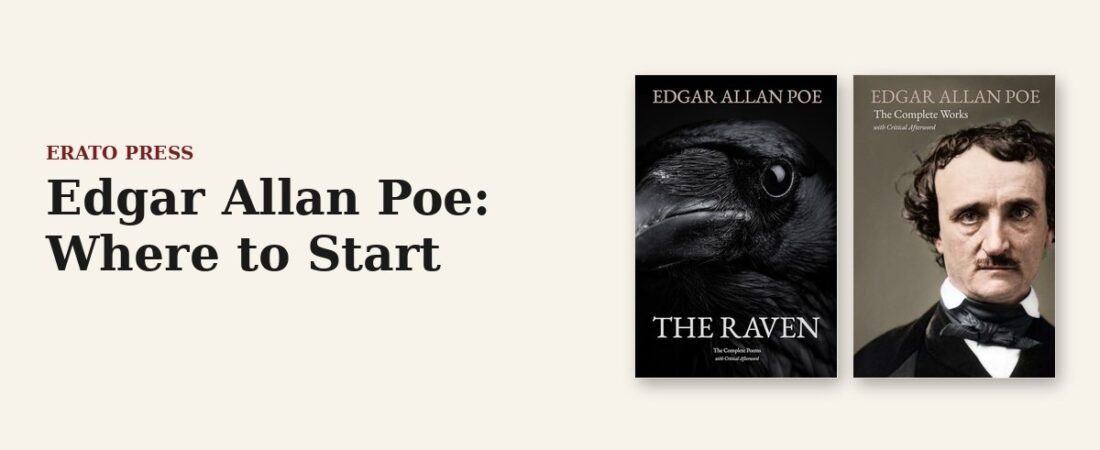
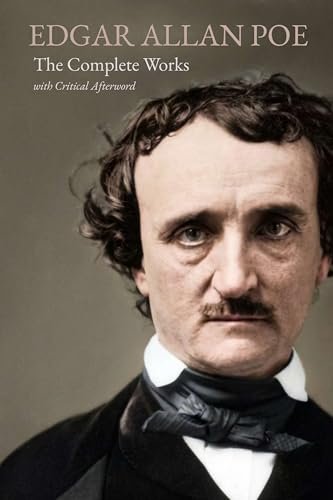
Save “The Raven” and “Annabel Lee” for after. The poems are hypnotic but can feel airless on a first encounter; the tales show you why Poe matters. Come to the verse — gathered with a critical essay in The Raven: The Complete Poems — once the stories have you, and the obsessive music makes sense. And do not skip Eureka, his strange 1848 prose-poem of the cosmos, in which he describes a universe expanding from an original unity and contracting back toward it — anticipating the Big Bang by eighty years through nothing but aesthetic intuition. Poe is the rare writer who founded several genres almost single-handedly — the detective story, the modern psychological tale, foundational science fiction, the theory of the short story itself — and remains, as Borges and Lovecraft and a century of imitators attest, the most efficient terror in literature.
Read the complete works of Edgar Allan Poe →
Related reading: The Essential Gothic Novels: A Reader’s Guide · Frankenstein: Mary Shelley and the Birth of Science Fiction · The Best Detective Fiction in the Classics · The Great American Novel: A Reader’s Map
This article draws on the original critical essay “The Invention of Poe,” written for the Erato Press edition. This article contains affiliate links; as an Amazon Associate, Erato Press earns from qualifying purchases.
Enjoyed this piece?
Get the next one — our essays on the classics and news of each new Erato Press edition — straight to your inbox.