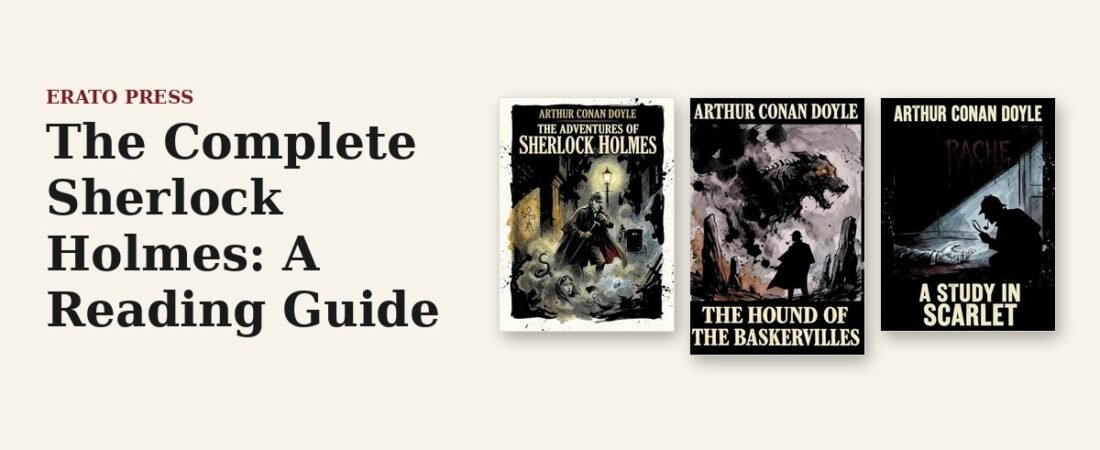
Short answer: Start with the short stories, not the novels — specifically The Adventures of Sherlock Holmes. Holmes was born for the short form, where Conan Doyle’s invention burns brightest. Read those, then the four novels in roughly the order Doyle wrote them — and read the whole canon as what it secretly is: not a celebration of pure reason but a study of reason’s limits.
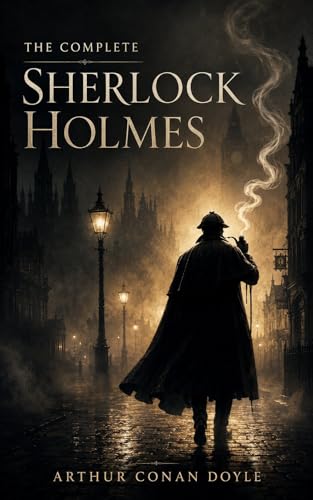
The character who escaped his author
Few creations have so thoroughly outgrown their creator. Conan Doyle came to resent Holmes — he thought of himself as a serious historical novelist, the author of Micah Clarke and The White Company, and saw the detective as a distraction from his real work. He killed Holmes off at the Reichenbach Falls to be rid of him, and was forced by public outcry to resurrect him. The detective has since become something closer to a myth than a character: there are more adaptations, pastiches, and scholarly studies of Sherlock Holmes than of any other figure in English literature except, possibly, Hamlet. Reading the originals, you rediscover what the adaptations dilute — and you discover that the canon is stranger, and more honest about its own hero, than its reputation suggests.
Start with the short stories
Begin with The Adventures of Sherlock Holmes (1892) — “A Scandal in Bohemia,” “The Red-Headed League,” “The Speckled Band.” These are the perfect Holmes: a strange problem, a dazzling performance of deduction, Watson’s affectionate bafflement, and a resolution that makes the impossible look obvious in hindsight. The short story is Holmes’s natural habitat, because his method is essentially theatrical — a demonstration staged for an audience — and the form’s compression keeps the drama tight. Doyle modelled that method on a real man, Dr. Joseph Bell of the Edinburgh Royal Infirmary, who could read a stranger’s occupation and history from the mud on his boots and announced his deductions to students with a showman’s relish. Holmes inherits the showmanship, and the early stories are where it is most electric.
Then the novels
Of the four novels, The Hound of the Baskervilles is the masterpiece — gothic, atmospheric, genuinely frightening, and the one novel where the fog itself becomes a character. A Study in Scarlet is worth reading first for Holmes and Watson’s origin — Watson enters the canon as a wounded veteran of the Second Afghan War, an imperial casualty washed back to London — though its long American flashback surprises newcomers. The Sign of the Four deepens that imperial undertow, with a crime whose roots reach back to the looting of India. Read the novels after the stories have made you love the duo.
Read it as more than a puzzle
The deeper pleasure of the canon is that it knows its own hero is a fantasy. Holmes embodies the Victorian faith that the world is fully legible — that reason, sharp enough, can master anything. But the best stories quietly undercut it: Holmes fails, Holmes is wrong, Holmes is outwitted and deceived. The gap between the promise of the method and the reality of its limits is what saves the stories from being merely clever and makes them, at their best, genuinely moving. What endures is not the deduction but the image beneath it — Holmes and Watson by the fire at Baker Street while the London night presses against the windows, two minds keeping each other company in a world they cannot fully understand. For the sharpest contrast to Holmes’s cold rationalism, read him against Chesterton’s Father Brown, the priest who solves crimes by sympathy rather than science.
Why read all of it
Because the Complete Holmes is one of the great companionable pleasures of reading in English — a whole world of fog, hansom cabs, and stubborn reason, returned to again and again across a lifetime. It is comfort and brilliance at once, and it rewards the reader who comes to it for the friendship as much as the puzzles.
Read the Complete Sherlock Holmes →
Related reading: The Best Detective Fiction in the Classics · Sherlock Holmes vs Father Brown: Two Kinds of Detective
This article contains affiliate links. As an Amazon Associate, Erato Press earns from qualifying purchases.
Enjoyed this piece?
Get the next one — our essays on the classics and news of each new Erato Press edition — straight to your inbox.