Short answer: Mary Shelley did not write a horror novel. She wrote a philosophy of creation disguised as a horror novel, and the disguise was so effective that two centuries of readers have mistaken the mask for the face. Frankenstein (1818) is the first true science fiction novel — but its real question is older and harder than any genre: what do we owe the beings we bring into existence, and what becomes of them, and of us, when we refuse to answer?
A teenager’s nightmare that founded a genre
The origin story is almost too good: the volcanic summer of 1816, the sky the colour of pewter after Mount Tambora’s eruption darkened the northern hemisphere, snow in June, and five people — Byron, Percy Shelley, the eighteen-year-old Mary Godwin, her stepsister Claire, and Byron’s physician Polidori — confined to the Villa Diodati on Lake Geneva, reading ghost stories until Byron proposed that each of them write one. But the men debated and abandoned their fragments; the woman wrote. While Percy and Byron discussed galvanism and the spontaneous generation of life, Mary, “a devout but nearly silent listener,” did something neither of them could: she translated their abstract speculation into the concrete, embodied terror of what it would actually feel like to make a living thing and then confront what you had made. By grounding the horror in science rather than the supernatural, she invented a fiction in which the monster is made by human knowledge — and the terror comes from what we can do, not what haunts us.
The real horror is abandonment
The popular image — Boris Karloff’s flat-headed, bolt-necked brute — bears no resemblance to the being Shelley actually wrote: eloquent, sensitive, desperate to be loved. The horror is not that Victor Frankenstein makes a monster. It is that he makes a person and then, recoiling from his own creation, abandons it. Everything monstrous in the creature is the product of rejection — a being born good and educated into rage by a world, and a maker, that will not look at him. Reading Paradise Lost, the creature finds the question it cannot put down: “Whence did I come? What was my destination?” Its epigraph is Adam’s accusation against God, which is also, unmistakably, a child’s accusation against its parents: Did I request thee, Maker, from my clay to mould me man? Shelley’s insight is devastatingly modern — the sin is not creation but the refusal of responsibility for what we create.
A book about parents and makers
It is no accident this came from Mary Shelley specifically. She was the daughter of the feminist philosopher Mary Wollstonecraft, who died giving her birth, and the radical William Godwin — raised, family tradition holds, learning to read by tracing the letters on her mother’s tombstone. Her first act in the world was, through no fault of her own, an act of destruction: a creature whose creation killed its creator. By the time she wrote the novel she had already eloped, been cut off by her father, and lost a child. Frankenstein is soaked in the terror and responsibility of bringing life into being and the catastrophe of withdrawing love from it. The laboratory is a nursery; the monster is an abandoned child. And the novel’s nested structure — Walton writing to his sister, framing Victor, framing the creature, framing the De Lacey family — performs its deepest insight: the rejected and abandoned can never speak for themselves in a world that has already decided what they are. Their testimony always reaches us mediated, distorted by the very authority that excluded them.
Two Frankensteins, thirteen years apart
There is not one Frankenstein but two, and the difference is the editorial heart of the matter. The radical 1818 text is a novel of agency: Victor acts freely, his refusal to care for the creature is a moral choice, and everyone is held responsible. By the conciliated 1831 revision, the language of fate and providence has flooded in — “Destiny was too potent,” Victor now says; an “Angel of Destruction” pushes him toward the knowledge that ruins him; Elizabeth is demoted from blood cousin to a foundling “present” given to Victor. What happened between the two texts was everything: Shelley buried two more children, watched Percy drown, and revised as an exhausted widow of thirty-three. The young woman of 1818 believed, with her father, that rational beings choose and are accountable. The woman of 1831 had learned what no philosophy she inherited could accommodate — that catastrophe arrives whether you deserve it or not, that sometimes the truest thing you can say about suffering is not “I caused this” but “this happened to me.” Neither text supersedes the other. The tension between them is the point, and it is why the complete works of Mary Shelley print both in full.
Not an accident of genius
Frankenstein was not a one-off but the center of a lifelong obsession. The Last Man (1826) — Shelley’s neglected masterpiece, a pandemic novel that reads after 2020 as prophecy — asks the same question at civilisational scale: what happens when not a creature but an entire species is abandoned, by a providence that turns out never to have been there? Mathilda, the novella her own father suppressed for 140 years, inverts it again into a story of a father’s love that annihilates rather than neglects. And the tales — The Mortal Immortal, The Transformation, the reanimated Romans — circle endlessly around figures brought back from death into bodies and times that are not theirs. Survival, for Shelley, was never a simple good. It was a condition to be endured: the last woman standing, keeper of a flame everyone else had let go out.
Why it reads as prophecy
Two hundred years on, every debate about technology we cannot control — artificial intelligence, genetic engineering, the powers we build faster than the wisdom to govern them — is a footnote to Shelley. From Wells’s Doctor Moreau to Ishiguro’s Never Let Me Go, every clone and android that asks its maker why did you make me, and what do you owe me now? descends from her creature. She saw, before the machinery existed, that the danger is never only the creation. It is the maker who walks away. Read it and be unsettled by how completely a teenager in 1816 understood our century.
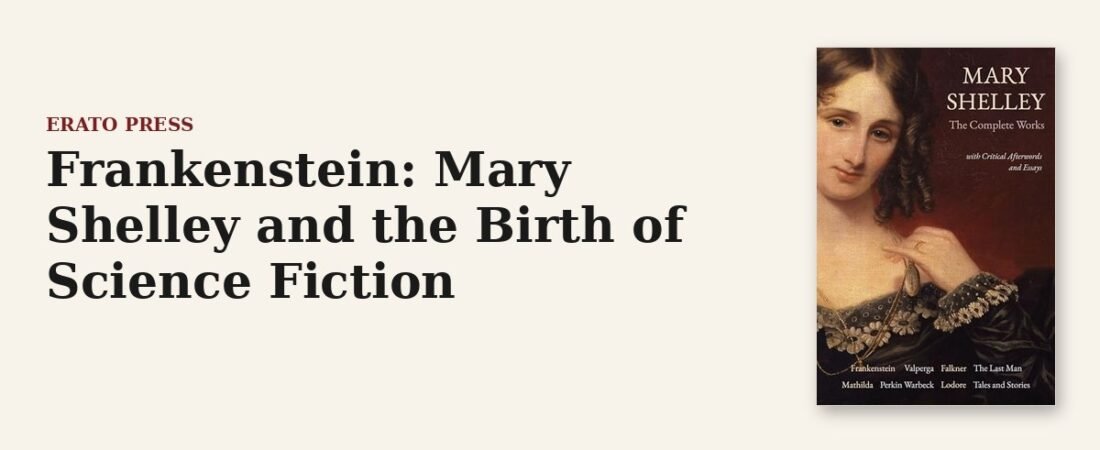
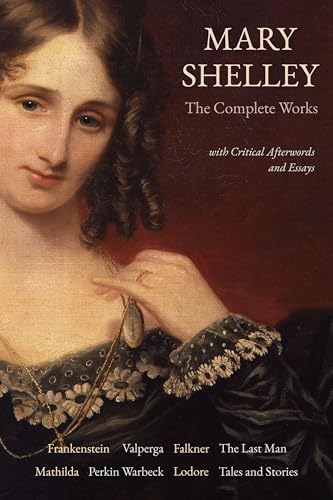
Read Frankenstein in the complete works of Mary Shelley →
Related reading: The Essential Gothic Novels: A Reader’s Guide · Dracula: How Bram Stoker Invented the Modern Vampire · Edgar Allan Poe: Where to Start · Jules Verne and the Extraordinary Voyages
This article draws on the original critical essay “A Philosophy of Creation,” written for the Erato Press edition. This article contains affiliate links; as an Amazon Associate, Erato Press earns from qualifying purchases.
Enjoyed this piece?
Get the next one — our essays on the classics and news of each new Erato Press edition — straight to your inbox.