There is a kind of book that cannot happen on land. Not because the action requires water, but because the sea does something to character that a drawing room or a battlefield cannot: it strips away the audience. Out past the last buoy there is no society to perform for, no inherited rank that holds, no priest, no police, no parents. A man on a ship is reduced to what he actually is when no one who matters is watching, and then he is tested by a force that has no opinion of him whatsoever. This is why the two greatest sea writers in English, Herman Melville and Joseph Conrad, are not really writing adventure stories at all. They are writing about fate, and about the unbearable question of whether a self exists underneath the costume we wear ashore.
The sea, in both men, is the great leveler and the great revealer. It does not care that Ahab is a captain or that the Patna’s pilgrims are poor. It applies the same pressure to everyone and lets us watch who breaks, who endures, and who discovers, too late, what he was made of. That is the argument of this essay: the ocean in Melville and Conrad is not a setting but a moral instrument, an arena in which the question “what am I, finally?” can be asked without mercy and answered without flattery.
Why the nineteenth century went to sea to find the truth
It is no accident that the deep-water novel reaches its height in the decades when the steamship was killing sail. Melville published Moby-Dick in 1851; Conrad’s sea fiction belongs to the 1890s and 1900s. Both men wrote at the moment when the thing they loved was becoming obsolete, and that elegiac pressure runs under every page. They knew the rigging, the watches, the smell of a forecastle, the particular loneliness of the night helm. Melville shipped on the whaler Acushnet and jumped ship in the Marquesas; Conrad spent sixteen years in the British merchant marine and became a master mariner before he wrote a word of English fiction. Neither was a tourist. The authority of their prose comes from labor.
But the technical command is never the point; it is the floor the philosophy stands on. The nineteenth century had inherited a confidence that the universe was legible, that providence shaped events, that a good man’s life made a coherent story. The open ocean is the perfect place to interrogate that confidence, because the sea is the one environment where human intention counts for almost nothing. You can be the finest seaman alive and a squall will still take you. The competence that means everything ashore means very little against a thousand fathoms of indifferent water. So the sea novel becomes the natural laboratory for the century’s deepest anxiety: that the cosmos is not arranged for us, that it is not arranged at all.
Melville and the whiteness of the whale
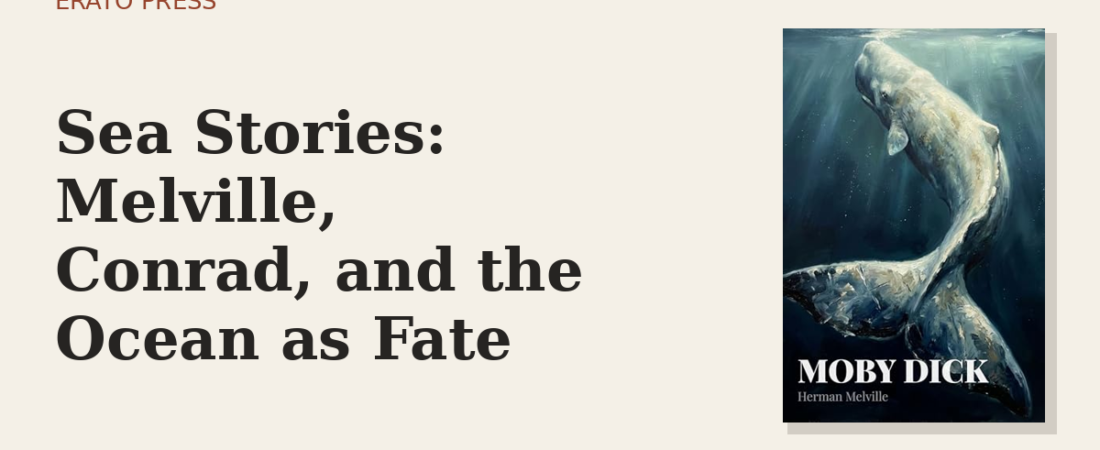
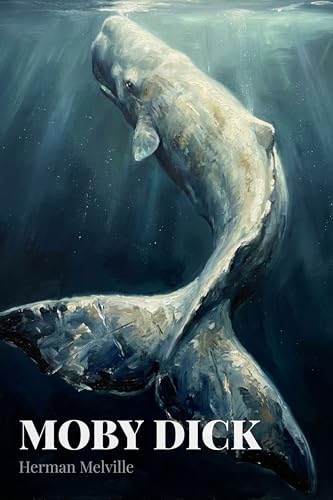
Ahab’s pursuit of the white whale is usually described as a story of revenge, and it is, but the revenge is metaphysical before it is personal. Moby Dick took his leg, yes; but what Ahab cannot bear is the suspicion that the maiming was meaningless, that the universe is “naught,” a blank, a pasteboard mask with nothing behind it. He needs the whale to be malicious because a malicious universe is at least a universe that knows he is there. To strike through the mask is to insist that something is looking back. The tragedy is that Ahab would rather be destroyed by a hostile cosmos than ignored by an indifferent one.
Melville surrounds this monomania with one of the strangest structures in fiction: chapters on cetology, on the color white, on the ropes and the rendering of blubber, a whole working theology of an industry. Readers who want only the chase find this maddening; readers who understand the book see that the digressions are the argument. Melville is trying to know the whale completely, scientifically, exhaustively, and the more he piles up the facts the more the creature recedes into mystery. Knowledge does not domesticate the unknown; it deepens it. We have argued elsewhere, in Moby-Dick: Why the Great American Novel Is About a Whale, that the book’s apparent obsession with the mechanics of whaling is the very means by which it reaches the sublime. The ocean here is the surface of the unknowable, and the white whale is what swims beneath every confident human system.
Conrad and the moral fog
If Melville’s sea is metaphysical, Conrad’s is ethical, and the difference defines the two writers. Conrad rarely asks whether the universe means anything; he assumes, with a kind of weary Polish stoicism, that it does not, and turns instead to the only question left: how shall a man conduct himself in the dark? His sea is a place of fog, of moral visibility reduced to a few yards, where a decision must be made before its consequences can be seen, and where the wrong decision cannot be unmade.
This is why Conrad keeps returning to the figure of the man tested in an instant. The ocean in his work is less a monster than a witness, and the cruelest thing about a witness is that it remembers. When his river turns inland and becomes the Congo, the sea’s indifference curdles into something worse: the discovery that “civilization” is itself a thin plank over the same abyss. The voyage upriver in Heart of Darkness: Conrad and the Horror of Empire is a sea story turned inside out, where the water leads not to open freedom but into the continent’s interior and into Kurtz’s interior and, by Marlow’s terrible implication, into our own. The sea taught Conrad that a man is only ever a few hours of fair weather away from finding out what he truly is, and that empire was a vast machine for arranging that discovery on a continental scale.
The crew, the captain, and the ship as a world
One reason these books feel larger than their plots is that a ship is a complete society compressed into a hull. It has its hierarchy, its labor, its racial and national mixture, its rituals, its outcasts. Melville’s Pequod carries a Polynesian harpooner, an African, a Native American, a Parsee, all bound to the will of one obsessed New Englander; it is America afloat, and its doom has the force of prophecy. Conrad’s ships are similarly miniature nations, and his great theme of solidarity, the fragile fellowship of men who must trust one another or drown, comes directly from the deck. The sea makes the social contract visible because at sea it is literally a matter of survival. Break faith with the ship and the ship kills you.
This is the moral seriousness that lifts the sea novel above the genre of adventure into the company of the longest and most demanding works of fiction, the kind we survey in Are Long Classic Novels Worth Reading? Start With These 4. The length is not padding. A short sea story can give you a storm; only a long one can give you the slow corruption of a Kurtz or the patient accumulation of Ahab’s madness, the way an obsession or a guilt grows in a confined space over weeks of watches. These books take time because fate takes time.
What the ocean knows that the land forgets
Both writers end in the same place, though they arrive by different routes. Ahab goes down lashed to the whale, dragged into the depths by the very thing he tried to master; the Pequod sinks and the sea “rolled on as it rolled five thousand years ago,” utterly unmarked by the human drama it has just swallowed. Conrad’s men, when they survive, survive into a guilt or a knowledge they can never set down. In neither vision does the sea grieve. That indifference is the final lesson, and it is not nihilism but a strange clarity: the ocean returns us to scale. It reminds us that the human story is small, that our codes and honors and revenges matter enormously to us and not at all to the water, and that the only dignity available is the dignity of how we behave when we finally understand this.
That is why we still read them, and read them at length. The sea story is the place where the nineteenth century put its hardest questions into a hull and pushed them off from shore to see what would come back.
Frequently asked questions
Do I need to know about ships and sailing to read Melville and Conrad?
No. Both writers explain enough as they go, and the technical detail is there to ground the philosophy, not to test you. Melville’s whaling chapters can be read as prose poems on knowledge and mystery; Conrad’s seamanship is the soil his ethics grow in. If a passage on rigging or rendering slows you, let it wash over you as atmosphere. The human and metaphysical stakes never depend on your knowing a halyard from a hawser.
Which should I read first, Moby-Dick or Heart of Darkness?
Heart of Darkness is far shorter, around a hundred pages, and makes an excellent introduction to Conrad’s method and his moral fog. Moby-Dick is a much larger undertaking but also one of the supreme achievements in the language. A good path is to read Heart of Darkness first to acclimate to the rhythm of the sea narrative, then commit to Melville’s leviathan with the patience it rewards.
Are these adventure novels or philosophical novels?
They are both, and the refusal to separate the two is precisely their greatness. The chase and the storm are real and gripping; they are also the vehicle for the deepest questions either century could ask. Read them for the adventure and the philosophy will arrive on its own, carried in on the same tide.
The Erato Press edition of Moby-Dick presents Melville’s full text with a critical apparatus that maps the cetology chapters back to the book’s central design, so that the digressions read as architecture rather than detour, and the whale recovers its strangeness. If you want to meet the ocean as Melville and Conrad understood it, as the arena where fate asks its hardest question, this is the place to begin.
Read the Erato Press edition →
Enjoyed this piece?
Get the next one — our essays on the classics and news of each new Erato Press edition — straight to your inbox.