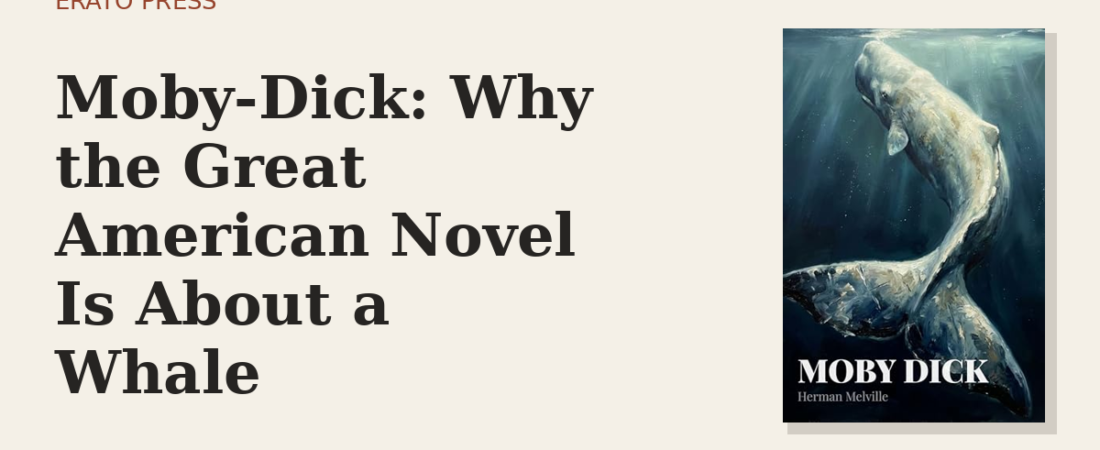
It is the strangest fact in American literature: the country’s candidate for the greatest novel ever written by one of its citizens is a book about hunting a whale, padded with chapters on rope, blubber, the anatomy of the cetacean head, and the precise shade of the color white. When it appeared in October 1851 the reviewers were baffled and the public stayed away. The first edition ran to about three thousand copies; many went unsold. Herman Melville, who had been a popular author of South Seas adventures, watched his career collapse and ended his working life as a customs inspector on the New York docks, writing for no one. Moby-Dick was not rediscovered until the 1920s. The question is not why it failed. The question is why a book this difficult, this digressive, this uninterested in pleasing anyone became the American epic.
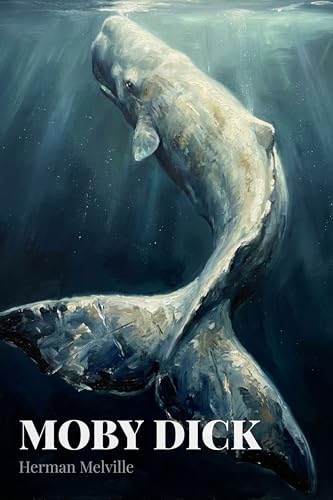
Here is the thesis, and it is worth stating against the grain of the title: Moby-Dick is great not in spite of being about a whale but because the whale means nothing fixed. The novel is a machine for generating meaning and then refusing to confirm it. We never learn whether the white whale is a vicious animal, a blank fact of nature, or the malevolent agent Ahab believes it to be. Melville builds the most elaborate apparatus of interpretation in nineteenth-century fiction and then leaves the central object inscrutable. That refusal is the book’s deepest achievement, because it forces the reader to confront the most modern problem there is: how do we assign meaning to a world that will not tell us what it means?
A book that refused to be consumed
Melville’s contemporaries wanted an adventure novel and got a metaphysical encyclopedia. They were not wrong about what they were holding; they were wrong about whether that was a flaw. The cetology chapters, the twenty-page meditation on the color white, the sudden lurch into stage directions and soliloquy as if the novel had become a play — these are not Melville losing control of his material. They are the material. He understood that a novel could do something no other form can: it can stop the action dead and think. A film cannot pause for a sermon on whiteness without losing its audience; a novel can, and in the pause it gains depth. The digression is not a detour from the story. It is the insistence that no action means anything until you have meditated on what it means.
This is also why the book had to wait seventy years for its readers. The audience of 1851 was not equipped to embrace ambiguity, fragmentation, and a narrative that ends with the destruction of the ship, the annihilation of the crew, and a single survivor floating on a coffin. But the modernists were. When T. S. Eliot, Joyce, and Woolf were inventing fragmentation and shifting perspective in the 1920s, critics looked back and found Melville had been doing it seventy years earlier. The Great Depression and the rise of European fascism finished the rehabilitation: a generation that had watched permanent certainties collapse recognized in Ahab something essential about power and self-destruction. Melville was a modernist who arrived too early — a writer whose problems (meaning in an indifferent universe, alienation in industrial labor, a society at once democratic and brutally unjust) were the problems of the century after his own.
Ahab, or the logic that consumes
Captain Ahab is one of literature’s permanent figures, and he has only grown more legible with time. He exercises absolute authority over a multicultural crew — the Pequod, named for an exterminated Native nation, is a floating model of the world — and his authority runs on charisma, fear, and the promise of reward. He nails a gold doubloon to the mast and turns a commercial voyage into a holy war against a single animal. He will accept no limit: not the wisdom of his officers, not the laws of the sea, not the survival of his own men can contain him.
It does not take much to recognize this structure. Ahab is a study in the leader who channels a crowd’s rage and humiliation toward an external enemy — the whale, the immigrant, the “other” in whatever form — and rides their fury onto an obviously self-destructive course. The crew, for all our sympathy with the narrator Ishmael and his beloved harpooner Queequeg, never effectively revolts. They are held by their contracts, by the chain of command, by the ideology of the hunt. And when Ahab steers them into the abyss, they cannot get off the ship. Melville also gave the obsession an economic dimension that has only sharpened. The whaling industry was the petroleum of its day, converting living creatures into commodity, treating the exhaustion of a resource as the normal cost of doing business. That logic — extraction without limit, the living turned into product — did not end when whale oil gave way to kerosene. It expanded. To read the try-works chapters, the whale rendered down to oil on the deck at night, is to recognize the machinery of our own age.
Ishmael survives, and survival is not virtue
The most quietly radical choice in the book is who lives. The captain dies, dragged down by his own harpoon line. The common sailor survives. And he survives not because he is good, wise, or favored by God, but because he happened to be in the right place when the ship went down and managed to grasp Queequeg’s coffin, which bobs up to become his life buoy. There is no providence here, only the randomness of fate. “And I only am escaped alone to tell thee,” the epilogue announces, borrowing the words of Job’s messengers.
This is Melville’s hardest and most democratic insight. Ishmael lives because he kept his distance from the center of the obsession. He shared in the voyage but never fully shared Ahab’s mania; he remained, throughout, the observer at the margin, the man who watches and records. Survival, the book suggests, is partly chance and partly the ability to maintain a certain distance from the disaster that is always threatening to pull us in. In a civilization organized around relentless pursuit — of growth, of profit, of dominance — the form of resistance Melville offers is not victory but withdrawal: to stay at the edge, to witness, to refuse the rhetoric of inevitability, and to keep telling the story of what was lost.
The whiteness that gives nothing back
Every reader of Moby-Dick reports the same vertiginous moment, usually in the chapter on “The Whiteness of the Whale,” when the prose seems to open onto something larger than the page. Melville piles up everything white can mean — purity, terror, blankness, the absence of all color and therefore the presence of the void — and the accumulation arrives not at a meaning but at the edge of meaning, the sense of standing at the brink of a truth you are condemned never to reach. That sensation is the experience Ishmael has trying to read the whale’s pattern, the experience Ahab has believing he pursues a conscious malice through the ocean, and the experience the reader has on closing the book: we never learn what the whale is. It remains a white screen onto which obsession projects itself.
That is the source of the novel’s permanence. A clearly evil whale would give us a fable of good and evil; a whale that is merely an animal would give us a cautionary tale about reckless men. Because the whale stays inscrutable, the book becomes something rarer — a sustained meditation on how human beings manufacture meaning in a universe that supplies none. Moby-Dick sits at the head of a national literature for this reason, and it is the keystone of any serious account of the Great American Novel and where it leads: a book that diagnoses the obsessions — expansion, accumulation, domination — that built the country, and offers, in Ishmael, the faint possibility of standing apart from them.
Frequently asked questions
Do I have to read the whale-anatomy chapters?
Read them. They feel like detours and they are the book. Melville stops the chase to think because the thinking is what raises a hunting story into a meditation on knowledge itself. Skim them and you are left with a thriller; read them and you understand why the novel haunts people for life. They also reward patience with some of the strangest, funniest, most beautiful prose in the language.
Is it really as hard as people say?
It is demanding, not impenetrable. The narrative spine — Ishmael ships out, meets Queequeg, joins Ahab’s doomed hunt — is perfectly clear and often very funny in its early chapters. The difficulty is that Melville keeps interrupting himself to philosophize. Let the digressions wash over you on a first reading; the meaning accumulates rather than arriving on schedule.
Why did it fail in 1851 and triumph in 1920?
Because it was written for readers who did not yet exist. Its ambiguity, fragmentation, and refusal of comfort baffled an audience expecting adventure, but spoke directly to a modernist generation that had watched its own certainties collapse. The book did not change; the world caught up to it.
The Erato Press edition is built to carry a first-time reader through the difficulty and reward the returning one — with apparatus that follows the novel’s hundred-year journey from commercial failure to American scripture, the economic and political machinery beneath the hunt, and the great unanswerable question of the whale’s meaning. It treats the digressions not as obstacles to be endured but as the heart of what Melville achieved. and find out why the Great American Novel had to be about a whale.
Enjoyed this piece?
Get the next one — our essays on the classics and news of each new Erato Press edition — straight to your inbox.