There is a moment, two-thirds of the way up the river, when Marlow finds a book. It is an old volume on seamanship, annotated in the margins in what he takes to be cipher, left behind in an abandoned hut. The annotations turn out to be Russian. The detail is easy to skim past, and that is exactly why it matters: in the middle of a journey toward what Conrad insists is the end of the world, the most savage and lightless place a European mind can imagine, there sits a dull manual about keeping ships afloat, lovingly studied. Civilization has not been left behind. It has come along, in the luggage, in the head, in the hold. Heart of Darkness is a book about a man who travels into the wilderness expecting to find barbarism out there, and discovers instead that he has been carrying it the whole time, in the very institutions that sent him.

Conrad finished the novella in 1899, having himself commanded a steamer up the Congo nine years earlier, an expedition that wrecked his health and, by his own account, changed what he was. He was Polish by birth, a sailor by trade, an Englishman by adoption and a master of English prose by an act of will that remains one of the strangest in the language. He came to the Congo not as a tourist of horror but as an employee of it, and what he saw there — the chained labor, the casual death, the obscene gap between the rhetoric of uplift and the practice of plunder — is what the book keeps trying, and failing in a deliberate way, to put into words.
The lie at the center of the civilizing mission
The official story of European empire, in 1899, was a story of light. The colonizing powers were bringing roads, trade, medicine, Christianity, and order to a continent imagined as empty of all four. Conrad lets Marlow voice this rhetoric so that we can watch it curdle. Early on Marlow’s aunt sends him off as one of the “emissaries of light,” and he is embarrassed even then, muttering that the Company was run for profit. The Company itself is fronted by a “whited sepulchre” of a city and a brass plate, and behind the plate sit two women knitting black wool, a pair of Fates stationed at the door of an enterprise that consumes men and pretends to elevate them.
What Conrad does that cheaper anti-imperialist writing does not is refuse to let the reader stand comfortably outside the lie. Marlow despises the “flabby devil” of greed he sees in the agents, the pilgrims with their staves, the manager whose only talent is not getting sick. But Marlow is also doing the work; he repairs the steamer, he keeps the schedule, he is the competent man on whom the whole rotten apparatus depends. The book’s deepest indictment is not that empire attracts villains. It is that empire runs on ordinary efficiency, on people who keep the books and mend the rivets and tell themselves they are merely doing a job. The horror is administrative before it is ever theatrical.
Kurtz, and the eloquence that ends in a scrawl
Kurtz is the genius of the system and its reductio. He is the man of every accomplishment — painter, musician, orator, a “universal genius” — sent inland to be the very best of what Europe claims to offer. He writes a seventeen-page report for the International Society for the Suppression of Savage Customs, a document of soaring humanitarian idealism. And at the bottom of it, in a later hand, he has scrawled: Exterminate all the brutes. That sentence is the whole argument of the novella compressed to four words. The high-minded prose and the genocidal postscript are not opposites. They are the same impulse at two stages of its career. The will to improve other people, once it has all the power and none of the restraint, becomes the will to erase them.
Kurtz’s dying words — “The horror! The horror!” — have been quoted into meaninglessness, but in context they are precise. Marlow takes them as a verdict, “an affirmation, a moral victory,” the one honest thing a damned man manages to say about himself. Kurtz at least looks at what he has become. Everyone else in the book looks away. And Marlow, returned to the “sepulchral city,” tells one final lie: he assures Kurtz’s grieving Intended that her name was on his dying lips. The civilizing mission rests on exactly this kind of comforting falsehood, told by decent people to protect each other from the truth they helped create.
Darkness that will not stay in Africa
Conrad’s title is doing heavy work, and part of that work is to dislocate the word “darkness” from any single place. The book opens not in the Congo but on the Thames, with Marlow musing that London too “has been one of the dark places of the earth,” that the Romans once came up this river to a wilderness of fog and savagery. The framing is a warning: do not imagine that the heart of darkness is a remote geography you can sail away from. It is a condition, latent in every imperial center, and it travels under cover of commerce and good intentions. The river that leads to Kurtz and the river the listeners are anchored on are the same kind of river. Empire is a circuit, not a frontier.
This is the quality that places Heart of Darkness at the dark edge of a whole tradition of voyaging fictions. Read alongside the other Lost Worlds and Lost Cities: The Best Adventure Classics, Conrad’s novella reads almost as their conscience, the book that takes the genre’s thrill of penetrating the unknown and turns it inside out. The map’s blank spaces that excited Marlow as a boy have, by the time he reaches them, been filled in with the worst that the men who filled them could do.
The Achebe problem, taken seriously
No honest account of this book can skip the most powerful charge against it. In 1975 the Nigerian novelist Chinua Achebe delivered a lecture, later titled “An Image of Africa,” arguing that Heart of Darkness is the work of “a thoroughgoing racist.” His case is concrete and difficult to wave away. Africa in the novella functions as a backdrop, “a metaphysical battlefield devoid of all recognizable humanity,” onto which a European drama of self-discovery is projected. Africans rarely speak; when they do it is in fragments (“Mistah Kurtz — he dead”) or in the suppressed roar of a crowd. Their suffering is real in the text but it is scenery for Marlow’s moral education. The book that exposes the dehumanization of empire, Achebe insisted, also reproduces it.
The right response is not to dismiss the critique and not to capitulate to it. Both things are true at once. Conrad saw further than almost any European of his moment into the criminality of the colonial project, and he remained a man of that moment, unable or unwilling to grant his African characters the interiority he lavishes on Marlow and Kurtz. A serious reader holds the achievement and the limitation in the same hand. The novella is a savage indictment of empire that is itself partly written in empire’s grammar. That is uncomfortable, and the discomfort is part of what makes it worth reading now rather than merely admiring from a distance.
Frequently asked questions
Is Heart of Darkness based on Conrad’s real experience?
Closely. In 1890 Conrad commanded a Belgian steamer on the Congo River during the worst period of King Leopold II’s privately owned colony, an atrocity that killed millions. He kept a diary, witnessed the chain gangs and the dying, and contracted illnesses that dogged him for life. Kurtz is a composite rather than a portrait, but the rapacity, the hypocrisy, and the death are reported, not invented. Reading the novella against the documented history of the Congo Free State only sharpens it.
Why is the prose so difficult and indirect?
The difficulty is the point. Marlow keeps insisting that the experience cannot be communicated, that “we live, as we dream — alone.” Conrad’s clotted, qualified, fog-bound sentences enact the failure of language to render the unspeakable, while a frame narrator listens at one remove, so that we receive everything secondhand. The result is a prose that refuses easy moral clarity and forces the reader to do the work of judgment.
What does “The horror! The horror!” actually mean?
Conrad leaves it open, which is why it has lasted. The most persuasive reading is that Kurtz, at the threshold of death, sees his whole career of idealism-turned-atrocity clearly for the first time and names it. It is a confession and a verdict, the only moment in the book when someone looks directly at what empire has made of a human being and does not flinch or lie about it.
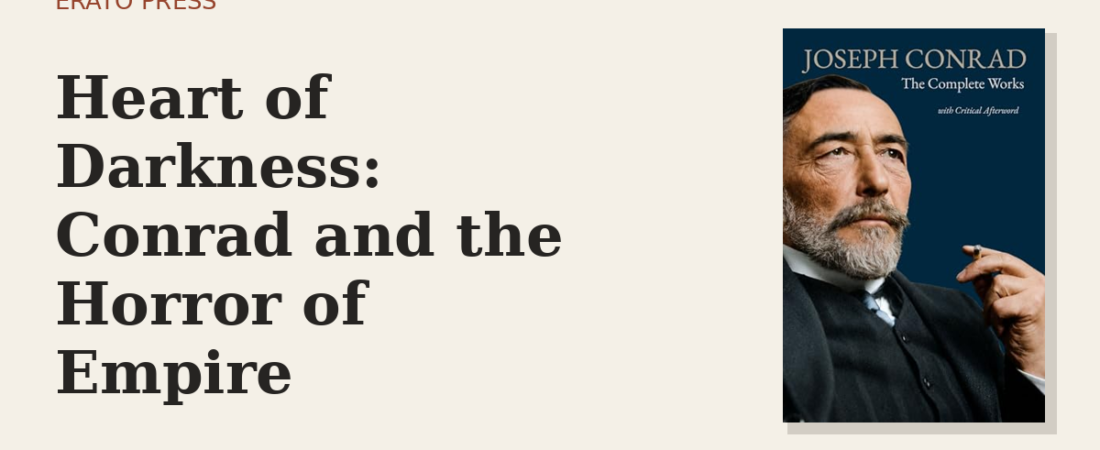
This is a book that rewards slow reading and resists the quick summary, and it gains enormously from being met with the right apparatus — a text that situates Conrad’s Congo against the real history of Leopold’s regime, that lays out the Achebe debate without softening either side, and that follows the threads back to the Thames where the whole circuit begins.
Read the Erato Press edition →
and let the novella make its demands on you, as it was built to do.Enjoyed this piece?
Get the next one — our essays on the classics and news of each new Erato Press edition — straight to your inbox.