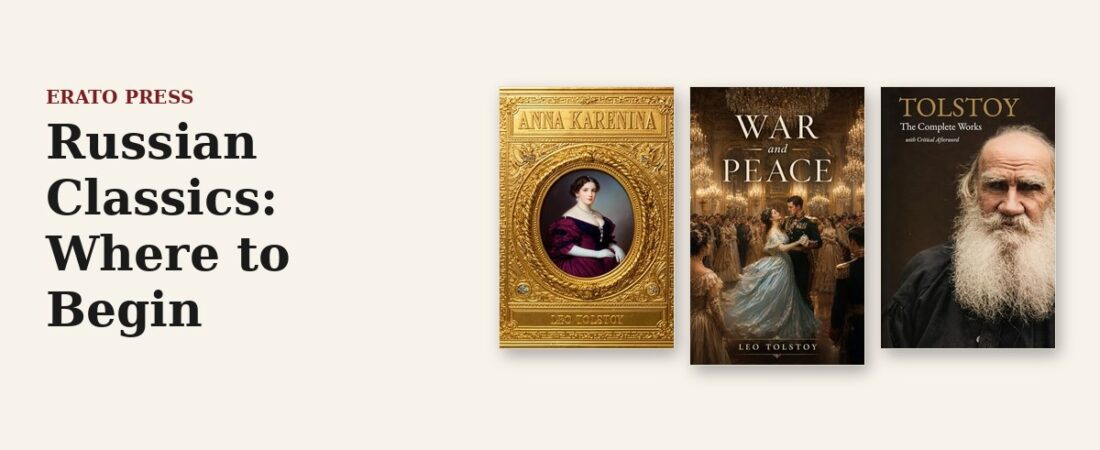
Short answer: Begin with whichever giant suits your temperament. Want sweep, daylight, and the whole of life? Start with Tolstoy — Anna Karenina first, then War and Peace. Want fever, ideas, and the edge of the abyss? Start with Dostoevsky — Crime and Punishment, then The Brothers Karamazov. You don’t need Russian history to begin. You need a good translation and a free evening.
Two giants, two temperaments
The nineteenth-century Russian novel is dominated by two writers who could not be less alike, and the easiest way into the tradition is to figure out which one you are. Tolstoy writes in daylight: panoramic, serene even in tragedy, certain that the truth of a life is visible if you only look long and honestly enough. Dostoevsky writes at night: feverish, claustrophobic, convinced that the truth of a person is found at the extreme — in crisis, in the cellar of the self. Critics have spent a century arguing which is greater. The useful news for a new reader is that you don’t have to choose — but you should start with the one whose weather you’d rather live in for a few weeks.
If you start with Tolstoy
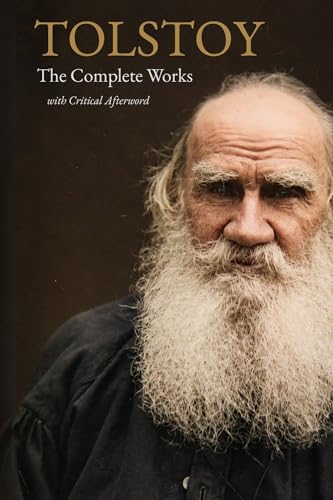
Begin with Anna Karenina, not War and Peace — it’s more intimate and just as profound, and its famous first line (“Happy families are all alike; every unhappy family is unhappy in its own way”) is a trap worth springing, because the eight hundred pages that follow quietly take it apart. Tolstoy’s method is to make you feel the life of people before you have made up your mind about them: the doomed Anna and the searching Levin move in opposite directions — one toward dissolution, one toward integration — and the novel refuses to let either comment on the other. Then, if Tolstoy has you, the national epic of War and Peace will feel less like a mountain and more like an invitation.
If you start with Dostoevsky
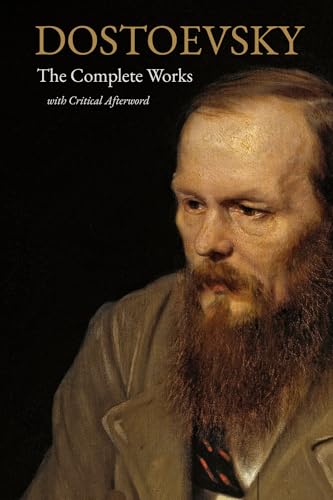
Begin with Crime and Punishment — the most propulsive and accessible of his major novels, essentially a psychological thriller about a student who murders a pawnbroker to test a theory, and is then crushed not by the police but by his own mind. It reads like a thriller and detonates like philosophy, and it teaches you how Dostoevsky works before you attempt anything larger. Then graduate to The Brothers Karamazov, his last and largest book, where a parricide becomes a trial of God himself. (Do not start with Karamazov, no matter what anyone tells you.)
How they differ — and why you want both
The contrast is almost diagrammatic. Tolstoy gives you the world as it is, suffused with the sense that ordinary life — a mowing, a marriage, a death in the family — is the real theater of meaning. Dostoevsky gives you the world at its breaking point, convinced that comfort is a lie and only the extreme tells the truth. One is the novelist of health, the other of crisis; one of daylight, the other of night. They are not rivals so much as two complete and incompatible theories of what a human being is — which is why the serious reader, in the end, wants both weathers. If you’d like the case laid out in full, see our companion essay, Tolstoy vs Dostoevsky: Two Ways of Writing a Soul.
A note on translations
More than with most literatures, the translation matters here: a flat one can make these books feel like homework; a living one makes them unputdownable. That’s the whole premise of an annotated critical edition — to give you the text in English that actually moves, with the context that makes the unfamiliar names and the religious and political undercurrents legible. Beyond the two giants, the tradition runs deep: once Tolstoy and Dostoevsky have you, Turgenev, Gogol, and Chekhov are the natural next country to explore.
Related reading: Where to Start With Dostoevsky · The Brothers Karamazov: Faith, Doubt, and the Grand Inquisitor · Raskolnikov and the Anatomy of a Guilty Mind · Tolstoy vs Dostoevsky: Two Ways of Writing a Soul · Are Long Classic Novels Worth Reading?
This article contains affiliate links. As an Amazon Associate, Erato Press earns from qualifying purchases.
Enjoyed this piece?
Get the next one — our essays on the classics and news of each new Erato Press edition — straight to your inbox.