Short answer: Start with Crime and Punishment. It’s the most accessible of Dostoevsky’s major novels — a murder, a guilty mind, and a manhunt that turns out to be a soul-hunt — and it teaches you to read him before you reach the vast Brothers Karamazov. Do not start with Karamazov, no matter what anyone tells you.
Forget what you expect a “great novel” to feel like
Literary reputation produces a certain expectation of the monumental: the great novel will be grave, measured, restrained, written in a style commensurate with its importance. Dostoevsky is none of these things. He writes with a frantic, journalistic energy, accumulating detail, lingering on scenes that seem excessive, loading his characters with speeches that run far longer than any real person would tolerate. Characters arrive at scenes already shouting; arguments begin in drawing rooms and end in confession or collapse. The first surprise of reading him is the texture — hot, urgent, almost out of control. That urgency was real: he wrote against deadlines, against debt, against his own failing health, and the prose has the speed of a man who does not believe he has time to finish.
Start with Crime and Punishment
Crime and Punishment has the cleanest engine of any of his books. A poor ex-student, Raskolnikov, murders a pawnbroker to prove a theory — that extraordinary men are permitted to step over ordinary morality — and spends the rest of the novel being slowly crushed, not by the police but by his own mind. What looks like a detective story is really an interior one: the magistrate Porfiry circles, but the real pursuit is Raskolnikov’s disintegration under a guilt he refuses, intellectually, to feel. It reads like a thriller and detonates like philosophy, and by the end you understand how Dostoevsky works — he uses the machinery of suspense to ask the largest possible questions. It is the first novel in which his full powers operate at once, and the best possible training for everything that comes after.
Where to go next
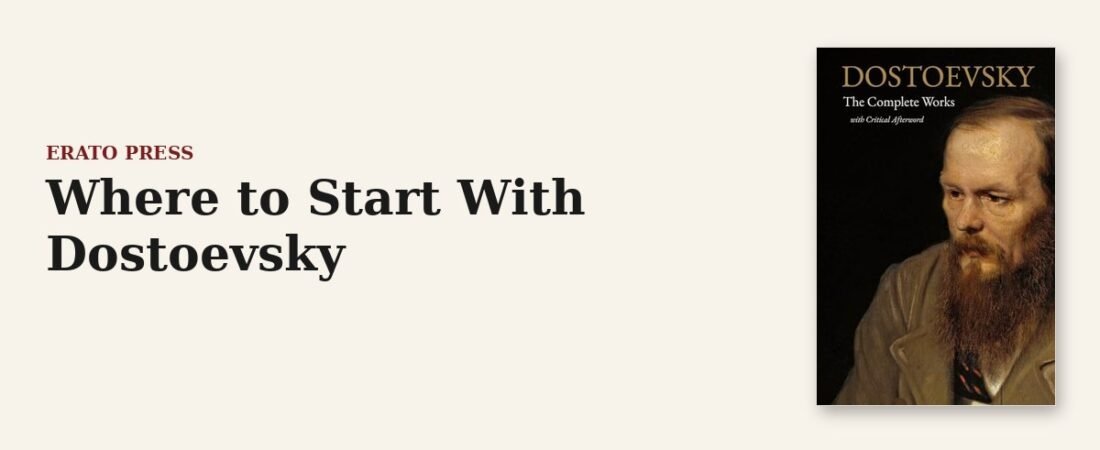
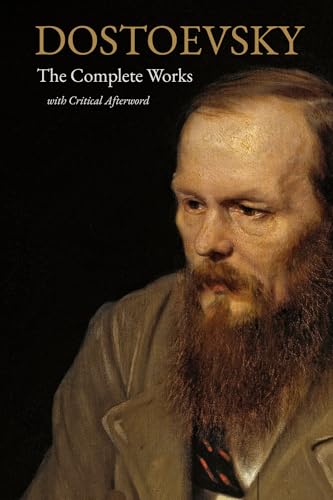
Once Crime and Punishment has you, the shortest and strangest of the major works is Notes from the Underground — a hundred furious pages that invent a new kind of literary consciousness and stand behind every alienated narrator of the century that followed. From there, The Idiot (Dostoevsky’s attempt to portray a genuinely good man and watch the world destroy him) and Demons (his ferocious, prophetic novel of political fanaticism) deepen the picture. All of them are gathered in the complete Erato Press volume below, with the context that makes their quarrels legible.
Then, and only then, Karamazov
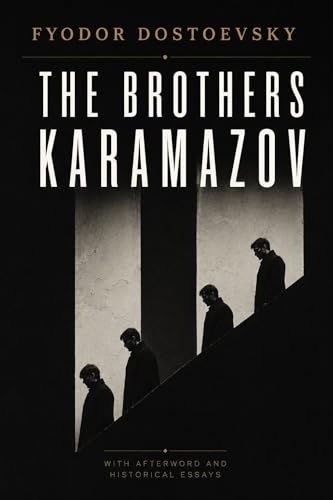
Once the earlier novels have trained you, The Brothers Karamazov — his final novel, a parricide that becomes a trial of God, free will, and human suffering — will reward every one of its 350,000 words. Come to it first and you risk drowning; come to it prepared and it may become the most important novel you ever read. He finished it four months before he died, knowing he might not complete it, and what we have is both a complete book and the testament of a man who spent his life staring into the abyss and refused, at the end, to let it have the last word.
Get the complete Dostoevsky in one annotated volume →
Why an annotated edition helps with Dostoevsky especially
His novels are saturated with the religious, political, and intellectual quarrels of 1860s and 1870s Russia — radical nihilism, Orthodox faith, the intelligentsia’s flirtation with Western materialism. He had lived all of it: a liberal in the 1840s, he went to prison and a mock-execution and returned from Siberia a changed man, passionately convinced that the spiritual question was prior to the political one. A reader without that context still feels the power but misses half the argument. The right edition gives you the map without dulling the fever. For the wider tradition he belongs to, see our guide to Russian Classics: Where to Begin.
Related reading: Russian Classics: Where to Begin · The Brothers Karamazov: Faith, Doubt, and the Grand Inquisitor · Raskolnikov and the Anatomy of a Guilty Mind
This article contains affiliate links. As an Amazon Associate, Erato Press earns from qualifying purchases.
Enjoyed this piece?
Get the next one — our essays on the classics and news of each new Erato Press edition — straight to your inbox.