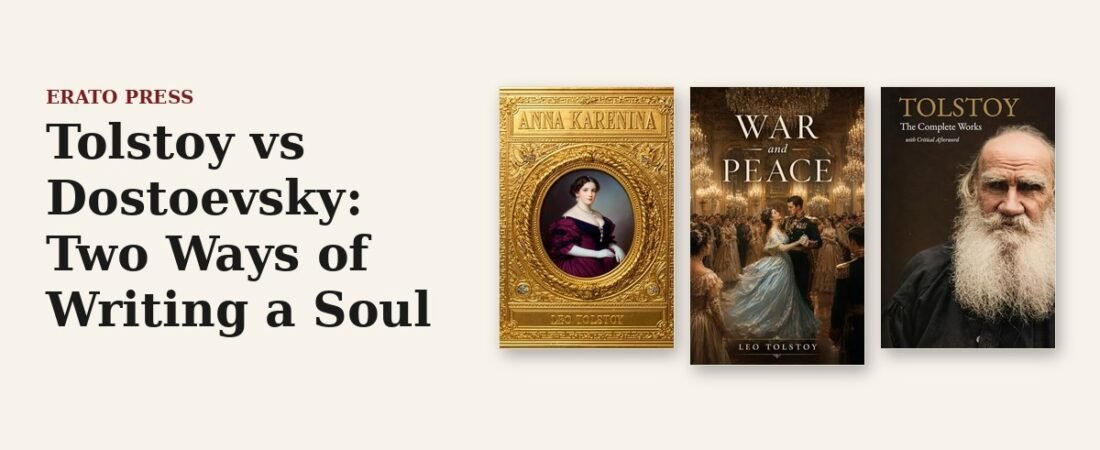
Short answer: Tolstoy and Dostoevsky are the two summits of the novel, and they are opposites. Tolstoy writes in daylight — panoramic, serene, certain that a life becomes legible if you look at it honestly enough. Dostoevsky writes at night — feverish, extreme, certain that a person is revealed only in crisis. Read both, and you have two complete and incompatible theories of what a human being is.
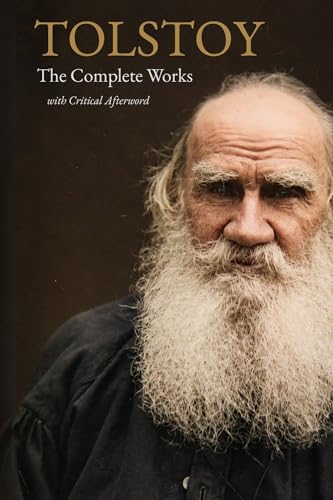
Tolstoy: the suspended judgment
Anna Karenina opens with the most famous sentence in fiction — “Happy families are all alike; every unhappy family is unhappy in its own way” — and that sentence is a trap. It sounds like wisdom, a maxim for a dinner party. But Tolstoy does not believe it; the line belongs to the narrator, not to him, and the eight hundred pages that follow quietly take it apart. The families we meet are not happy or unhappy in ways that can be catalogued. They are self-contradictory, capable of surprising kindness and surprising cruelty, moved by impulses they do not understand. This is Tolstoy’s whole method: to make us feel the life of people before we have made up our minds about them. The first sentence proposes a judgment; the novel suspends it. His genius is breadth and patience — he can hold an entire society and a single trembling heart in the same steady gaze, and he trusts that the truth will emerge from accumulated observation rather than from a thesis.
Two souls in one book: Anna and Levin
The deepest demonstration of Tolstoy’s art is the architecture of Anna Karenina itself, which runs two stories in parallel and lets their contrast do the arguing. Anna and Levin are formally twinned: both are people of strong feeling and unconventional intelligence, both at odds with the social world, both capable of sudden overwhelming certainty. But they move in opposite directions. Anna’s intensity is directed outward, toward another person, toward a passion that can be satisfied only at the cost of everything else she has — and so she moves steadily toward dissolution. Levin’s intensity is directed inward and then upward, toward a principle that can accommodate everything rather than requiring the sacrifice of everything — and so he moves toward integration. The novel’s great formal achievement is to present both trajectories with equal conviction, cutting from Anna’s public humiliation at the opera to Levin mowing in his summer fields, without ever letting one comment on the other. When Anna finally throws herself under the train, it is not because Tolstoy is punishing the adulteress; it is because she has invested everything in one man’s love and has no other resource — no land, no labor, no wonder at the stars — when that love shows the first signs of strain. Levin, at the corresponding moment, finds the counter-argument; Anna has none. It is less a condemnation of passion than a diagnosis of the catastrophic social impoverishment of a brilliant woman given no tools for living except the management of a world that has expelled her.
Dostoevsky: the fever and the abyss
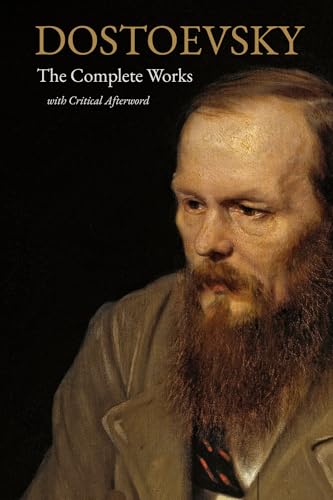
Dostoevsky works the opposite way. Where Tolstoy is broad, he is deep and narrow; where Tolstoy is calm, he is frantic. His characters do not live ordinary lives that gradually reveal their meaning — they are pushed to the extreme, into the cellar, onto the scaffold, and there, in crisis, the truth of them detonates. He writes with journalistic urgency, loads his people with speeches that run far past realism, and stages ideas as if they were fevers. In Crime and Punishment, a young man murders a pawnbroker to test a theory and is destroyed not by the police but by what the act reveals in him. For Dostoevsky a person is not a life to be observed but an abyss to be sounded, and the deepest truths are found exactly where the self comes apart.
The book divided against itself
There is a further difference, and it goes to the root. Tolstoy controls his novels; Dostoevsky is half-overpowered by his. The Brothers Karamazov was meant to be a Christian apologia — a defense of faith against the secular intelligentsia — and instead it gave the case against God, in Ivan’s chapters, the most powerful expression it has ever received. The book Dostoevsky intended to write and the book he actually wrote are not the same, and that gap between intention and achievement is the source of his strange power. Tolstoy’s contradictions are deliberate; Dostoevsky’s are symptomatic, things that rise from the work unbidden, under the pressure of its own imagining. One writer masters his material; the other is honest enough to be mastered by it.
Two ways of writing a soul
The contrast is almost diagrammatic. Tolstoy gives you the world as it is, suffused with the sense that ordinary life — a mowing, a marriage, a death in the family — is the real theater of meaning. Dostoevsky gives you the world at its breaking point, convinced that comfort is a lie and only the extreme tells the truth. One is the novelist of health, the other of crisis; one of daylight, the other of night. George Steiner argued that you finally have to choose between them. Maybe — but only after you’ve spent real time in both weathers, because each exposes what the other cannot see.
Where to begin with each
Meet Tolstoy in Anna Karenina and Dostoevsky in Crime and Punishment. If Tolstoy takes hold, go on to War and Peace; if Dostoevsky does, save Karamazov for when you’re ready. Then spend a winter with the complete works of each and decide, for yourself, which one tells you the truth about being a person — or whether, as most readers eventually conclude, you need them both.
Related reading: Russian Classics: Where to Begin · Where to Start With Dostoevsky · The Brothers Karamazov: Faith, Doubt, and the Grand Inquisitor
This article contains affiliate links. As an Amazon Associate, Erato Press earns from qualifying purchases.
Enjoyed this piece?
Get the next one — our essays on the classics and news of each new Erato Press edition — straight to your inbox.