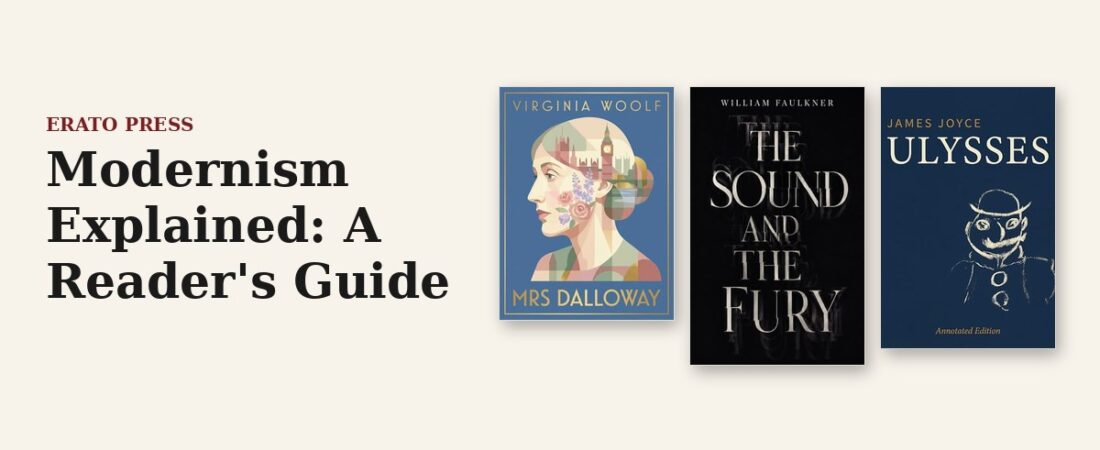
Short answer: Modernism is what happened when writers stopped trusting that the old forms could tell the truth about a world the old forms hadn’t prepared them for. To read it without dread, start small — Dubliners, Woolf’s Mrs Dalloway — and work up to the monuments. The difficulty is not snobbery; it’s the point.
A reaction to a broken world
Literary modernism — roughly 1900 to 1940 — was the response of a generation that had watched the certainties of the nineteenth century shatter: the slaughter of the First World War, Freud’s discovery that the self was a stranger to itself, Einstein unmaking absolute time, the collapse of religious and imperial confidence. The realist novel, with its tidy narrators and orderly plots, suddenly felt like a lie. If consciousness was fragmentary, associative, and irrational, then a true novel would have to be fragmentary too. The realists, the modernists charged, had described the houses and incomes and furniture and called it character — catalogued the outside of a person and missed the luminous, ceaseless shower of impressions going on within.
What modernist writers actually did
So they broke the machine and rebuilt it. They moved the camera inside the skull — stream of consciousness, the unedited flow of perception and memory. They abandoned the reliable narrator. They made the reader do the work of assembling meaning, the way we assemble meaning from real experience. Difficulty became a method: if the world no longer made easy sense, neither should the book that told the truth about it. And the strategies diverged in instructive ways. Joyce expands: in Ulysses a single Dublin day dilates until it contains a newspaper, a library, a pub, a maternity hospital, eighteen rival styles. Virginia Woolf compresses: a June morning in London narrows to the inside of a few minds, and a whole decade and a war pass, in To the Lighthouse, inside ten luminous pages and a pair of square brackets. Two opposite engines, one discovery — that the inside of an ordinary moment is the real subject the novel had been missing.
It wasn’t only the novel
The same earthquake ran through poetry. T. S. Eliot’s The Waste Land (1922) — the same year as Ulysses — assembled a civilisation’s wreckage out of fragments, quotations, and competing voices, and asked the reader to shore those fragments against their own ruin. Across the Atlantic, the Lost Generation of American writers in Paris pared the sentence down to the bone: Hemingway built a new prose out of what he left out, the famous iceberg whose meaning lies beneath the visible surface. And the movement crossed the ocean again into The Sound and the Fury, where William Faulkner handed the opening of his novel to the consciousness of a man who cannot order time at all. Modernism was less a single style than a shared conviction: that form itself had to register the shock of the new century.
Where to begin
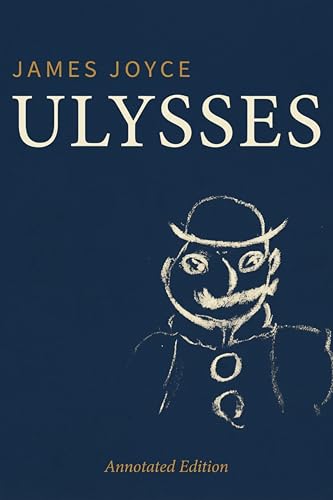
Don’t start with Ulysses. Start with Dubliners — conventional on the surface, revolutionary underneath — and Mrs Dalloway, where a single London day becomes a whole interior universe. These teach you the modernist habits of attention you’ll need for the bigger books, after which Ulysses becomes exhilarating rather than crushing.
Read Ulysses when you’re ready →
Why bother
Because modernism is where the novel learned to render the inside of a mind — the thing you spend your whole life inside and almost never see described truthfully. Master a little of its difficulty and ordinary fiction will start to feel like it’s leaving out the most important part.
Start with the essential Virginia Woolf →
Related reading: Where to Start With James Joyce · Is Ulysses Worth Reading? An Honest Guide · Virginia Woolf and the Stream of Consciousness · Dubliners: The Best Way Into Joyce · A Farewell to Arms and the Lost Generation
This article contains affiliate links; as an Amazon Associate, Erato Press earns from qualifying purchases.
Enjoyed this piece?
Get the next one — our essays on the classics and news of each new Erato Press edition — straight to your inbox.