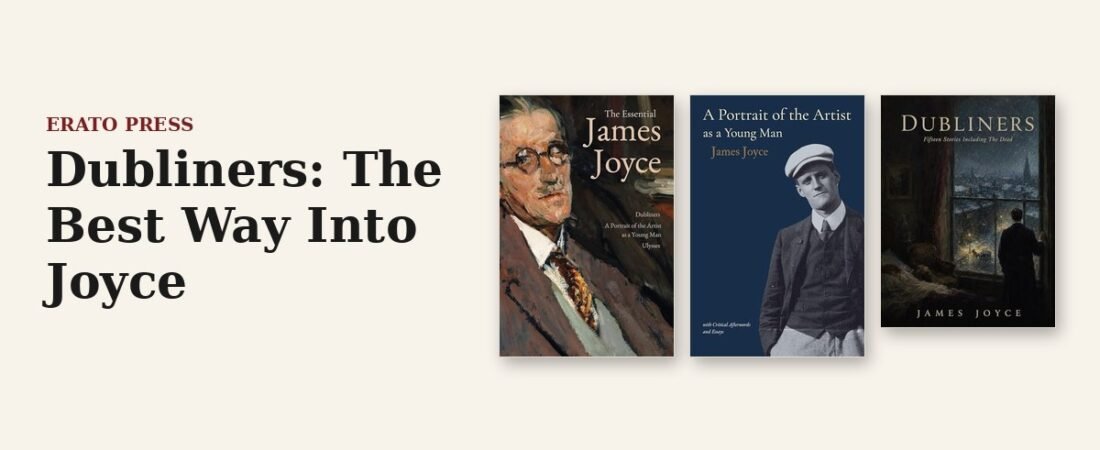
Short answer: Read Dubliners before Ulysses — always. These fifteen stories look like conventional realism and are quietly revolutionary, and their central claim is the most unflinching thing Joyce ever wrote: that consciousness without freedom is not a step toward liberation but a more refined form of suffering. They are the perfect way in, because they are the argument every later book must answer.
The deceptive simplicity
On first read, Dubliners looks like straightforward realism — fifteen sketches of ordinary life in turn-of-the-century Dublin: a boy at a bazaar, a clerk’s humiliations, a Christmas dinner that curdles into a political argument over Parnell. There are no fireworks of style, none of the famous difficulty. And then you notice that nothing quite resolves, that each story has been built with the precision of a poem toward a single quiet detonation. Joyce gave the condition a name: paralysis. Dublin’s inhabitants know, in some part of themselves, exactly what they are — they know the Church is suffocating, the British administration treats them as subordinates, the nationalist movement has been corrupted by the same factionalism that destroyed Parnell — and they sit at their tables, drink their whiskey, repeat their rounds, and nothing changes. Knowledge without the structural conditions for change is simply the clearest possible view of a locked room.
The epiphany — real, and inert
Joyce’s great technical contribution here is the “epiphany” — a sudden, ordinary moment in which a character (or just the reader) sees the truth of a life with brutal clarity. A woman frozen at a railing, unable to leave; a man realizing his wife has loved a dead boy more than she will ever love him. But the crucial point, and the one that made the book unpublishable for a decade, is that the recognition changes nothing. The boy in “Araby” understands his own vanity; he does not become less vain. Mr Duffy in “A Painful Case” understands, reading of the death of the one person who loved him, that his terrified refusal of connection has murdered her; he does not become capable of connection. The diagnosis is complete. The cure is not available. This is Joyce inheriting Henrik Ibsen — whose last play the nineteen-year-old Joyce had reviewed with such authority that Ibsen himself sent thanks — and pushing him further: where Ibsen’s Nora can at least walk out the door, Joyce’s Dubliners cannot even imagine themselves outside the formation that made them.
“The Dead”
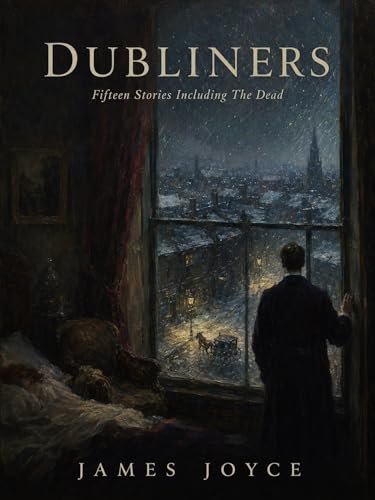
The collection ends with “The Dead,” frequently called the finest short story in English. A man at a holiday party discovers, in a single evening, how little he has understood his own wife and his own life, and the story closes on a passage of falling snow that is among the most beautiful paragraphs ever written. The snow is the most democratic substance in all of Joyce: it falls on everything equally — on the deaf and the hearing, the dead and the paralyzed, the boy who burned in the bazaar and the woman who will never leave her father’s house. It makes no distinctions. This is not despair; Joyce was not a despairing writer. It is honesty — the specific honesty of a writer who refused to sell his readers a comfort he did not believe in, who held the mirror steady even when the mirror was unwelcome, who understood that the diagnosis is not the cure but is, in the absence of any cure, the only thing left that could be called love for the patient. If you read only one thing by Joyce, read this.
The book the city refused to read
The ten years between the book’s completion and its publication are themselves a chapter of the story. Publishers objected — to the word “bloody,” to named Dublin establishments, to “An Encounter,” to the politics of “Ivy Day in the Committee Room” — and the Dublin printer George Roberts finally destroyed the typeset sheets in 1912 rather than let the book exist. The destruction of the proofs is the purest possible enactment of the paralysis the book describes: the moment of transformation reached and refused, the door opened and slammed shut. When Dubliners at last appeared in 1914, it sold a few hundred copies and Dublin, by and large, did not read it. The city had managed, through the decade of refusal, to ensure that by the time the mirror appeared, most of the faces it reflected had stopped looking. The book the city wanted broken is the one that still reflects.
Then onward
The fifteen stories are not background to Joyce’s later work; they are the world that made Stephen Dedalus possible and the question his later books must answer. The boy who calls a shopping trip a sacred quest in “Araby” is already performing the aestheticization that Stephen will systematize into a philosophy. Once Dubliners has shown you how Joyce turns the ordinary luminous, the staircase to Ulysses is open — and far less frightening than its reputation. You can climb it in sequence in The Essential James Joyce, which gathers Dubliners, A Portrait of the Artist as a Young Man, and Ulysses in one volume — so the great closing “yes” of Ulysses means what it means precisely because you began here, in the snow falling faintly through the universe.
Read the Erato Press Dubliners →
Related reading: Modernism Explained: A Reader’s Guide · Where to Start With James Joyce · Is Ulysses Worth Reading? An Honest Guide
This article draws on the original critical essay “The Art of Paralysis,” written for the Erato Press edition. This article contains affiliate links; as an Amazon Associate, Erato Press earns from qualifying purchases.
Enjoyed this piece?
Get the next one — our essays on the classics and news of each new Erato Press edition — straight to your inbox.