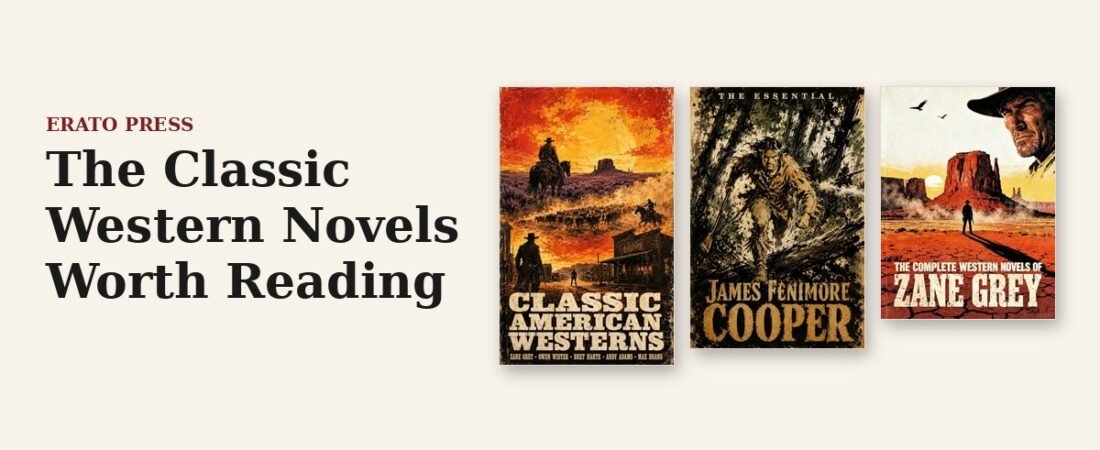
Short answer: The Western is America’s national myth in novel form, and its master is Zane Grey, whose Riders of the Purple Sage and dozens of other novels built the genre’s whole vocabulary of lone riders, big skies, and moral reckoning. Read Grey first — he is far better than the genre’s pulp reputation suggests — then range out to the writers who built the form around him.
More than cowboys and shootouts
It is easy to dismiss the Western as formula — the gunslinger, the saloon, the showdown at noon. But at its best the Western is the American myth of how civilisation is wrested from wilderness, and at what moral cost. It asks the questions the young country asked itself: What is justice where there is no law? What does a person owe a community? Where is the line between the outlaw and the hero? These are real questions, and the great Westerns take them seriously. The genre is also, quietly, a record of conquest — of the land and the peoples already on it — and the better novels carry an unease about the very frontier they celebrate.
Zane Grey: the man who made the myth
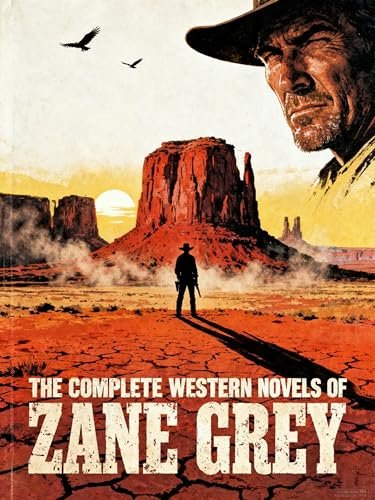
Grey, writing in the early twentieth century, fixed the template more than anyone. His Riders of the Purple Sage (1912) is the genre’s defining novel — a story of revenge, faith, and freedom set against the red-rock canyons of Utah, charged with a barely submerged hostility toward the closed, persecuting community its heroes flee. Grey was a dentist who abandoned his practice for the West he had fallen in love with, and the real glory of his work is the land itself: his descriptions of the desert make it a character, an overwhelming presence of scale and beauty and indifference against which human drama plays out small and brief. The big sky is not backdrop; it is the moral fact of the genre, the wilderness that tests and dwarfs the people in it. He sold tens of millions of books and shaped how the world pictures the American West.
The form around him
Grey did not invent the Western alone, and the pleasure deepens when you read him against his peers. Owen Wister’s The Virginian (1902) gave the genre its template gentleman-cowboy and its code of honour; Andy Adams’s The Log of a Cowboy brought documentary realism to the cattle drive; Bret Harte’s mining-camp stories supplied its sentimental, ironic frontier types; and Max Brand spun out the pulp hero at industrial speed. Behind all of them stands James Fenimore Cooper’s The Last of the Mohicans and the Leatherstocking Tales, the original American frontier romance from which the whole genre descends. Read across them and you watch a national myth assemble itself in real time.
Why the landscape is the point
What separates Grey from his imitators is that the Western, in his hands, is fundamentally about place. The imitations remember the gunfights and forget the canyons; Grey never does. Read him for the land as much as the action, and the genre’s clichés fall away to reveal the real thing the imitations were imitating — propulsive, romantic, and far richer in feeling than its reputation allows.
Where to start
Begin with Riders of the Purple Sage, then range across the complete Western novels. If the appetite holds, the multi-author anthologies let you trace the genre outward from Grey to Wister, Harte, Adams, and Brand — the founding library of the American West. For more of the adventure tradition that runs alongside it, follow the trail to Edgar Rice Burroughs and H. Rider Haggard.
Read the Complete Western Novels of Zane Grey →
Related reading: Edgar Rice Burroughs: Tarzan, Mars, and Pulp Adventure · Allan Quatermain and the Lost-World Adventure · Jules Verne: Where to Start With the Extraordinary Voyages · Lost Worlds and Lost Cities: The Best Adventure Classics
This article contains affiliate links; as an Amazon Associate, Erato Press earns from qualifying purchases.
Enjoyed this piece?
Get the next one — our essays on the classics and news of each new Erato Press edition — straight to your inbox.