Short answer: H. Rider Haggard’s Allan Quatermain — the weathered, self-deprecating hunter of King Solomon’s Mines (1885) — invented the lost-world adventure, and he did it through a narrative trick so durable we no longer notice it: a narrator who insists he is not a literary man and is, by insisting, more persuasive than any literary man could be. Read him for the thrill, but read him knowing that the genre’s deepest assumption — that the hidden kingdom is there to be found — is also its quiet tragedy.
The voice that does everything wrong
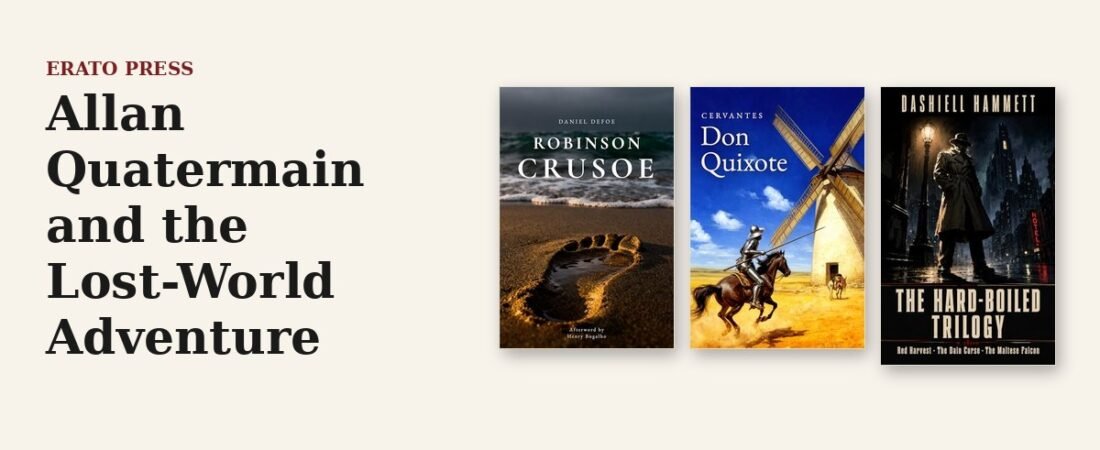
The central achievement of King Solomon’s Mines is not its map or its treasure but its voice, and that voice begins by apologising. “I am not a literary man,” Quatermain warns us on the first page, promising a plain, unadorned account by someone who lacks the skill to embellish. This is one of the oldest tricks in fiction — Defoe used it in Robinson Crusoe, Cervantes anticipated it with Don Quixote‘s found manuscripts — but Haggard aimed it at a specific Victorian expectation. In 1885 the British public knew Africa through two kinds of text: the dry scientific expedition report and the earnest missionary account, both of which demanded a credible witness rather than an imaginative artist. By giving us a narrator who insists on his own literary inadequacy, Haggard produced a fiction that disguises itself as exactly the kind of document his readers already trusted.
The irony is that Quatermain’s artless prose is in fact highly crafted. The dry humour, the sudden flashes of lyric intensity when the African landscape opens up, the modulated rhythm of tension and release — none of it is accidental, and all of it depends on our believing the narrator incapable of artifice. The disclaimer is the most artful thing in the book: it is the frame that makes the picture credible. And the figure it created proved astonishingly durable. The competent witness who insists on plain speech while delivering something far more precise runs straight from Quatermain to the hard-boiled detectives of Hammett and Chandler and into the first-person adventure narrators of Ernest Hemingway.
A working man’s Africa
Quatermain is not a gentleman, and this matters more than it first appears. He is a professional hunter who has worked for wages, acutely conscious of the social distance between himself and the aristocratic Sir Henry Curtis and Captain Good who travel with him. He sees Africa neither as an administrator hunting for territory, nor as a missionary hunting for souls, nor as an investor hunting for resources, but as someone who has lived in it for decades and knows its geography the way a cab driver knows a city — not as a conceptual map but as a set of practical paths through terrain. That is why the route to Kukuanaland carries such conviction even though Haggard invented it: it is filtered through a consciousness that thinks in journeys rather than in imperial abstractions.
The hidden kingdom is doomed by its discovery
The recurring engine of the cycle is the hidden kingdom — Kukuanaland in King Solomon’s Mines, Zu-Vendis in Allan Quatermain, the sacred lands of the later novels: an advanced civilisation sealed behind a desert, a mountain, an impassable forest. These are not merely exotic locations; they are philosophical propositions. The age of exploration was effectively over by 1885, the map’s blank spaces nearly filled in, and the hidden kingdom is Haggard’s structural solution to a genre that needed uncharted territory in a world that had run out of it.
But Haggard is more honest than his imitators about what discovery costs. The societies he invents are almost always more stable and more sophisticated than the colonial world around them — precisely because they have not yet been subjected to contact. And the arrival of the Europeans is always, at some level, a catastrophe for the kingdom they enter. The colonial encounter did not require malice; it required only contact. The moment the adventurers find the hidden kingdom is the moment the hidden kingdom begins to die — and the narrative knows it, even when its heroes do not. This is the genre’s buried tragedy, and it is why the lost world is only ever “lost” to the men who claim to find it.
Gagool, and the terror of the open
The Quatermain novels also have a Gothic dimension rarely discussed. Where the old castle-Gothic of Walpole and Radcliffe produced terror in enclosed spaces, Haggard’s imperial Gothic produces it in open ones — the African plain, the unmapped interior, the kingdom in the mountains. The terror is specifically the terror of the uncontrollable in a space that colonial ideology claims to control. Its supreme figure is Gagool: ancient beyond nature, shrunken, claw-handed, apparently immortal — the living memory of everything that happened in Kukuanaland before the Europeans came, and therefore the one adversary their rationalism cannot reach. Her death, crushed by the stone door while clutching at the treasure she has guarded for generations, is Gothic in the classical sense. Yet Haggard makes it ambivalent: she is also a very old woman who dies, as she lived, in the exercise of her own will, and the terror she produces never quite extinguishes the admiration.
Reading Haggard with both eyes open
None of this is an argument for dismissing Haggard; it is an argument for reading him fully. His treatment of African speech is itself a political choice: rather than the pidgin and phonetic distortion most of his contemporaries used — which embeds racial contempt in the very texture of the prose — he renders African dialogue in a formal, elevated register that signals seriousness without condescension. It is not a perfect solution, and it produces its own distortions, but it is a thoughtful one, made by a man who had served in the colonial administration and knew that a mistranslation could start a war. Haggard exoticised Africa even as he was genuinely fascinated by it, and the best annotated editions let you feel the thrill and see the worldview at once. Begin with King Solomon’s Mines, then Allan Quatermain and She, and read the whole saga as what it is: the thrilling, problematic, hugely influential founding document of modern adventure — the books from which Indiana Jones and a century of lost-world cinema descend.
Related reading: The Classic Western Novels Worth Reading · Edgar Rice Burroughs: Tarzan, Mars, and Pulp Adventure · Lost Worlds and Lost Cities: The Best Adventure Classics
This article draws on the original critical essay written for the Erato Press edition. This article contains affiliate links; as an Amazon Associate, Erato Press earns from qualifying purchases.
Enjoyed this piece?
Get the next one — our essays on the classics and news of each new Erato Press edition — straight to your inbox.