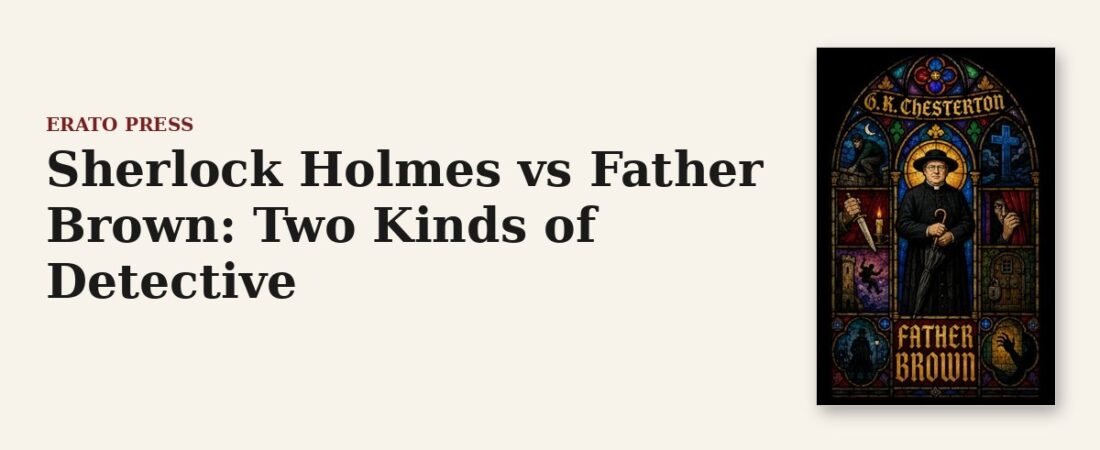
Short answer: Sherlock Holmes and Father Brown solve crimes by opposite methods, and the contrast is one of the richest in fiction — because it is really an argument about how we know other people at all. Holmes reasons from the outside in: evidence, deduction, the cold gaze of science. Father Brown understands from the inside out, catching criminals because, as a priest, he knows the human heart’s capacity for sin from within. One is a thinking machine; the other is a fellow sinner. Chesterton built the second deliberately to answer the first.
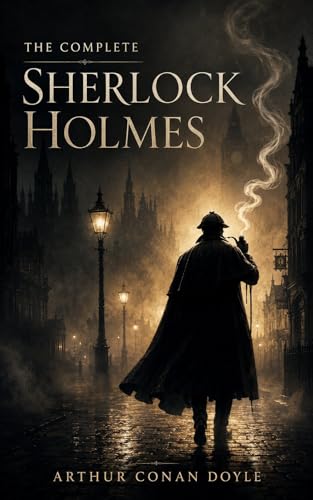
Holmes: the world as a text to be read
Conan Doyle’s Sherlock Holmes is the supreme rationalist, and his method — the celebrated science of deduction — is one of the most successful intellectual brands in the history of popular culture. For Holmes the world is a surface covered in legible signs: the callus on a thumb, the wear on a sleeve, the splash of mud that betrays which county a man has travelled from. Crime is a puzzle that yields to sufficiently sharp observation, and “Elementary” is the perfect tagline, because it reframes what looked miraculous as what was merely obvious — available, in principle, to anyone who would only look. There is something quietly democratic in that promise: the clues lie in plain sight, and the talent is not in seeing what others cannot see but in seeing what others will not.
But embedded in the method is a philosophical commitment most readers never notice. The science of deduction assumes that the world is, in principle, fully legible — that every phenomenon has a cause and every mystery a solution. This is not common sense; it is nineteenth-century positivism, the faith that the methods of natural science can be turned on every domain of human experience, including the most irrational. Holmes is the fictional embodiment of that promise, and his enduring popularity measures how desperately people wanted to believe it. He stands apart from humanity, almost above it; his coldness is both the price and the proof of his genius. Holmes flatters the modern conviction that reason can master anything.
Father Brown: the criminal understood from within
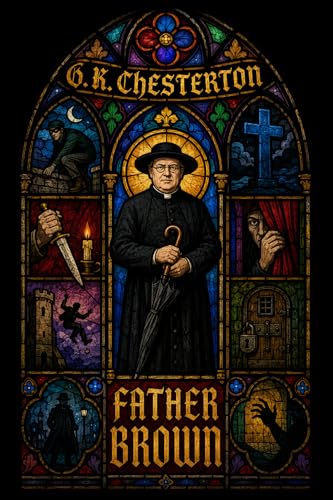
G. K. Chesterton built his detective as a conscious rebuttal. Father Brown is dumpy, shabby, perpetually underestimated — the opposite of Holmes’s hawk-like glamour — and he solves crimes not by collecting clues but by imaginative sympathy. In the famous exchange, asked how he knew the criminal’s mind so precisely, he answers that he had “murdered them all myself”: he catches the murderer by mentally becoming him, because in the confessional he has heard every variety of human wickedness and knows that the line between himself and any killer is thin. His method is moral, not forensic. Where Holmes reads the world’s surfaces, Father Brown reads its souls — beginning with his own.
This is the heart of Chesterton’s provocation. He is not merely offering a gentler, more spiritual detective; he is arguing that Father Brown’s method is the more realistic one. Crimes, after all, are committed by human beings, out of human motives — greed, fear, wounded pride, despair. A man who has never examined the wickedness in his own heart will always be, in some crucial sense, a stranger to the criminal, no matter how many cigar-ash varieties he can identify. The priest, who has spent his life listening to people confess the worst of themselves, knows exactly how an ordinary person talks himself into murder. He does not need the mud and the calluses; he already knows what the heart is capable of.
Two theories of knowledge
This is why the contrast runs far deeper than detective fiction. The two men embody two complete theories of how we come to know anything true about other people. Holmes embodies the scientific worldview: truth reached by detached observation, the observer standing outside his object and reasoning coolly about it. Father Brown embodies an older, religious one: truth reached by self-knowledge and humility about our shared fallenness, the observer recognizing himself in the very person he is judging. Holmes’s knowledge is power, and it keeps its distance. Father Brown’s knowledge is communion, and it closes the distance entirely.
Each method has a built-in blind spot that the other exposes. The thinking machine can reconstruct a crime in perfect detail and still understand nothing of why a soul would commit it; Holmes sees everything and grasps nothing of the heart. The humble priest can see straight into a motive and yet would be helpless before a locked-room mechanism or a forged timetable; his gift is for people, not for things. Read together, they are not rivals so much as two halves of a single faculty — the head and the conscience, observation and confession, the eye that measures and the eye that forgives.
Why the contrast still matters
It matters because both detectives are quietly aware of their own limits, and that awareness is what keeps them from being mere puzzle-machines. The best Holmes stories know that the world is not finally legible — Holmes fails, is wrong, is outwitted — and the gap between the promise of his method and its real limits is the source of the canon’s surprising depth. Chesterton, for his part, never lets Father Brown’s humility curdle into smugness; the priest catches the criminal precisely by refusing to feel superior to him. One detective teaches us how much can be known by looking; the other teaches us how much can only be known by admitting what we share with the guilty.
Read them together
Take them as a pair and you have two complete philosophies of human knowledge bound inside the same humble genre — the detective story doubling as a debate between reason and the soul. Start with the Sherlock Holmes short stories and the first Father Brown collection, read them in alternation, and let them argue. You will never look at a mystery the same way again — and you may find, as Chesterton hoped you would, that the shabby little priest has quietly won.
Read the essential Father Brown →
Related reading: The Best Detective Fiction in the Classics · The Complete Sherlock Holmes: A Reading Guide · Hard-Boiled vs Cozy: The Two Souls of Crime Fiction
This article contains affiliate links. As an Amazon Associate, Erato Press earns from qualifying purchases.
Enjoyed this piece?
Get the next one — our essays on the classics and news of each new Erato Press edition — straight to your inbox.