Short answer: Crime fiction has two souls. The “cozy” (Christie, Father Brown, the country-house puzzle) treats crime as a disruption of an orderly world, to be solved and repaired. The hard-boiled (Hammett, Chandler) treats crime as the natural condition of a corrupt world, and the detective as a lonely figure of compromised honor walking through it. They are not just styles — they are opposite verdicts on human nature, and the gap between them is one of the most revealing fault lines in modern fiction.
The cozy: a fallen world that can be set right
In the classic puzzle mystery, the murder is an aberration. The village or the manor is fundamentally orderly; one bad actor has broken the peace, and the detective’s job is to identify the guilty party so that the innocent community can return to normal. The pleasure is reassurance: reason triumphs, the guilty are named, order is restored, and the disturbance is sealed off like a wound that heals without a scar. It is a profoundly conservative, comforting form — the world makes sense, justice is available, and the social order, once cleansed of its single corrupt element, is shown to have been sound all along. Even Chesterton’s Father Brown, who locates crime in the universal human capacity for sin, finally restores a moral universe in which confession and forgiveness are possible. The cozy says, in the end: the world is clean, and crime is a stain upon it.
The hard-boiled: a world rotten to the root
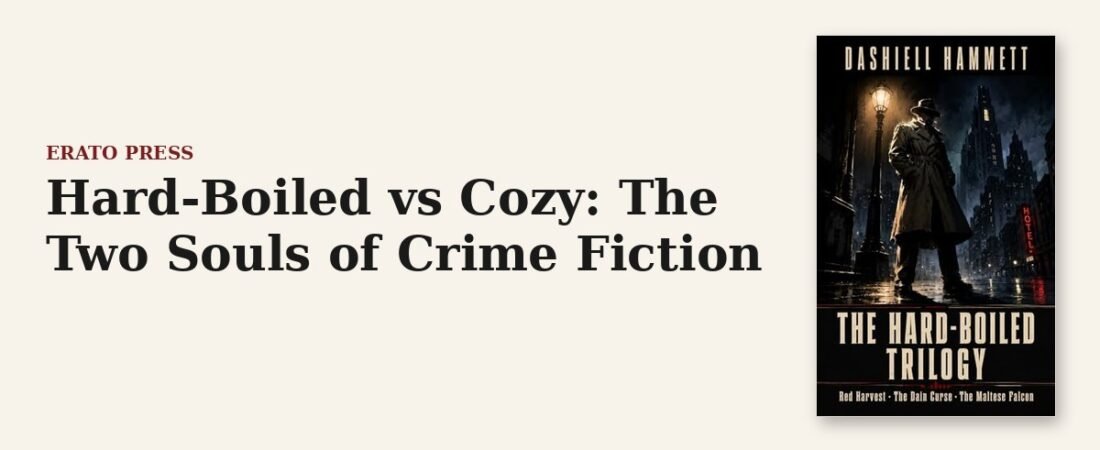
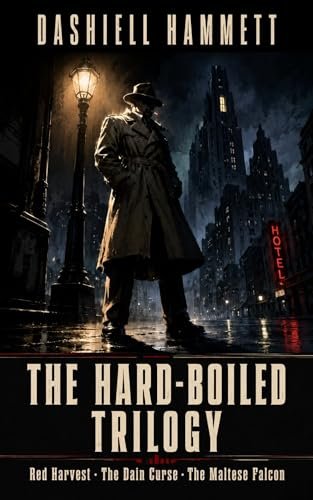
Then, in 1920s America, Dashiell Hammett turned the form inside out — and he did it from experience, having worked for years as a Pinkerton detective before he ever wrote a word of fiction. In Red Harvest, The Dain Curse, and The Maltese Falcon, crime isn’t an aberration; it is the medium everyone swims in. The police are corrupt, the rich are criminal, the politicians are bought, and the detective is no genius savant performing deductions for an admiring audience but a tough, tired professional with a private code, navigating a world where everyone lies and almost everyone is for sale. Solving the case does not restore order, because there was no order to restore — in Red Harvest, the detective’s intervention leaves a whole town drowning in blood. The most he can do is keep his own integrity intact, and even that is a near thing. Hammett stripped the form of its consolations and its parlor manners and left it lean, brutal, and bracingly honest.
Two faces of the same fear
Read together, the two traditions stage a genuine debate about whether evil is exceptional or ordinary. The cozy says crime is a stain on a clean world; the hard-boiled says the world is the stain and decency is the exception — a flickering, costly thing one man maintains by sheer stubbornness while everything around him rots. Both, tellingly, are answers to fear. The cozy soothes the fear that the world might be senseless by proving, every time, that it isn’t. The hard-boiled confronts that same fear head-on and refuses the easy comfort, finding its dignity not in restored order but in the detective’s lonely insistence on his own code when no code is rewarded.
Hammett’s deeper achievement was to make the detective story tell the truth about power and money in modern America. He took a parlor game and turned it into social realism with a body count — fiction that knew how cities are actually run, how corruption actually works, and how little the law has to do with justice. Raymond Chandler, who followed him, gave the form its poetry and its melancholy knight in Philip Marlowe; but it was Hammett who first proved that pulp could carry serious moral weight, and that the cheapest of genres could become a clear-eyed report on the world.
Where to start with each
For the cozy intelligence at its most humane and paradoxical, read Chesterton’s Father Brown, where the gentlest of detectives proves the most unsettling. For the hard-boiled at its origin, read Hammett’s trilogy — leaner, harder, and far more serious than its pulp reputation suggests. Read the two against each other and you are not just sampling two styles; you are choosing between two visions of what kind of world we live in.
Read Hammett’s Hard-Boiled Trilogy →
Related reading: The Best Detective Fiction in the Classics · The Woman in White and the Birth of the Sensation Novel · Sherlock Holmes vs Father Brown: Two Kinds of Detective
This article contains affiliate links. As an Amazon Associate, Erato Press earns from qualifying purchases.
Enjoyed this piece?
Get the next one — our essays on the classics and news of each new Erato Press edition — straight to your inbox.