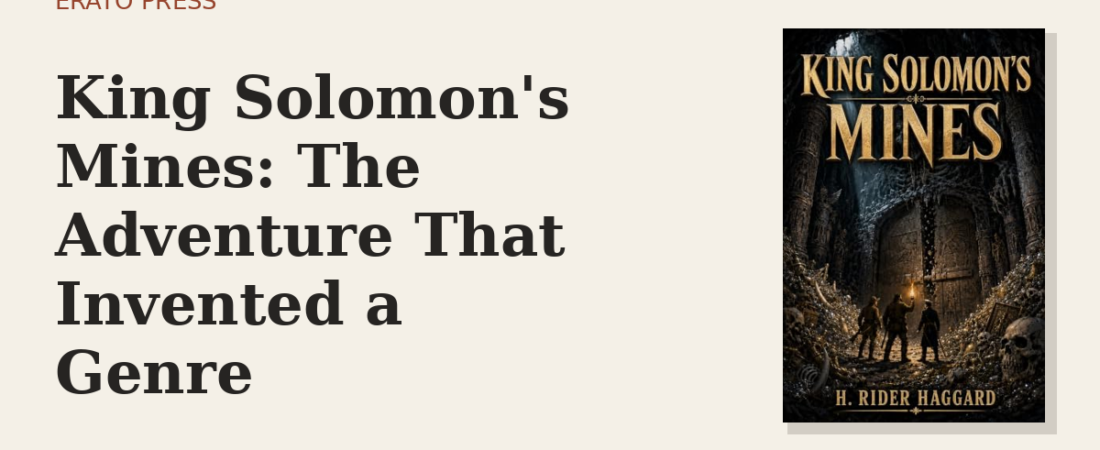
Three Englishmen — a big-game hunter, a sea captain, and a grieving aristocrat searching for his lost brother — set out across a trackless African desert and over impassable mountains, guided by an ancient map written in blood, toward the fabled diamond mines of King Solomon and a lost kingdom no white man has seen. H. Rider Haggard’s King Solomon’s Mines (1885) was a sensation, and it invented a genre: the “lost world” adventure, the quest into unknown territory for legendary treasure, that runs in a straight line down to Indiana Jones and beyond. Fast, thrilling, and hugely influential, it is the template from which a century of adventure fiction was cut.

The birth of the lost-world quest
Haggard’s formula was new and irresistible: the map to a hidden place, the perilous journey into the unknown, the lost civilization untouched by the modern world, the treasure and the danger, the narrow escapes and the climactic confrontation. He wrote it, famously, on a bet that he could match the success of Treasure Island, and he more than won — creating in the hunter Allan Quatermain a hero who would headline a long series of novels and become the model for the rugged adventurer-explorer. Everything from pulp adventure to the modern blockbuster owes something to this book; it fixed the shape of the treasure-hunt story so firmly that we still feel its outline whenever a hero unfolds an old map. Our essay on Allan Quatermain and the lost-world adventure traces how far Haggard’s invention reached.
Thrills and their shadows
The novel is a masterclass in pace and suspense — the killing drought in the desert, the battle for a kingdom, the terrifying entombment in the treasure chamber — and it moves with a momentum that has not dated. But a modern reader also meets its shadows honestly: it is a product of the age of empire, and its assumptions about Africa and race belong to that age, even as Haggard, more than many of his contemporaries, grants his African characters dignity and grandeur (the warrior Umbopa is one of the book’s noblest figures). Reading it now means enjoying the genre it founded while seeing clearly the imperial worldview it carried — a double awareness that makes it a richer, more instructive experience than mere nostalgia.
The romance of the unknown
What gives the book its enduring power is its tapping of something deep: the dream of the blank space on the map, the place where wonders might still be found. Haggard wrote at the last moment when large parts of the world were genuinely unexplored by Europeans, and he poured into his lost kingdom all the longing of an age for mystery, danger, and the marvelous. That romance of the unknown — the pull of the uncharted, the hope of the hidden marvel — is why the lost-world story has never died, only migrated to new frontiers, from Verne’s ocean depths to outer space. Haggard found the ur-form of that longing and gave it a shape we still use.
Why read it now
Because it is the fountainhead of adventure fiction — fast, gripping, and endlessly influential — and because reading the original after a century of imitations is a revelation: leaner and stranger than its descendants, and shadowed by the imperial history that a thoughtful reader can weigh even while turning the pages. It remains one of the most purely exciting novels ever written.
Frequently asked questions
Is King Solomon’s Mines the first lost-world novel?
It is the book that established the genre and made it wildly popular — the treasure-hunt quest into unknown territory that countless novels and films have followed ever since. Haggard essentially invented the template.
How should a modern reader handle its colonialism?
Read it with open eyes: it is a product of the imperial age and carries that era’s attitudes, even as it grants some African characters real nobility. A good edition frames the context honestly, so you can enjoy the adventure while understanding its history.
Who is Allan Quatermain?
The novel’s narrator-hero, a seasoned big-game hunter who became Haggard’s recurring adventurer across many books — the prototype of the rugged explorer-hero that runs down to Indiana Jones.
Read the Erato Press edition →
and follow the blood-drawn map into the unknown.
Enjoyed this piece?
Get the next one — our essays on the classics and news of each new Erato Press edition — straight to your inbox.