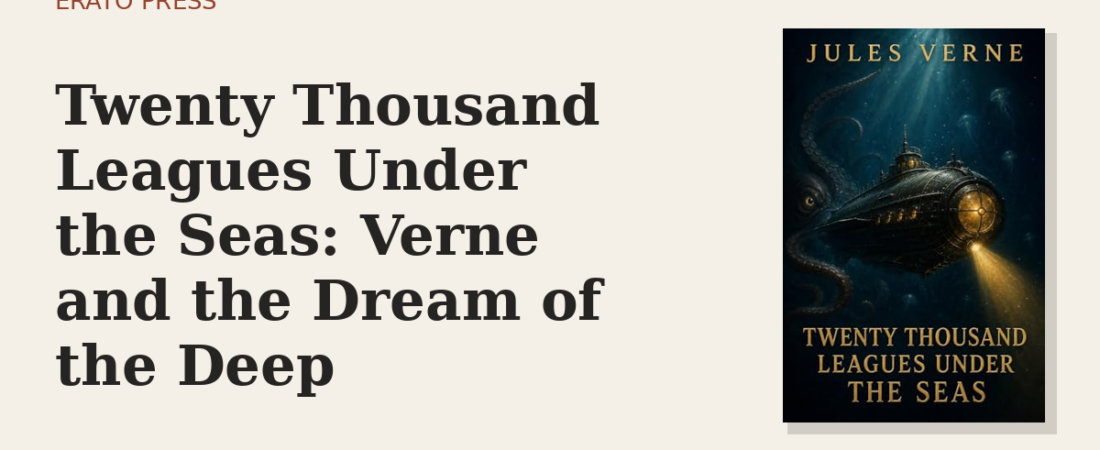
In 1870, when no working submarine existed, Jules Verne sent his readers twenty thousand leagues beneath the waves aboard the Nautilus — an electric submarine of impossible luxury and power, commanded by the enigmatic Captain Nemo, a man who has renounced the human world and made the ocean his kingdom. Twenty Thousand Leagues Under the Seas is the greatest of Verne’s “Extraordinary Voyages,” the novels with which he more or less invented modern science fiction, and it remains a marvel: a thrilling adventure, a visionary act of technological prophecy, and, in Nemo, a portrait of one of literature’s great tormented rebels. Verne dreamed the machine before the engineers built it, and dreamed, too, the ambivalence we still feel toward the powers our machines confer.

The machine that dreamed itself real
Verne’s imagination ran decades ahead of the technology, and the Nautilus is his masterpiece of prophecy: an electric-powered submarine that can cross oceans, harvest food and fuel from the sea, and remain submerged indefinitely — described with such loving, plausible engineering detail that generations of readers, and more than a few actual inventors, took it as a blueprint. (The first nuclear submarine was named Nautilus in Verne’s honor.) But the wonder is never merely technical. Verne uses the machine to take us where no reader had been: across coral forests and sunken Atlantis, through the ice of the South Pole, into battle with a giant squid, along the whole floor of the world’s oceans, rendered with the enthusiasm of a man in love with the marvels of the natural world and the human ingenuity that might reach them.
Captain Nemo, the rebel of the deep
The novel’s dark heart is Nemo — brilliant, cultured, immensely rich, and consumed by a hatred of the imperial powers of the surface world, against whom he wages a private war from beneath the sea. Verne keeps his backstory shadowed (revealing more in a later novel), and the mystery is part of his power: he is a liberator or a terrorist depending on the angle, a man who has answered the injustice of the world by withdrawing from it entirely and turning his genius against it. He is the ancestor of a hundred later figures — the sympathetic villain, the genius who has broken with humanity — and his tragedy gives the adventure a moral weight that Verne’s imitators rarely reached. Beneath the wonders runs a real question: what does a good man do when the world is unjust and he has the power to strike back?
The birth of science fiction
Verne, with Wells, stands at the origin of science fiction, and the two define its poles: where Wells used the genre for social warning and dark irony, Verne used it for wonder — the romance of exploration, the poetry of the machine, the thrill of the possible. Twenty Thousand Leagues is the summit of that optimistic, marveling tradition, the direct ancestor of every story that finds awe in technology and the unexplored. It helped teach the modern world to dream forward, toward the deep sea and the poles and eventually the stars.
Why read it now
Because it is the great romance of exploration and invention, still thrilling a century and a half on, and because Nemo — the genius in flight from a world he cannot forgive — is a figure of surprising depth. It is an adventure the whole family can love and a serious imaginative achievement at once, the book that first made the machine a hero and the ocean a frontier.
Frequently asked questions
Is the science accurate?
Astonishingly so for 1870 — Verne’s submarine anticipates real technology by decades, and his oceanography is carefully researched. Some details are dated, but the visionary engineering is why he is called a prophet of the modern age.
Who is Captain Nemo?
A mysterious genius who has renounced the surface world and wages a private war against imperial powers from his submarine. Verne deliberately shrouds his past (filling it in partly in The Mysterious Island), making him one of literature’s great enigmatic rebels.
Is it good for younger readers?
Yes — it is a thrilling adventure accessible to teens, while its darker undercurrents and Nemo’s tragedy reward adult readers. It is one of the great cross-generational classics.
Read the Erato Press edition →
and descend with Nemo into the kingdom he made of the sea.
Enjoyed this piece?
Get the next one — our essays on the classics and news of each new Erato Press edition — straight to your inbox.