Short answer: If you have ever wanted to know where the Greek gods actually come from — why Zeus rules, who the Titans were, how the cosmos was born from a gap called Chaos — the answer is Hesiod’s Theogony, the strange, violent poem that is essentially the origin story the rest of Greek myth assumes you already know. It is also the first surviving attempt in the West to think the whole of reality at once.
The poem behind the myths
Homer tells stories about the gods; Hesiod tells you where the gods came from. Composed around 700 BC, the Theogony (“birth of the gods”) traces a genealogy from the absolute beginning — from Chaos, through the violent overthrow of one divine generation by the next — down to the final order under Zeus. It is the scaffolding on which all later Greek mythology hangs: read it, and the tangle of myth you half-know from childhood suddenly acquires a family tree and a logic.
But the first surprise is the word Chaos itself, which does not mean what the English word means. The Greek cháos comes from a root meaning “to gape, to yawn open.” It is not a jumble of elements in confusion; it is gap, fissure, abyss — the sheer interval that must exist before anything can appear. And the cosmos does not begin with an act of will. There is no creator, no design, no “let there be.” Chaos simply came to be, Hesiod says, using the same verb he uses for natural processes. Here, at the very start of Western cosmology, the genealogy that can organize everything afterward runs up against the one thing it cannot reach: its own ground. The method names the abyss and moves on, because the abyss resists explanation.
A cosmos built out of violence
What follows is a drama of brutal simplicity: fathers fear sons, sons overthrow fathers, and the instrument of power is always the body. Ouranos, the sky-god, terrified of his own children, forces them back into the earth; Gaia arms her youngest, Kronos, who castrates his father. From the blood spring the Furies; from the foam around the severed flesh in the sea, Aphrodite is born. Pause on that. The goddess of desire is born from an act of castration. Beauty emerges from mutilation. Hesiod does not moralize — he simply states — but the implication is structural: in this universe desire and violence are not opposites but siblings, born from the same wound. Then Kronos, fearing the same fate, swallows his own children as they are born, until Zeus escapes, forces him to disgorge them, and wages war on the Titans.
What emerges is more than a sequence of coups; it is a phenomenology of power. Ouranos is the tyrant of suppression, who tries to push what threatens him back into nonexistence. Kronos is the tyrant of consumption, who incorporates the threat by eating it. Both fail, because the body cannot be permanently denied: what is swallowed must be expelled. Zeus breaks the cycle not by being more violent but by a different art — he frees the imprisoned monsters and enlists them, distributes domains and honours, and when he swallows the goddess Metis he does it not to destroy her but to absorb her cunning into his own rule. He does not purify the cosmos of its dangerous elements; he assigns them places. The Titans still seethe in Tartarus. The order under Zeus is not given but constructed, at great cost, out of materials that constantly threaten to undo it. To the Greeks, the foundation of the world was not a benevolent act but a succession of generational seizures — power taken, never simply granted — and that tells you something permanent about how they understood it.
What the poem cannot quite say
Like every great text, the Theogony is shaped as much by its silences as by its declarations. Watch the feminine in it. Gaia is the most powerful agent in the first half: she devises the plot against Ouranos, saves Zeus, advises him against the Titans. Without that maternal intelligence there would be no order and no poem. Yet once Zeus ascends, Gaia recedes, Rhea disappears, Metis is swallowed. Hesiod gives the goddesses a voice precisely in order to narrate their silencing — and then the silenced returns anyway, as the Furies, as Aphrodite, as Pandora, the “beautiful evil” described in language so anxious it reads less like misogyny than like confession. The masculine order fears the feminine because it depends on it. These are not flaws in the poem. They are the points where myth runs into problems it cannot solve within its own terms — the very problems that Greek tragedy and philosophy would later be built to confront.
Why it still repays reading
Not only because it unlocks everything else — though it does — but because it shows you what thinking looked like before philosophy separated itself from poetry. The words Hesiod puts into play (chaos, eros, dikē, moira, hybris) become the conceptual vocabulary of all later Greek thought, but here they are not yet categories; they are characters, forces, events. Chaos is not “a concept of primordial indeterminacy”; it is a gaping abyss. Eros is not “the principle of attraction”; it is a god who loosens your knees. If Homer gave us the epic of heroes, Hesiod gave us the genealogy of the world itself — and the harder knowledge that to inhabit the cosmos is always to negotiate with the abyss. It is short, foundational, and unlike anything else you will read. Approach it with a good edition that keeps the names legible, and treat it less as a story with a plot than as a cosmic genealogy lit by flashes of vivid drama.
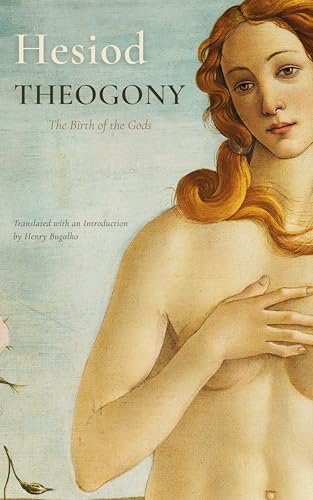
Read the Erato Press Theogony →
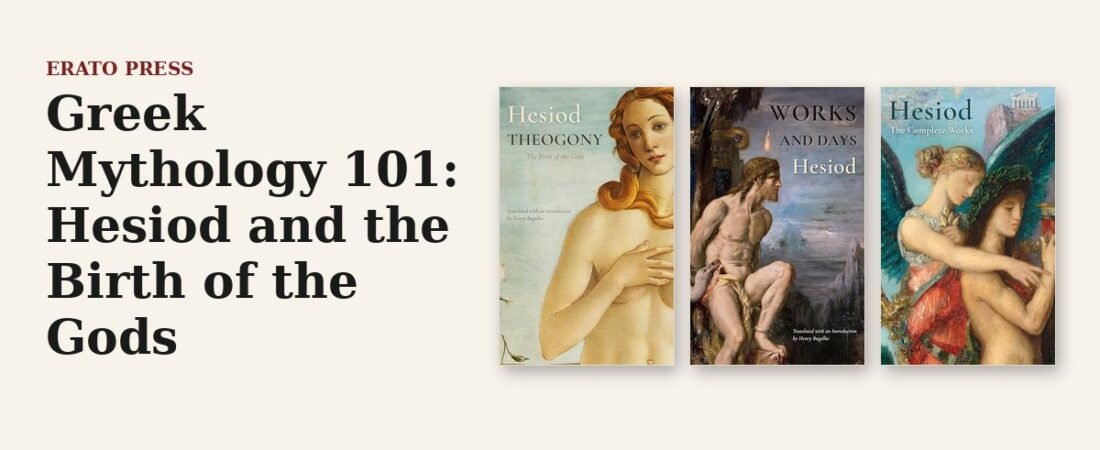
If the poem takes hold, Hesiod’s other surviving work — the down-to-earth Works and Days, on justice and labour — and the complete Hesiod in one volume carry the same vision into the human world.
Related reading: Greek and Classical Epics: Where to Begin · The Odyssey: Why Homer Still Matters · Reading Homer: The Iliad and the First Epic of War
This article draws on the critical introduction written for the Erato Press edition. This article contains affiliate links; as an Amazon Associate, Erato Press earns from qualifying purchases.
Enjoyed this piece?
Get the next one — our essays on the classics and news of each new Erato Press edition — straight to your inbox.