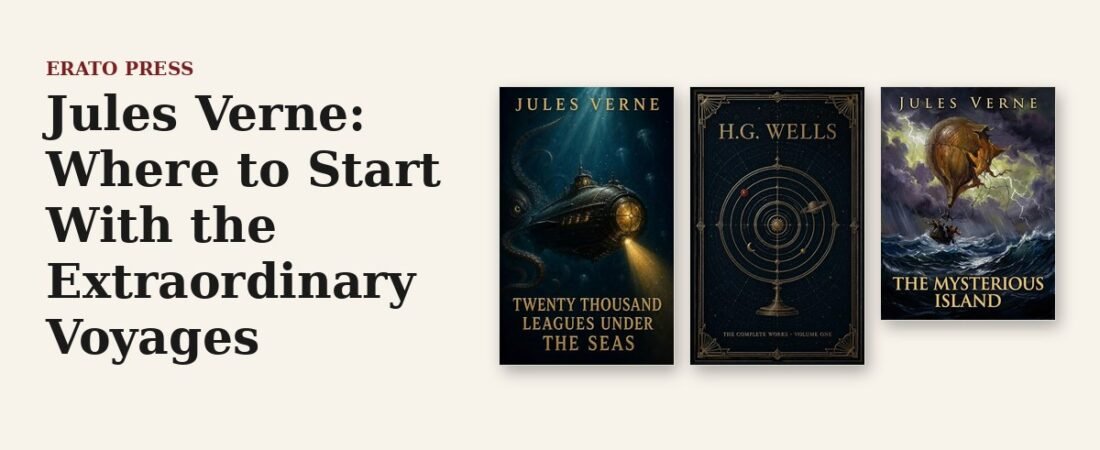
Short answer: Start with Twenty Thousand Leagues Under the Seas or Journey to the Center of the Earth — Verne at his most thrilling and visionary. The father of science fiction wrote adventures that double as meditations on the limits of knowledge, and the right editions restore the scientific seriousness that lazy old translations stripped away.
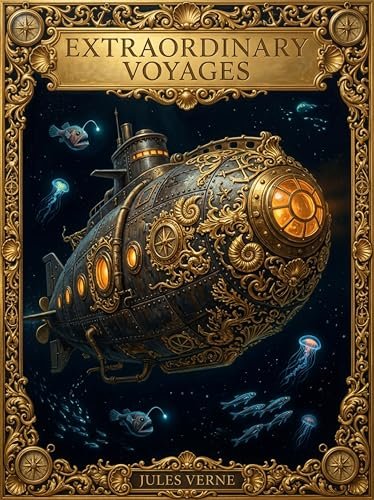
The man who imagined the future
Verne, writing from the 1860s on, did something no one had quite done: he built thrilling adventure on a foundation of real, carefully researched science and used it to imagine technologies that did not yet exist. Submarines, powered flight, space travel, deep-sea exploration — he dreamed them in detail decades before engineers built them. With Mary Shelley and H. G. Wells he is a founder of science fiction, and the one who married it most completely to the pure pleasure of adventure.
The engineer and the abyss
But Verne is darker and stranger than his reputation as a cheerful prophet of progress suggests. Read the four great voyages together and a single obsession emerges: a man of science descends into an unknown region — an ocean, a volcanic shaft, an uncharted island, the globe itself — and what he finds is never quite what his instruments predicted. His central figure is the engineer, the man who looks at a forest and sees lumber, at a river and sees a dam. Yet something always intrudes on the engineer’s closed system: something irrational, excessive, sublime. The project of rational mastery keeps meeting a limit, and what happens at that limit is far more interesting than the mastery itself.
Start beneath the sea
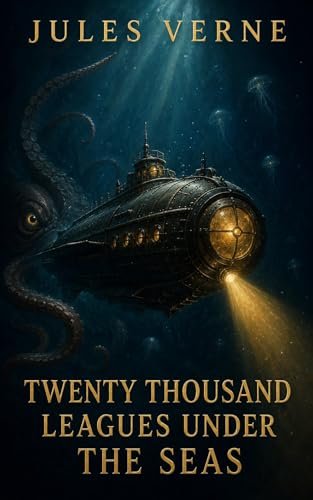
Twenty Thousand Leagues Under the Seas is the ideal entry. Professor Aronnax, a naturalist of impeccable credentials, is drawn into the orbit of Captain Nemo and his submarine, the Nautilus. Aronnax classifies, measures, catalogues — the ocean is a museum and he is its curator — but the deeper the Nautilus descends, the more his comfortable categories dissolve into the sublimity of the deep. The novel’s long passages of marine taxonomy are not padding; they are the mind’s attempt to domesticate the unknown by naming it, and they are always interrupted by awe or violence no catalogue can contain. Nemo himself is the element that will not balance: brilliant, wounded, a freedom fighter in self-imposed exile beneath the waves, whose motive the novel deliberately refuses to fully explain — a refusal that scandalised Verne’s publisher, who wanted a clear moral frame. Nemo remains the abyss in human form.
A note on translations
This matters more for Verne than for almost any other classic author. The Victorian English translations that long dominated were notoriously bad — slashed by a third, riddled with errors, and dumbing down the science Verne took such care over. For a century English readers met a diminished Verne and concluded he was merely a children’s writer. A good modern edition reveals the real thing: a serious, visionary, often melancholy writer whose adventures are arguments about what knowledge can and cannot reach.
Where to go next
After the Nautilus, descend into Journey to the Center of the Earth, circle the globe with Around the World in Eighty Days, and end with The Mysterious Island, where the engineer Cyrus Smith rebuilds civilisation from a single grain of wheat — and where Nemo returns, the romantic outcast secretly sustaining the rational world above him. The Extraordinary Voyages are a whole library of wonder, the place where adventure and the scientific imagination first truly fused. For the wider tradition, follow the trail to Edgar Rice Burroughs and the lost-world classics.
Read the Extraordinary Voyages of Jules Verne →
Related reading: The Classic Western Novels Worth Reading · Allan Quatermain and the Lost-World Adventure · Lost Worlds and Lost Cities: The Best Adventure Classics
This article draws on the original critical essay written for the Erato Press edition. This article contains affiliate links; as an Amazon Associate, Erato Press earns from qualifying purchases.
Enjoyed this piece?
Get the next one — our essays on the classics and news of each new Erato Press edition — straight to your inbox.