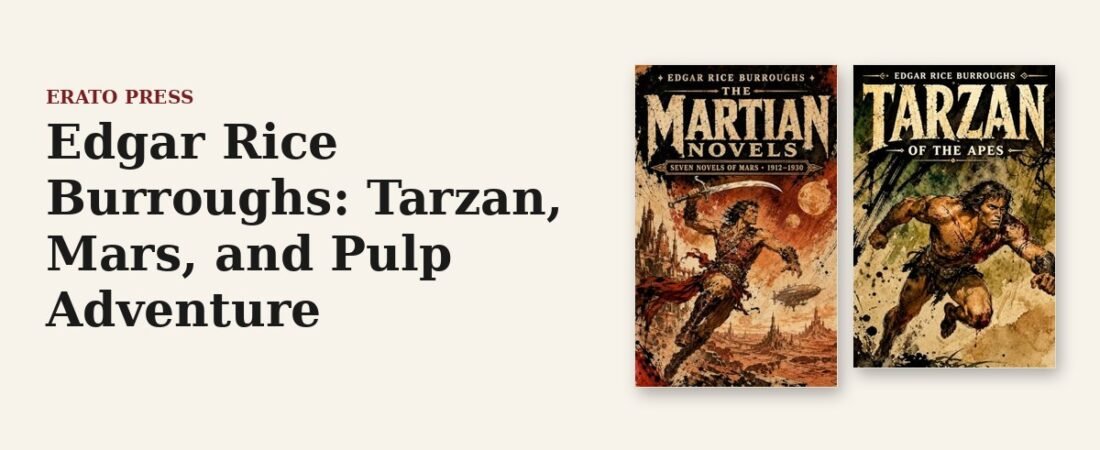
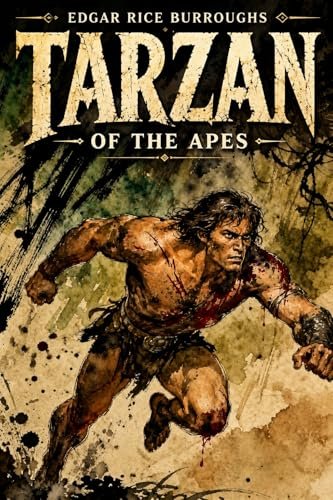
Short answer: Edgar Rice Burroughs invented modern pulp adventure and two of the twentieth century’s most influential characters: Tarzan of the apes and John Carter of Mars. Start with Tarzan of the Apes (1912) or A Princess of Mars — both wildly entertaining, both quietly foundational to everything from Superman to Star Wars to Avatar.
The father of pulp
Burroughs is one of those writers whose creations are far more famous than he is. He was the great engine of early-twentieth-century pulp adventure — fast, vivid, shamelessly imaginative storytelling produced for cheap magazines and devoured by millions. He never wrote literary prose and never pretended to; what he had was an inexhaustible gift for invention and momentum, and an influence on popular culture almost impossible to overstate. A former cavalryman, pencil-sharpener salesman, and serial business failure, he sat down in 1911 in genuine desperation, convinced he could write something better than the rubbish he was reading in the pulps — and he was right. Within a year he had created two myths that would outlive him by a century.
Tarzan: the noble savage reborn
Tarzan — the orphaned English aristocrat raised by apes, torn between the jungle and civilisation — tapped something deep: the fantasy of the natural man, free and powerful, uncorrupted by society. The character became a global phenomenon, spawning films, comics, and a hundred imitations. But the books are stranger and more uneasy than the screen Tarzan suggests. Burroughs’s ape-man comes to hold both civilisation and his own savagery in a kind of double contempt, and the novels return obsessively to the question of nature versus nurture — whether the aristocrat’s “blood” or the jungle’s brutal schooling made the man. That tension, never quite resolved, is what gives the early Tarzan books their pull. Read against their historical moment, they also carry the assumptions of the age of empire and race that produced them, which the best editions ask you to see rather than ignore.
John Carter: the birth of science fantasy
Just as important is Burroughs’s Mars — Barsoom — where a Confederate veteran is mysteriously transported to a dying red planet of warring races, strange beasts, thin air, and a beautiful egg-laying princess. A Princess of Mars and the Barsoom novels essentially founded the planetary romance, and their DNA runs straight through the century of science fiction and adventure cinema that followed. The dying world, the displaced earthman who becomes a hero, the sword-and-ray-gun blend of the archaic and the futuristic: George Lucas, James Cameron, and generations of comic-book creators are in Burroughs’s debt, whether they know it or not.
The engine underneath
What unites Tarzan and John Carter is a single fantasy that Burroughs understood better than any writer of his time: the dream of the competent body in a world that rewards it. His heroes are displaced — an English lord raised by beasts, an American soldier flung across space — and what redeems them is not birth or wealth but sheer physical capability, courage, and adaptability. It is a profoundly democratic daydream dressed in exotic costume, and it is why the pulps Burroughs perfected never lost their grip on the popular imagination.
How to read him
Read Burroughs for what he is: pure, propulsive, unembarrassed adventure — the headwaters of modern pop mythology. Start with Tarzan of the Apes; if the appetite takes hold, the collected Tarzan and Mars adventures are an almost inexhaustible supply of exactly the pleasure the pulps were invented to give. He belongs on the same shelf as H. Rider Haggard’s Allan Quatermain and Jules Verne — the founders of the lost-world and planetary adventure that still powers the multiplex.
Read the Tarzan of the Apes collection → Read the Martian Novels →
Related reading: The Classic Western Novels Worth Reading · Allan Quatermain and the Lost-World Adventure · Lost Worlds and Lost Cities: The Best Adventure Classics
This article contains affiliate links; as an Amazon Associate, Erato Press earns from qualifying purchases.
Enjoyed this piece?
Get the next one — our essays on the classics and news of each new Erato Press edition — straight to your inbox.