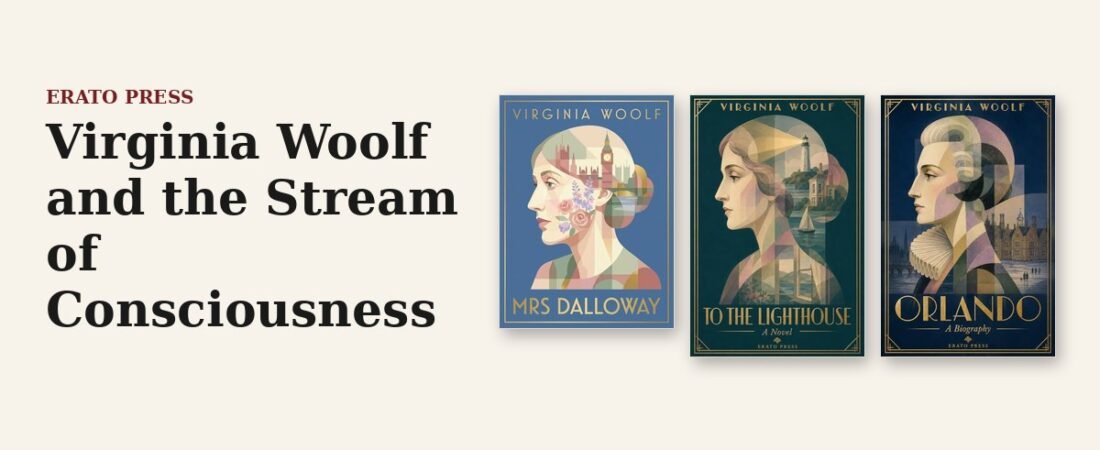
Short answer: “Stream of consciousness” sounds like a gimmick and is actually a discovery — and treating Woolf as a mere stylist is a way of keeping her safe. She was not a stylist but a demolitionist: her stream of consciousness, her dissolving narrators, her parenthetical deaths are not ornaments but structural critiques of everything the novel had assumed about who exists, who acts, and whose inner life is worth following through a single London day.
The problem Woolf set herself
Woolf believed the realist novelists of her day — Arnold Bennett and company — had got life exactly backwards. They described houses, incomes, furniture, clothes; they catalogued the outside of a person and called it character. But life, Woolf wrote, is not a series of gig-lamps symmetrically arranged; it is “a luminous halo, a semi-transparent envelope.” The real human being lives inside, in a ceaseless shower of impressions. A true novel would have to get in there — and to get in there, the old machinery had to be broken. What remains when you strip away the coherent self, the causal plot, and the omniscient narrator who stands above the fray dispensing understanding? What remains, Woolf found, is consciousness itself: not the self, which is a fiction of coherence produced under social pressure, but the raw, unceasing process of perceiving, remembering, anticipating.
Mrs Dalloway: time as a wound
“Mrs Dalloway said she would buy the flowers herself.” The first sentence contains the whole argument — the conditional would, the private determination before the world gets hold of it, the inner moment Woolf will inhabit for three hundred pages. In Mrs Dalloway, a single June day in 1923 London becomes vast because we live it from inside several minds at once, the narration gliding from one consciousness to another like a passing thought. Its boldest move is the twin narrative: Clarissa Dalloway, planning her party, and Septimus Warren Smith, a shell-shocked veteran, share the same city on the same day and never meet — bound not by relationship but by the simultaneity of Big Ben’s chimes, public time pealing over both. And the prose does not “flow” the way the lyrical reputation suggests; it is interrupted. A car backfires and Clarissa thinks of the war; the interruptions trace a precise map of what she cannot think directly — death, the war, a suppressed love, the choices that made her life. Time here is not a river but a wound: the present shot through with a past that could not be processed when it happened, surfacing now in the ordinary London morning.
To the Lighthouse: death in a bracket
If To the Lighthouse contains Woolf’s single most radical decision, it is not the stream of consciousness — it is the parenthetical death. The novel’s first part runs to nearly two hundred pages around Mrs Ramsay, the mother who holds the whole social world together. Then comes the ten-page central section, “Time Passes,” in which a decade and a war sweep through an empty, decaying house — and Mrs Ramsay dies inside a pair of square brackets, an aside, while the dust settles and the wallpaper peels. It is a formal argument about grief: that the most important things do not arrive as scenes but as ruptures in a continuity that goes on indifferently around them. The lighthouse itself is not, as it is lazily called, a symbol of hope; it is what persists when the meaning has been removed — a light that keeps sweeping out whether anyone is left to see it or not.
Not chaos, but composition
The common mistake is to think stream of consciousness means formlessness. The opposite is true. Woolf compresses where her contemporary Joyce expands — both published their great single-day novels in the same handful of years, but where Bloomsday dilates until it contains a whole city, Woolf’s interior flow is shaped with the precision of poetry: rhythms, repetitions, recurring images that bind a scattered day into a whole. She gives you the feeling of a mind wandering while controlling every step. That tension — between apparent spontaneity and total command — is her genius. And the same demolitionist works in comic key in Orlando, the mock-biography of a hero who lives four centuries and changes sex midway — a book that takes the novel’s most basic assumptions about identity and time and laughs them apart.
Where to begin
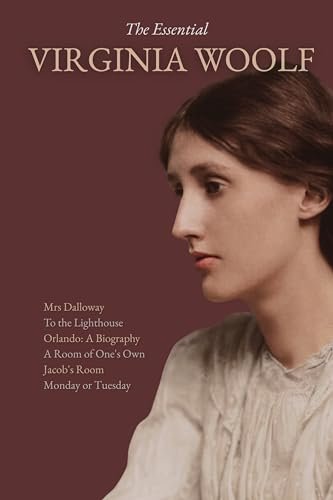
Start with Mrs Dalloway, then To the Lighthouse — her two perfect novels. Read slowly, and let the sentences carry you the way thought carries you. You’ll come out noticing the texture of your own consciousness, which no other writer renders so truthfully. The convenient way to have the whole sequence — Mrs Dalloway, To the Lighthouse, Orlando, and A Room of One’s Own — is The Essential Virginia Woolf.
Read the essential Virginia Woolf →
Related reading: Modernism Explained: A Reader’s Guide · Dubliners: The Best Way Into Joyce
This article draws on the original critical essay “The Art of Interruption,” written for the Erato Press edition. This article contains affiliate links; as an Amazon Associate, Erato Press earns from qualifying purchases.
Enjoyed this piece?
Get the next one — our essays on the classics and news of each new Erato Press edition — straight to your inbox.