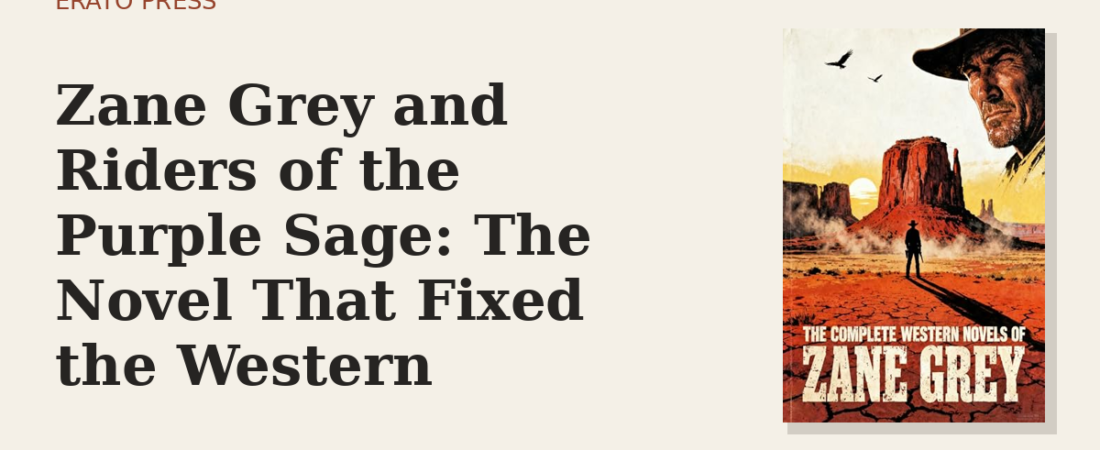
Close your eyes and picture a Western. The lone rider on the ridge, dressed in black, gun low on the hip. The vast sweep of red rock and sagebrush. The decent settler menaced by a corrupt power that hides behind respectability. The woman who owns land and the men who want to take it from her. The climax in which the hero seals himself and the woman he loves away from a fallen world. You are not picturing John Ford, or Sergio Leone, or any film at all. You are picturing Riders of the Purple Sage, the 1912 novel by Zane Grey that did more than any single work to fix the visual and moral grammar of an entire American genre. Before this book, the Western was a loose bundle of dime-novel conventions. After it, it had a face.

The landscape becomes a character
The first thing Grey fixed was the look — and “fixed” is the right word, because he was a painter in prose before he was anything else. The title itself is a piece of visual programming: purple sage, the color of distance and dusk laid across the Utah canyonlands. Grey had traveled the Southwest, and the novel is saturated with its geology — the sage slopes, the looming walls, the hidden valleys, the great stone arches. He does not use landscape as backdrop. He uses it as a moral and emotional field, vast enough to dwarf human schemes, sublime enough to make the reader feel the smallness of the men crawling across it.
This is the template that the Western film inherited wholesale. When Ford points his camera at Monument Valley and lets the buttes do the talking, he is filming what Grey wrote — the conviction that the American West is not a place where a story happens but a presence the story must answer to. Grey taught the genre that the landscape is the first character introduced and the last one standing, and that a hero is partly defined by his ease in country that would kill a lesser man. Every subsequent oater that opens on a wide vista of empty country is quoting Riders of the Purple Sage, whether it knows it or not.
Lassiter, and the invention of the gunfighter
Then there is the man in black. Lassiter rides into the novel as a figure of pure, controlled menace — dressed in black leather, two guns worn low and forward for the draw, a rider with a reputation that precedes him and a grievance that explains him. He is hunting the men responsible for the abduction and death of his sister, and his violence, however terrifying, is in the service of a wound. He is laconic where lesser men bluster. He is the deadliest man in the country and the gentlest toward the woman he comes to protect. He is, in short, the prototype of the gunfighter as the twentieth century would know him: Shane, the Man with No Name, every taciturn killer with a private code who drifts into a troubled place and sets it right with a gun he wishes he did not have to use.
What Grey gave the type, and what made it stick, was the fusion of lethality and restraint. Lassiter is dangerous precisely because he does not want to be dangerous; his self-command is the measure of his power. The gunfighter who shoots reluctantly, who would rather ride away, who is morally cleaner than the respectable men around him — that figure begins in earnest here. It is a deeply American fantasy: the redemptive outsider whose violence is legitimate because it is reluctant and personal rather than institutional. Grey built it, and the genre has been refining it for a hundred years. Set Lassiter beside the other founding heroes I survey in The Classic Western Novels Worth Reading and his influence is unmistakable: he is the one they all answer to.
The moral machinery: a hidden power and a woman’s land
The plot fixed something deeper than scenery and costume — it fixed the genre’s characteristic moral shape. Jane Withersteen is a wealthy young rancher in the Mormon settlement of Cottonwoods, and the pressure on her comes not from outlaws but from her own community’s hierarchy — an elder who wants her land, her cattle, and herself, and who deploys the full machinery of social and religious authority to get them. The villainy in Riders of the Purple Sage wears the mask of respectability. It is the powerful insiders, not the wild men outside the law, who are corrupt.
This inversion — the threat comes from established power, the rescue comes from the armed outsider — became the structural backbone of the Western. The decent landowner squeezed by a cattle baron, the homesteaders menaced by men with the sheriff in their pocket, the corrupt town that needs an outsider to clean it: all of it is prefigured here. And Grey placed a woman’s autonomy at the center of the conflict in a way the genre did not always honor afterward but never quite forgot. Jane’s struggle is to keep her property and her conscience against men who believe both belong to them. The Western’s enduring obsession with land, ownership, and the right to be left alone gets one of its sharpest early statements in her predicament.
The closed valley and the price of innocence
The novel’s famous ending is its strangest and most revealing gesture. Lassiter and Jane, with the orphaned child Fay, flee their enemies into the hidden refuge of Surprise Valley, and Lassiter rolls the great balancing stone — Balancing Rock — to seal the only entrance behind them, walling themselves into a green paradise cut off from the world. They are safe; they are also entombed. It is a stunning and ambiguous image: the Western hero achieves peace only by removing himself entirely from society, sealing the door, choosing innocence over the world.
That ambivalence is built into the genre Grey founded. The Western hero is forever a man who saves a community he cannot join, who restores an order that has no place for him, who must ride on or wall himself off because his usefulness is inseparable from his apartness. Shane rides away wounded; the Man with No Name vanishes; Lassiter rolls the stone. The dream of the West that Riders of the Purple Sage bequeathed to the twentieth century is double-edged — freedom and exile, salvation and self-burial, the open range and the sealed valley. Grey did not just give the Western its scenery and its hero. He gave it its melancholy.
Frequently asked questions
Is Riders of the Purple Sage the first Western novel?
No — Owen Wister’s The Virginian (1902) precedes it and has a strong claim to founding the literary Western. But Riders of the Purple Sage is the book that fixed the genre’s enduring visual and emotional grammar — the painterly landscape, the black-clad gunfighter, the respectable villain, the bittersweet ending — and Grey’s enormous popularity is what carried that template into the century of Western film.
Why is the villainy tied to a Mormon community?
Grey set the conflict inside a frontier Mormon settlement and made its religious-social hierarchy the source of the pressure on Jane Withersteen, which gave the novel a controversial edge in its day. The deeper structural point survived the specific setting: the genre learned from Grey that the most dramatically potent threat is corrupt established power wearing the mask of respectability, whatever form that power takes.
Does the novel hold up for modern readers?
Its prose is lusher and its melodrama more overt than contemporary taste expects, and some of its attitudes are very much of 1912. But its landscape writing remains genuinely thrilling, Lassiter is still a magnetic creation, and reading it is the closest thing to watching the DNA of every Western movie assemble itself on the page. For anyone who loves the genre, it is essential.
The Erato Press edition presents Grey’s foundational novel with an apparatus that traces exactly how it programmed a century of Westerns — the painterly geography, the genesis of the gunfighter type, the moral architecture of respectable villainy, and the haunting logic of that sealed valley — so you read it not as a period curiosity but as the blueprint it actually is. It is the edition for the reader who wants to see the myth being built.
Enjoyed this piece?
Get the next one — our essays on the classics and news of each new Erato Press edition — straight to your inbox.