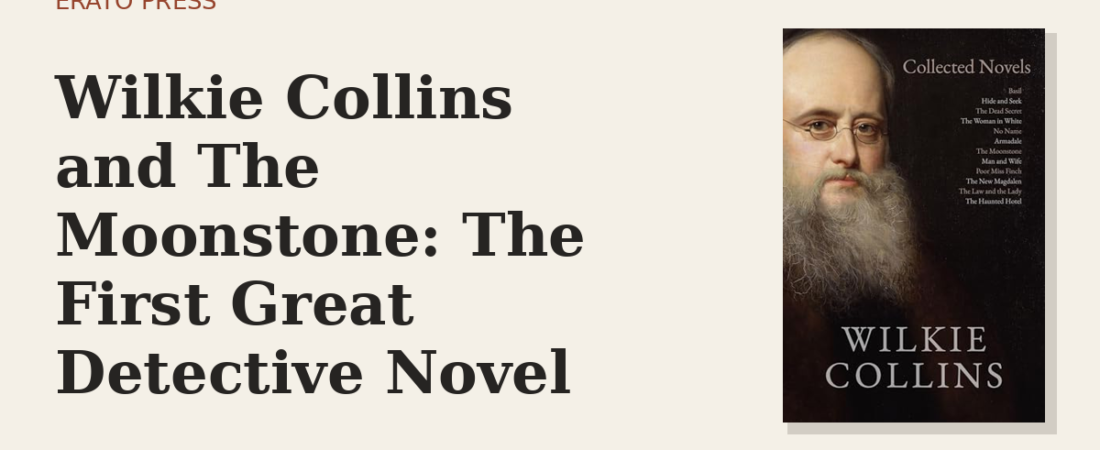
T. S. Eliot called it “the first, the longest, and the best of modern English detective novels,” and the verdict has held for a century and a half, which is awkward, because The Moonstone (1868) was written before the word “detective novel” meant anything at all. Wilkie Collins did not set out to invent a genre. He set out to write a sensation novel about a stolen diamond and a respectable English household quietly coming apart, and in doing so he assembled, almost casually, nearly every device the genre would spend the next hundred and fifty years refining: the country-house crime, the brilliant eccentric investigator, the red herring, the locked-room logic, the reconstruction of the crime, the least-likely culprit, the unreliable narration that turns the reader into a suspect along with everyone else. The astonishing thing is not that Collins did all this. It is that he did it before anyone had told him it was a formula.

A story told by the suspects
The first thing to understand about The Moonstone is its architecture, because the architecture is the genius. Collins does not tell the story. He has his characters tell it — in a sequence of written depositions, each narrator handling the stretch of events he or she witnessed directly, each forbidden to report what they could not personally have known. Gabriel Betteredge, the old house-steward who consults Robinson Crusoe the way other men consult scripture, opens the book and gives us the theft of the diamond on the night of Rachel Verinder’s birthday. Then the baton passes — to the sourly evangelical spinster Miss Clack, whose narrative is a small comic masterpiece of self-deception; to the lawyer Mr. Bruff; to Franklin Blake; to others.
This is not a stylistic flourish. It is the engine of suspense. Because each narrator knows only a fragment, the reader is forced to assemble the truth from partial, biased, mutually contradicting accounts — and to notice that everyone has a reason to shade their testimony. The form makes the reader a detective by necessity. And it quietly establishes a principle the genre would never abandon: that the most dangerous thing in a mystery is not a lie but a sincere witness who has misunderstood what they saw.
Sergeant Cuff and the birth of the professional detective
Into Betteredge’s orderly Yorkshire household Collins drops Sergeant Cuff, and English fiction is never quite the same. Cuff is lean, melancholy, devoted to the cultivation of roses, and possessed of a courteous indifference to the social rank of the people he investigates — which is precisely what makes him alarming to a respectable family that assumed crime was something that happened to other classes. He notices a smear of paint on a freshly decorated door and reasons outward from it with a precision that would become the signature gesture of every fictional detective who followed. He is wrong about the central question, as it happens — Collins is too sophisticated to make his detective infallible — but the manner is fully formed: the trivial physical detail elevated into evidence, the calm refusal to be impressed by appearances, the reading of a household as a text.
Cuff was partly drawn from a real Scotland Yard inspector, Jonathan Whicher, and that grounding matters. Collins was writing at the precise historical moment when the detective police were a new and faintly disreputable institution, when the idea that a salaried man might professionally suspect his social superiors was genuinely unsettling. The novel’s anxiety about who has the right to investigate whom is not incidental; it is part of what gives the book its charge. Compare him to the later masters and the lineage is unmistakable — a contrast I draw out in Sherlock Holmes vs Father Brown: Two Kinds of Detective, where the cold ratiocinator and the intuitive confessor split the inheritance Cuff left behind.
The crime no one is guilty of
Here is where The Moonstone stops being a clever entertainment and becomes something deeper. The solution — I will not spoil it for the reader who has somehow avoided it — turns on a possibility almost no Victorian mystery would have dared, and which most modern ones still shy from: that the culprit committed the crime without intent, without memory, and without guilt in any sense the law could prosecute. The theft of the diamond is real, the disappearance is real, the suffering it causes is real, and yet there is, in a strict sense, no criminal. Collins reaches this through a mechanism rooted in the medicine of his own era — he was himself a lifelong sufferer chained to laudanum, and the novel’s pharmacology is written from the inside.
This is a profound move. It detaches the mystery from the morality play. A lesser writer uses crime to confirm that the world is divided into the wicked and the innocent; Collins uses it to suggest that the line runs through people, not between them, and that a respectable man may do a terrible thing in a state for which “responsibility” is the wrong word. The detective novel as a form has spent a century and a half trying to recover the moral subtlety Collins built in on the first attempt.
The diamond and the empire
And there is a further dimension the genre took far longer to catch up with. The Moonstone is not a generic jewel. It is a sacred Hindu diamond, looted from the forehead of a temple idol during the storming of Seringapatam in 1799 by an English officer whose violence the novel frames as exactly that — theft, sacrilege, plunder. Three Brahmin guardians pursue the stone across England with patient, dignified menace, and Collins, remarkably for 1868, lets the reader feel that their claim is the just one. The “crime” the detectives investigate is nested inside a far larger crime that English society has agreed not to call a crime at all: imperial loot. When the diamond finally returns to India, restored to the god’s forehead in the novel’s last pages, Collins has quietly inverted the whole moral economy of the book. The English household was never the victim. It was the receiver of stolen goods.
That this critique sits inside a page-turner about a country-house theft is the measure of Collins’s achievement. He gave the detective novel its machinery and, in the same breath, demonstrated that the machinery could carry weight — psychological, moral, political — that no one suspected it could bear.
Frequently asked questions
Is The Moonstone really the first detective novel?
It depends on how you count. Poe’s Dupin stories (from 1841) come earlier and invented the ratiocinative detective in short form, and Collins’s own The Woman in White precedes it. But The Moonstone is the first full-length English novel to assemble the complete apparatus of the genre — investigator, suspects, clues, red herrings, reconstruction, surprise solution — into a sustained narrative. Eliot’s “first and best” verdict refers to that synthesis, and it is fair.
Is the multiple-narrator structure hard to read?
It is the opposite of hard — it is the reason the book moves. Each voice is so distinct (the Crusoe-quoting steward, the unctuous Miss Clack) that the shifts feel like changes of company rather than changes of method, and the comedy of biased testimony keeps even the slower stretches alive. Collins was a master of pace before pace was a craft term.
How does it compare to The Woman in White?
The Woman in White is the greater thriller of pure dread; The Moonstone is the greater feat of construction. If you want Collins at his most heart-stopping, start with the earlier book; if you want to watch a genre being born, start here. Most readers, having read one, immediately read the other.
The Erato Press edition gives you Collins’s intricate machine with the editorial apparatus it deserves — the historical context of Seringapatam and the new detective police, the medical reality behind the novel’s central device, and an introduction that traces how thoroughly this one book programmed a genre. It is the edition for the reader who wants not just the mystery but the architecture beneath it.
Enjoyed this piece?
Get the next one — our essays on the classics and news of each new Erato Press edition — straight to your inbox.