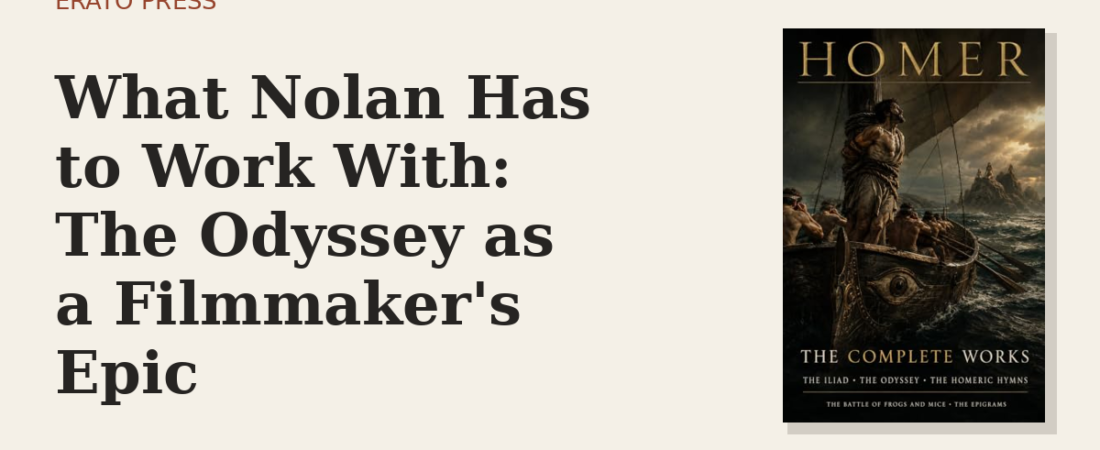
When Christopher Nolan announced that his next film, due in 2026, would be The Odyssey, the reaction told you something about how little most people remember the poem and how much they remember the brand. There was talk of the cast, of the shooting in IMAX 70mm, of which star would play which monster. There was much less talk about the thing itself — about what a director who has spent a career bending time and staging the unfilmable actually finds when he opens Homer. Because the truth is that the Odyssey is, in some respects, the most cinematic poem in the Western canon, and in other respects almost defiantly resistant to a camera. It is worth saying plainly which is which, because the gap between them is exactly where this adaptation will succeed or fail.

The structure is already a Nolan film
Start with the gift, because it is enormous. The popular image of the Odyssey is a straight line of adventures — Cyclops, then Sirens, then home. The poem is nothing of the kind. Homer opens in medias res, in the middle of things, with Odysseus already stranded on Calypso’s island and his son’s world collapsing back in Ithaca. The famous adventures — the Lotus-Eaters, Polyphemus, Circe, the descent to the dead, the Sirens, Scylla and Charybdis, the cattle of the Sun — do not happen in the present tense of the poem at all. They are a flashback, narrated by Odysseus himself, four books deep, to the Phaeacian court in Books 9 through 12. The hero tells his own past as a story, to an audience, knowing it makes him a legend even as he speaks.
A director who built Memento backwards, who nested dreams within dreams in Inception, who ran three timelines at different speeds through Dunkirk, did not have to invent a structure for this material. Homer handed him one three thousand years ago: a frame narrative in which the protagonist is also the narrator, in which the most spectacular sequences are explicitly memory, and in which the question of whether the teller is reliable hangs over everything — because Odysseus is a famous liar, and the Phaeacians are the only witnesses to his most fantastic claims. The poem’s deepest subjects are time and memory and the unreliability of the man telling you what happened. It is difficult to name a living filmmaker whose obsessions fit a source text more snugly.
What hands itself to the camera
Beyond the architecture, the poem offers a director several things that practically demand to be filmed, and that reward a filmmaker committed, as Nolan is, to the physical over the digital. The monsters are the obvious case. The Cyclops is not a vague horror; he is a specific, almost domestic nightmare — a giant in a cave with his cheeses and his lambs, who eats two men at a sitting and is defeated by a sharpened stake heated in a fire and a false name, Outis, “Nobody.” That is a set, a practical creature, a sequence of physical actions you can build and light and shoot in a real space. The same is true of the whirlpool Charybdis and the six-headed cliff-dweller Scylla, of Circe’s hall where men become swine, of the raft Poseidon shatters plank by plank in one of the great storm sequences in literature. This is a poem of weather and water and rock, of things that happen to a body in the world, and it was written by someone with an almost tactile sense of how a ship moves and how a man drowns.
Then there is the homecoming, which is the half of the poem nobody mentions in the trailers and which is, dramatically, the richer half. Odysseus returns to Ithaca disguised as a beggar and spends the back third of the epic watching — watching his wife, his son, his loyal swineherd, the suitors who have colonized his house, the maids who have betrayed it. He is present and unrecognized, gathering information, choosing his moment, governing a face that must not show what he knows. That is suspense in its purest form, the audience holding a secret the characters do not, and it culminates in two of the most filmable scenes imaginable: the old nurse Eurycleia recognizing him by the scar on his thigh while washing his feet, a recognition he must physically silence; and the contest of the bow, in which the disguised king strings the weapon no suitor could bend and turns it on the room. Disguise, recognition, withheld identity, violence held back until it breaks — this is cinema’s native grammar, and Homer is fluent in it.
What no camera has ever solved
And now the hard part, which the publicity will not mention. Three things in the Odyssey have defeated every previous adaptation, and there is no reason to assume technical mastery will overcome them.
The first is interiority. The poem’s center of gravity is inside Odysseus — his calculation, his restraint, his grief, the way he weeps in private and lies in public. Film shows the outside of people. Homer can tell us, in a single line, that the hero’s heart growled within him like a dog standing over her pups, and that he struck his chest and rebuked it and held still; a camera can show a face, but it cannot show the rebuke, the act of a mind mastering itself. The most “internal” film is still external, and the Odyssey is a study in what a man does not do, which is the one thing the camera cannot photograph.
The second is the gods. In Homer, Athena is not a special effect; she is a presence woven through every decision, appearing as a girl, a herdsman, a swallow on a roof-beam, lending courage, clouding the suitors’ minds, standing invisibly beside her favorite. The divine machinery is not decoration — it is the poem’s theology, its model of how inspiration and luck and intelligence feel from the inside, as if a goddess were at your elbow. Put Athena on screen as a literal figure and she becomes fantasy spectacle; leave her out and the poem loses its nervous system. Every adaptation founders here, and the choice Nolan makes about the gods will define his film more than any monster.
The third is simply the poetry. The Odyssey is, before it is a story, a sound — dactylic hexameter, the rosy-fingered dawn, the wine-dark sea, the epithets and repetitions that were the engine of oral performance and that carry the poem’s music and its strange, formal serenity even in the bloodiest scenes. No image replaces that. A film can be faithful to the events of the Odyssey and capture nothing of why it is the Odyssey, because what it is lives partly in the line, in the meter, in a voice. This is the permanent humility every adaptation owes the original: the best a film can do is send you back to the page.
Why the source still wins
None of this is an argument against the film. A great director wrestling with great material is its own event, and the parts of the poem that suit the screen — the nested flashback, the practical monsters, the long, coiled suspense of the disguised return — could make for something extraordinary. But the lesson points one direction. The closer a viewer comes to the poem, the more they will get from any adaptation, and the more they will see what the adaptation had to leave behind. The conversation around the casting, the IMAX format, and what fidelity to Homer even means has already been mapped out in our coverage, Christopher Nolan’s Odyssey: The Casting Backlash, the Trailer, and the Only Faithful Adaptation — and the conclusion there is the one this essay arrives at too: the only fully faithful version of the Odyssey is the Odyssey, and it is sitting on the shelf waiting, costing nothing but attention.
Frequently asked questions
Is the Odyssey actually structured like a flashback?
Yes. The poem begins in the present, with Odysseus stranded and Ithaca in crisis, and the famous adventures — Cyclops, Circe, the Sirens, the underworld — are told by Odysseus himself as a retrospective narration to the Phaeacians in Books 9 through 12. That frame, in which the hero recounts his own past to an on-page audience, is far closer to modern film structure than most readers expect, and it is the feature of the poem best suited to a director like Nolan.
What part of the Odyssey is hardest to film?
The interiority and the gods. Odysseus’s defining trait is self-restraint — the grief and rage he hides behind a controlled face — and a camera can only show the surface a character chooses to present. The gods, especially Athena, are woven invisibly through every scene as the poem’s model of inspiration and fate; rendered literally they become spectacle, and removed entirely they take the poem’s logic with them. And no film can reproduce the hexameter that makes the poem sound like itself.
Should I read the Odyssey before seeing the Nolan film?
Strongly yes. Any adaptation compresses, omits, and reinterprets, and you will only see what it has done — its choices about the gods, the flashback frame, the homecoming — if you know the source. Reading the poem first turns the film from a spectacle you watch into a conversation you can follow, and it gives you the half of the story, the long disguised return to Ithaca, that trailers rarely show.
The Erato Press edition presents the Odyssey complete and annotated alongside the rest of Homer, with the kind of notes that show you exactly where the flashback frame opens and closes, how the recognition scenes are built, and what Athena is doing in scenes where she is never named — everything an adaptation has to negotiate, laid bare on the page. Before the lights go down in 2026,
Read the Erato Press edition →
.Enjoyed this piece?
Get the next one — our essays on the classics and news of each new Erato Press edition — straight to your inbox.