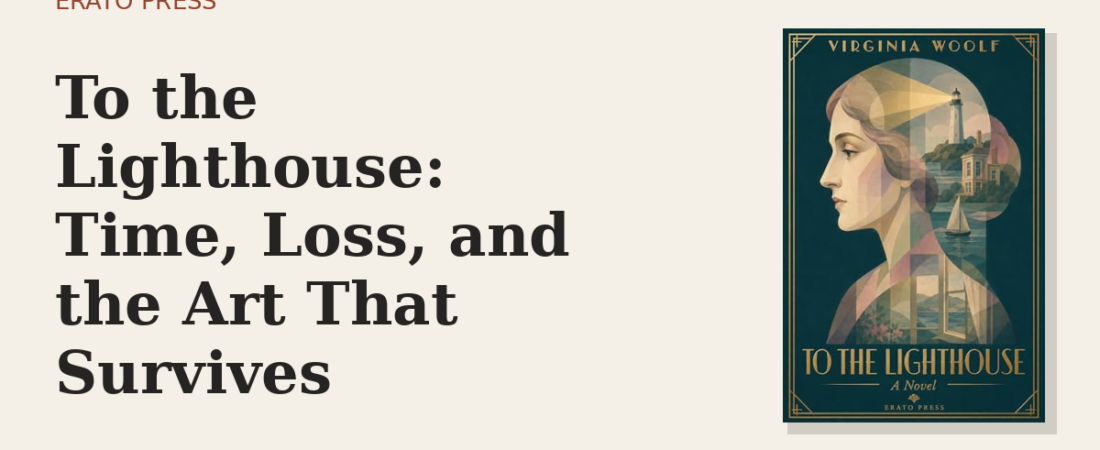
A family and their guests spend a day in a summer house by the sea, and a small boy is promised a trip to the lighthouse across the bay that the weather will not permit. That is nearly the whole “plot” of To the Lighthouse (1927), Virginia Woolf’s most profound novel and, many think, her finest. For what she does with that thread is extraordinary: she uses it to hold time itself in her hands — to show a single day rendered in the fullness of consciousness, then a decade of loss compressed into a dozen haunting pages, then the day’s small promise finally, achingly kept. It is the great novel of time and grief, and of the strange power of art and love to hold, for a moment, against the tide that carries everything away.

The three movements
The novel is built like a piece of music in three parts. “The Window” gives us a single evening at the Ramsays’ house before the First World War — Mrs Ramsay, luminous and maternal, presiding over her family and guests, holding the fragile human world together by sheer force of love, in a long day rendered entirely from within the flowing thoughts of a dozen minds. “Time Passes” then does something no novelist had done: it lets ten years rush through the empty, decaying house in a few pages of astonishing prose, and reports, almost in passing, in brackets, the deaths — Mrs Ramsay’s, a son’s in the war, a daughter’s in childbirth — as if time itself were narrating, indifferent to the human losses it sweeps up. And “The Lighthouse” returns the survivors to the house years later, to make at last the journey that was promised, and to complete, in an act of art, what the years have broken.
The bracketed deaths
Nothing in modern fiction is more devastating than Woolf’s handling of death in the middle section. Mrs Ramsay, the radiant center of the first part, on whom the whole human warmth of the book depends, simply dies — and Woolf reports it in a subordinate clause, in square brackets, almost as an aside, while the main sentence goes on describing the empty house. The technique is the meaning: this is how time and the universe regard our losses — as brackets, as asides, while the indifferent world goes on. And yet the very shock of that indifference makes us feel the value of what is lost with an intensity no deathbed scene could achieve. It is the same doubled vision — the preciousness of life set against the vastness that erases it — that animates all of Woolf’s greatest work, the ground our essay on Mrs Dalloway explores from another angle.
Lily Briscoe and the redemption of art
Against time’s erasures Woolf sets one fragile counterforce: art. Lily Briscoe, the painter who could not finish her picture in the first part, returns in the last and, as the boat reaches the lighthouse, completes it — draws a single line in the center, and thinks, “I have had my vision.” The painting will be hung in attics, forgotten, lost; but for a moment it holds the chaos in form, makes something that stands against the flux, as Mrs Ramsay made a perfect dinner that dissolved the moment it ended and yet was real. Woolf’s deepest faith, wrung from her own knowledge of loss and mental darkness, is that these acts of making — a painting, a marriage, a meal, a novel — are how mortal beings answer the indifference of time: not by defeating it, but by shaping, for an instant, something whole. It is one of the summits of modernist art.
Why read it now
Because it is the most beautiful thing ever written about the passage of time and the survival of love — and because its central experiences, the loss of the people who held our world together and the search for something that lasts, are the permanent human experiences. It asks patience with its method and repays it more richly than almost any novel, growing deeper on every reading. Short, luminous, and unforgettable.
Frequently asked questions
Is To the Lighthouse or Mrs Dalloway the better place to start?
Mrs Dalloway is slightly more accessible; To the Lighthouse is more profound. Either is a superb introduction to Woolf. Many readers find the second more emotionally overwhelming once they have adjusted to her method.
What actually happens in the book?
Very little, by conventional measure — a day before the war, the passage of ten years, and a boat trip after. The events are inward: the flow of thought, the experience of time, the work of grief and art. The lack of plot is the point.
Why the brackets around the deaths?
Woolf reports the major deaths in brief bracketed asides during the “Time Passes” section to dramatize time’s indifference to human loss — and, paradoxically, to make that loss hit harder. It is one of the most discussed techniques in modernist fiction.
Read the Erato Press edition →
and watch art hold, for a moment, against the passing of everything.
Enjoyed this piece?
Get the next one — our essays on the classics and news of each new Erato Press edition — straight to your inbox.