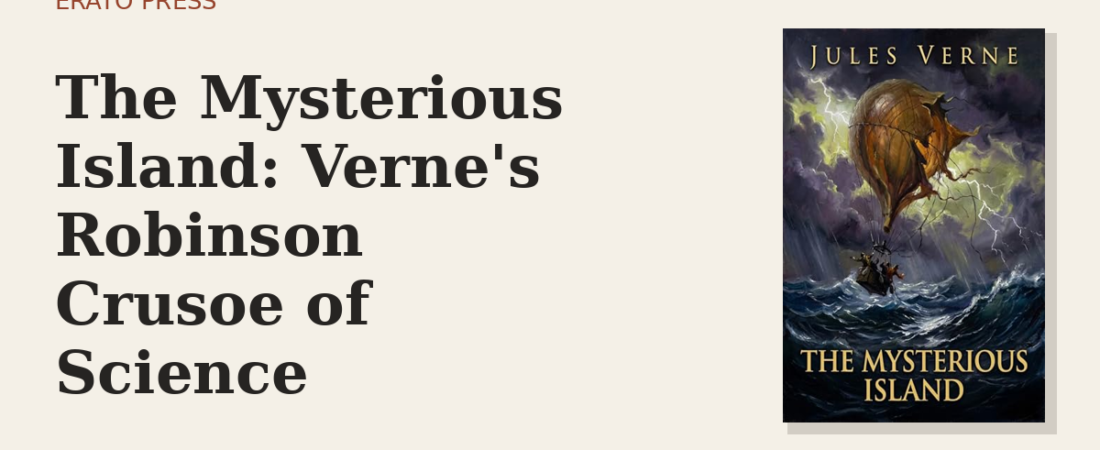
Five men and a dog, escaping a siege in a hot-air balloon, are blown across the world and cast up on an uncharted Pacific island with nothing — no tools, no supplies, no hope of rescue. And then, over the course of Jules Verne’s great survival epic, they rebuild civilization itself, from the ground up: making fire, pottery, iron, glass, nitroglycerine, a telegraph, an entire working society, by the sheer application of knowledge and will. The Mysterious Island (1874) is Verne’s Robinson Crusoe for the scientific age — a hymn to human ingenuity and cooperation — and it hides, at its center, one of the great secrets in adventure fiction, the resolution of a mystery Verne had left dangling across two earlier books.

Civilization from first principles
The engine of the novel is the deep pleasure of watching intelligent, cooperative people solve problems. Led by the engineer Cyrus Smith — a walking encyclopedia of practical science — the castaways face each need in turn and meet it with knowledge: how to find their position without instruments, how to smelt iron from ore, how to make bread, how to build a home in the cliffs, how to survive and then to thrive. Verne, the great popularizer of science, turns the survival story into an education, and a deeply optimistic one: his island is not a place of savagery and despair but a blank page on which reason and work write a small, hopeful civilization. It is the Enlightenment faith in human capability turned into an adventure story, and it has thrilled and instructed generations of young readers into a love of how things actually work.
The unseen benefactor
But something strange is happening on the island. At moments of ultimate danger, the castaways are saved by an unseen hand — a mysterious benefactor who watches over them, intervenes at the crucial instant, and leaves them wondering whether the island itself is enchanted. Verne sustains the mystery masterfully across the whole book, and its solution is one of the great reveals in nineteenth-century fiction: the guardian is Captain Nemo, the tormented genius of Twenty Thousand Leagues Under the Seas, aged and dying, his submarine hidden in a grotto beneath the island, watching over the little colony as his last act in a world he had renounced. The scene of Nemo’s death — the rebel of the deep, at the end, reconciling himself to the humanity he had fled — gives the adventure a sudden depth and closes the great trilogy Verne had woven across his career.
The optimism of the machine age
Where later castaway stories would turn dark — the island as a place where civilization’s veneer cracks — Verne’s island is the opposite: a place where human beings, using reason and standing together, build something good out of nothing. It is the purest expression of his lifelong faith in science, progress, and cooperation, the sunny counterpart to the darker imagination our essay on Wells explores. In an age that often doubts whether knowledge makes us better, Verne’s confident hymn to the problem-solving mind is bracing and even moving.
Why read it now
Because it is the most satisfying survival adventure ever written and a genuine celebration of human ingenuity — the book that has made more young readers curious about how the physical world works than any textbook. Long, generous, and full of wonder, it rewards the whole family, and its hidden connection to Nemo gives it an emotional resonance few adventure stories reach.
Frequently asked questions
Do I need to read Twenty Thousand Leagues first?
It enriches the experience — the island’s secret benefactor is Captain Nemo — but The Mysterious Island stands on its own as a complete adventure. Reading Nemo’s story first makes the revelation land harder.
Is it educational?
Delightfully so. Verne turns the castaways’ survival into a practical course in applied science — smelting, chemistry, engineering — woven so naturally into the adventure that readers absorb it without noticing. It has inspired countless scientists and engineers.
Is it good for younger readers?
Yes — it is one of the great cross-generational adventures, thrilling and wholesome for teens while its ingenuity and its Nemo subplot reward adults. A perfect family classic.
Read the Erato Press edition →
and watch five castaways build a world from nothing.
Enjoyed this piece?
Get the next one — our essays on the classics and news of each new Erato Press edition — straight to your inbox.