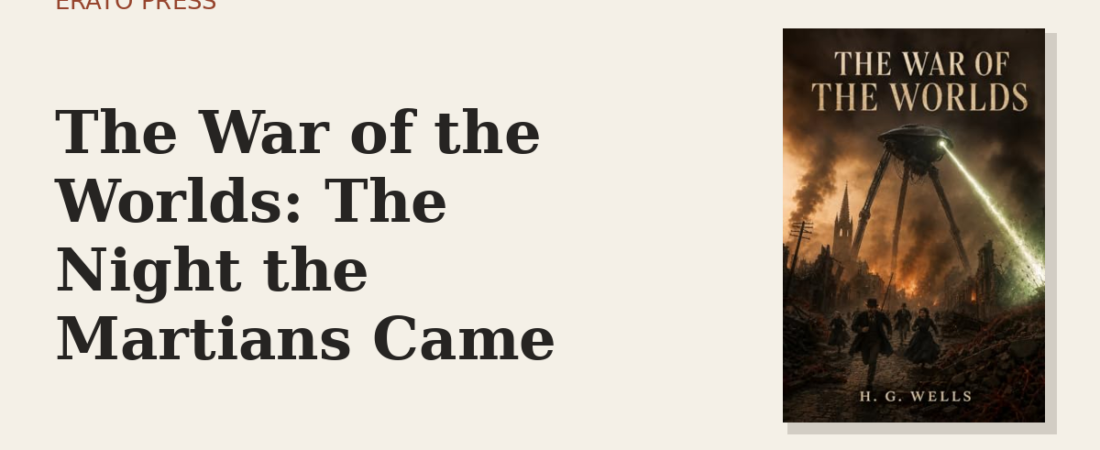
In 1898, H.G. Wells did something no one had done: he imagined the Earth invaded by beings from another planet — cool, vast, and unsympathetic intelligences that cross space in cylinders and lay waste to the greatest empire on Earth with weapons against which its armies are helpless. The War of the Worlds invented the alien invasion, one of the most durable stories our civilization tells itself, and it did so with a brilliance and a bitterness that its countless imitators rarely match. It is a thrilling catastrophe and, beneath the thrill, a savage piece of moral judgment — the empire that had conquered the world made, for once, to feel what conquest is like from below.

The empire conquered
Wells’s masterstroke is the setting: not some distant frontier but the comfortable suburbs of Victorian London, the heart of the mightiest empire in history, going about its ordinary business when the Martians land on Horsell Common. And then the unthinkable — the Martian heat-ray, the towering fighting-machines, the black smoke, the roads clogged with refugees, the collapse of civilization in a week. Wells, a socialist with no love for imperial complacency, wrote the book partly as a deliberate reversal: the British had exterminated peoples across the globe in the name of a superior civilization, and here he turns the telescope around, subjecting England to exactly the treatment it had dealt out. “Before we judge them too harshly,” his narrator says of the Martians, “we must remember what ruthless and utter destruction our own species has wrought” upon other peoples and creatures. The alien invasion is, from the first, a mirror.
Science as nightmare and wonder
Wells was trained in biology under Darwin’s great champion Huxley, and the novel thinks like a scientist. The Martians are not fairy-tale monsters but a plausible evolutionary extrapolation — great brains and grasping hands, having shed the bodies evolution no longer needed, feeding on the blood of other creatures, a chilling vision of where intelligence untethered from feeling might lead (and a warning about what humanity itself might become). And the ending is the purest Darwinian irony: the Martians, having defeated all our weapons, are destroyed by the smallest things on Earth — bacteria, against which they have no immunity, “slain, after all man’s devices had failed, by the humblest things that God, in his wisdom, has put upon this earth.” It is science fiction’s first and still one of its greatest reversals, life itself, not human heroism, saving the world.
The birth of a genre
Nearly every alien-invasion story since — the films, the novels, Orson Welles’s panic-inducing 1938 radio broadcast that convinced thousands the Martians had really landed — descends from this slim book. Wells, in a handful of years around the turn of the century, more or less invented modern science fiction, and his imaginative reach is charted in our essay on Wells, the man who invented the future. The War of the Worlds is the template’s origin: the ordinary world shattered by a superior force, humanity humbled, and the uncomfortable suggestion that we are not the masters of creation we imagine.
Why read it now
Because it is the original and still one of the best of all invasion stories — fast, vivid, and genuinely frightening — and because its real subject, the arrogance of a civilization sure of its own supremacy until something stronger arrives, has only grown more resonant. Short and gripping, it is science fiction being born fully formed, with a moral intelligence most of its descendants forgot.
Frequently asked questions
Is The War of the Worlds dated?
Its Victorian setting is period, but the storytelling is remarkably modern — swift, cinematic, and tense — and its themes of imperial arrogance and humanity’s fragile supremacy are entirely current. It reads far faster than its age suggests.
What is the ending about?
The Martians, unbeatable by human weapons, are killed by Earth’s bacteria, to which they have no immunity — a Darwinian irony that saves humanity by chance, not heroism, and undercuts any comfortable idea of human mastery. It is one of science fiction’s great reversals.
What about the 1938 radio panic?
Orson Welles’s Halloween broadcast dramatized the novel as fake news bulletins, and some listeners reportedly believed a real Martian invasion was underway — a testament to how plausibly Wells grounded his catastrophe in the ordinary world.
Read the Erato Press edition →
and watch the empire learn what conquest feels like.
Enjoyed this piece?
Get the next one — our essays on the classics and news of each new Erato Press edition — straight to your inbox.