
T. S. Eliot called it ‘the first, the longest, and the best of modern English detective novels.’ Long before Sherlock Holmes, Wilkie Collins wrote The Moonstone — and invented, almost single-handedly, the machinery every mystery has used ever since.
A great yellow diamond, looted from an Indian temple, is bequeathed to a young Englishwoman and vanishes from her bedroom on the night of her birthday. Around that theft Collins assembles the whole toolkit of the genre for the first time: the brilliant, eccentric detective (Sergeant Cuff, who would rather tend his roses); the bungling local police; the red herrings; the locked-room puzzle; the least likely suspect; the reconstruction of the crime. Everything the detective story would become is here in embryo.
But Collins does something later mysteries often forget: he tells it through a chorus of unreliable narrators, each recounting the part they saw, each betraying more than they mean to. And he laces the whole with a sharp critique of empire — the diamond is stolen property, and its curse is really the guilt of colonial plunder following it home to England. It is a page-turner with a conscience.
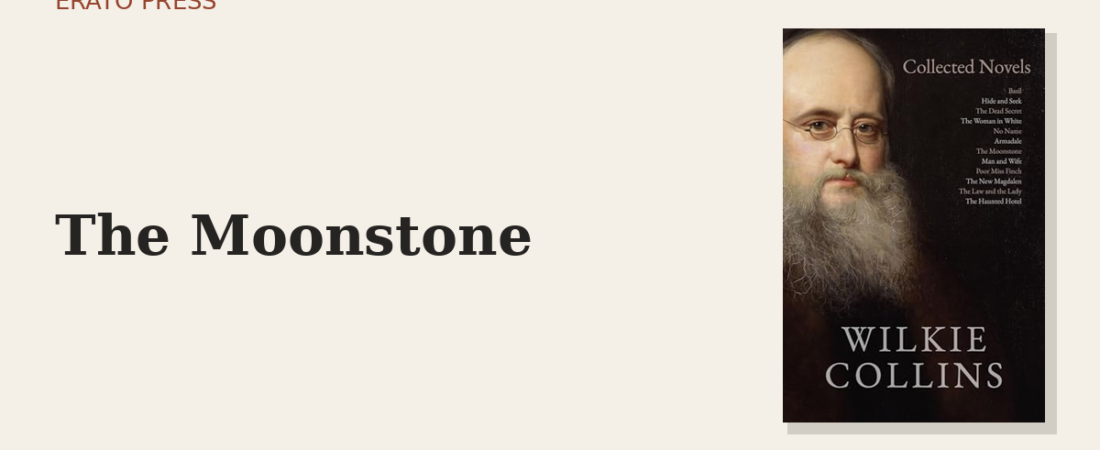
This edition gathers The Moonstone among the collected novels of Wilkie Collins, the master of the Victorian sensation novel.
Read The Collected Novels of Wilkie Collins →
Enjoyed this piece?
Get the next one — our essays on the classics and news of each new Erato Press edition — straight to your inbox.