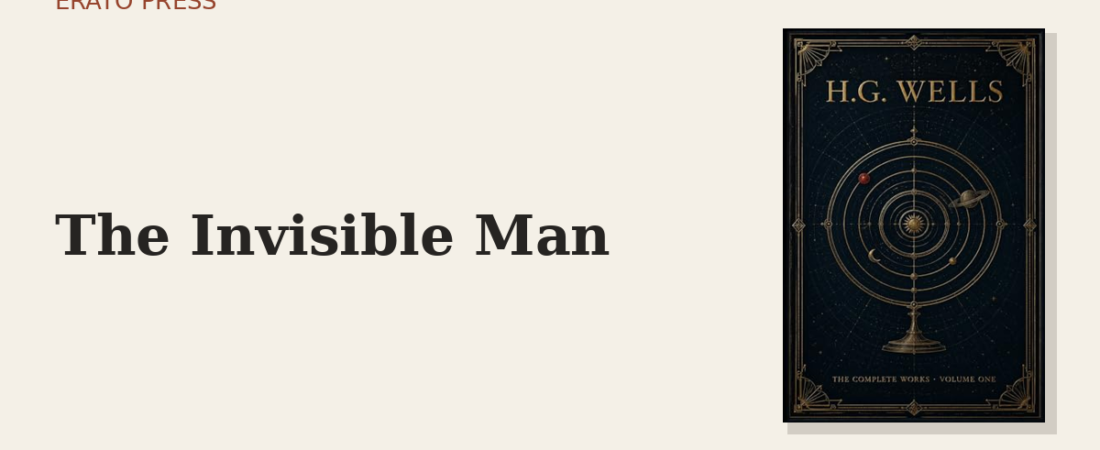

A stranger swathed in bandages arrives at a village inn in winter, and refuses to show his face. When at last he does, there is nothing there. H. G. Wells’s The Invisible Man takes a schoolboy fantasy — what if no one could see you? — and turns it, with terrible logic, into a study of what power does to a man who thinks he will never be caught.
Griffin, the scientist who has made himself invisible, discovers too late that the gift is a trap: he cannot eat without his food showing, cannot sleep safely, cannot walk in snow or rain without leaving himself visible. But the deeper trap is moral. Freed from the one thing that keeps most people honest — the fear of being seen — he slides swiftly from petty theft to assault to dreams of a ‘Reign of Terror.’ Invisibility does not make him free; it strips away the last restraint on what he already was.
It is the old question of the Ring of Gyges, which the Greeks first posed: would you be moral if you knew you would never be caught? Wells’s answer, like Plato’s, is unsparing. The invisible man is every one of us, tempted by the fantasy of consequence-free power — and a warning about where it leads.
This edition gathers it among Wells’s complete works, with The Time Machine.
Read H. G. Wells: The Complete Works, Volume One →
Enjoyed this piece?
Get the next one — our essays on the classics and news of each new Erato Press edition — straight to your inbox.