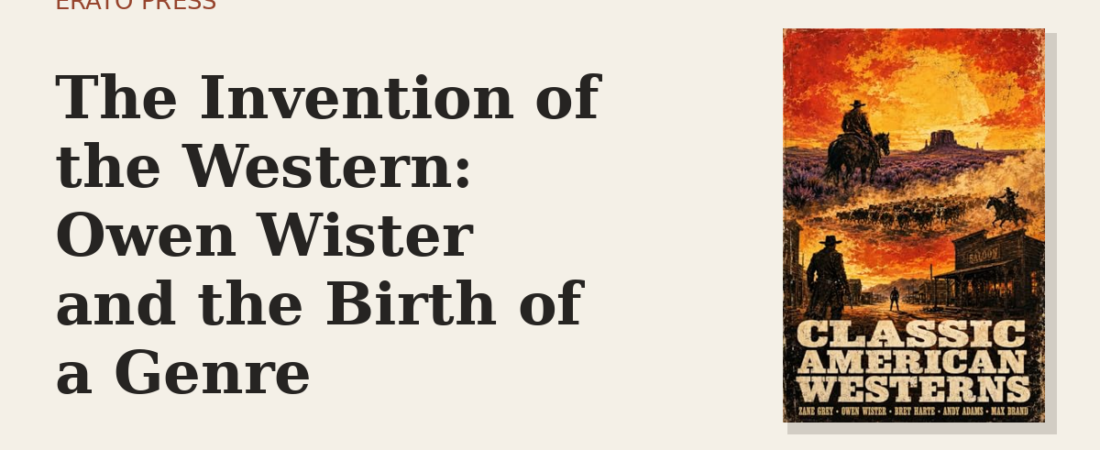
Every genre has a founding document, a single book in which the conventions that will harden into formula are first assembled and made to seem inevitable. For the Western, that book is Owen Wister’s The Virginian: A Horseman of the Plains, published in 1902. It is worth being precise about the claim. The Virginian is not the best Western novel ever written, and Wister was not the first American to set fiction in the cattle country. But no other book did more to invent what we now mean by the word “Western” — the laconic cowboy hero, the showdown at high noon, the schoolmarm from back East, the code of honor enforced by the gun rather than the court. The argument of this essay is that Wister’s novel matters less for its quality than for its generativity: it laid down the templates that every subsequent writer of Westerns would inherit, imitate, or rebel against, and it did so in order to win a quiet ideological argument about who, in a modernizing America, deserved to rule.

A Philadelphia aristocrat goes West
Wister was an unlikely father for the cowboy myth. He was a Harvard-educated Philadelphia gentleman, a friend of Henry James and of Theodore Roosevelt, a man of inherited social privilege who first traveled to Wyoming in the 1880s for the sake of his fragile health. Like many neurasthenic young men of his class, he expected the open range to cure him — and came away convinced it had transformed him. He kept detailed Wyoming journals, and he brought to his fiction a documentary impulse, a determination to make the East understand what he had seen on the cattle ranches before that world vanished. This is the crucial point about Wister’s motive: he was not merely entertaining readers. He was using the Western material to argue for a set of values he believed modernization was destroying.
The timing was not accidental. The U.S. Census Bureau had declared the frontier officially closed in 1890; three years later, in 1893, the historian Frederick Jackson Turner delivered his famous lecture arguing that the frontier experience had been the decisive force shaping American democratic character — and implying that its disappearance now threatened that character. Wister wrote into precisely this anxiety. The Virginian arrived in the aftermath of the Haymarket affair, the Pullman Strike, and the rise of organized labor, amid nativist alarm over mass immigration from southern and eastern Europe and unease at the new fortunes industrialization was minting. The cowboy hero, in this climate, was not idle entertainment. He was an argument — a fiction with cultural work to do.
“When you call me that, smile”
The genre’s grammar is laid down in the book’s most famous scene. Early on, the unnamed hero — always “the Virginian,” identified only by his region, a man of obscure origin who is type rather than individual — is dealt an insult across a card table by his rival, the cattle thief Trampas. Quietly, the Virginian lays his pistol on the table and answers: “When you call me that, smile.” The line became so famous it migrated out of the novel and into the common speech of a century. What it encodes is the whole Western ethic of the man whose honor is legible in his composure under pressure, who carries his law inside him and does not need a court to enforce it. That morality — you are what you do, not what you profess — Wister inherited directly from Bret Harte’s gambler John Oakhurst in “The Outcasts of Poker Flat” (1869). The Virginian, one might say, is Oakhurst given a horse, a range, and a rifle. The genealogy of the silent man of action runs straight from Harte’s mining camps to Wister’s Wyoming, and most later Western writers were, without knowing it, still arguing with Bret Harte.
The plot tightens that ethic into a series of trials. The Virginian must take part in the lynching of his old friend Steve, caught rustling cattle — a scene Wister stages not as villainy but as the grim necessity of frontier justice, the code costing the hero the thing he loves. And the book builds toward the climactic walk-down: on the eve of his wedding, the Virginian meets Trampas in the empty street at sundown, draws faster, and kills him. The showdown at high noon, that endlessly reproduced ritual of single combat in an empty street, is essentially Wister’s invention. Hollywood would replay it ten thousand times.
The schoolteacher and the natural aristocrat
If the gunplay is the genre’s surface, its engine is the romance — and the romance carries the ideology. The Virginian courts Molly Wood, a Vermont schoolteacher who has come West bringing the full apparatus of Eastern respectability: education, family connection, the conviction that social position matters. Their courtship is long and troubled by the gulf between them, and the resolution is pointed. The Virginian wins Molly not by climbing to her cultural level but by demonstrating, through one crisis after another, that his character is finer than any social criterion she can apply. He is unlettered and of unknown birth, yet he teaches himself to read and to love literature; he is, in the novel’s logic, a natural aristocrat — superior not because of where he came from but because of what he intrinsically is.
This is the book’s deep argument, announced in the very subtitle’s paradox of a hero both democratic and aristocratic, both a man of the people and a born superior. Wister’s Judge Henry, the hero’s employer and mentor, delivers the manifesto: “Let the best man win! That’s America’s word. That’s true democracy.” But this is not democracy as equal political rights. It is democracy as meritocracy — the doctrine, conveniently flattering to those who already believe themselves the naturally excellent, that intrinsic quality should outrank the accidents of birth and education. The novel naturalizes hierarchy by recasting it as a matter of inner worth, and Wister presents the whole construction with such good faith that the ideology is easily mistaken for plain observation.
What the myth left out
It is worth reading The Virginian with one’s eyes open to what it omits. Wister’s Wyoming is populated almost entirely by white men; the few non-white figures receive casual condescension. This whitening of the frontier is not incidental but constitutive of the myth — the West as a stage for democratic self-realization requires, for its ideological coherence, a homogeneously white cast. The historical reality was otherwise: Black cowboys are estimated to have made up somewhere between fifteen and twenty-five percent of the cattle-drive workforce, alongside the Spanish colonial inheritance of the vaquero, the Native peoples whose land it was, and the Chinese laborers who built the railroads. The genre Wister founded systematically wrote them out. To see how later writers extended, complicated, and occasionally challenged the formula he set down, the Erato edition’s survey of The Classic Western Novels Worth Reading follows the tradition from Wister forward.
Frequently asked questions
Was The Virginian really the first Western?
Not the first fiction set in the West — dime novels and Bret Harte’s California stories of the 1860s came earlier — but the first to assemble the conventions we now recognize as the Western and present them as a serious literary novel. Wister codified the laconic hero, the East-West romance, the code of honor, and the climactic showdown. Subsequent writers from Zane Grey onward built on his template, which is why The Virginian is best described not as the first Western but as the founding one.
Is the novel just a romance or an adventure story?
It is both, and deliberately neither only. Wister assembled the book from magazine stories he had published through the 1890s, which gives it an episodic, uneven structure — but also the texture of testimony, of a witness reporting a vanishing world. Beneath the courtship and the gunfights runs a sustained argument about American democracy, meritocracy, and class, narrated by a thinly disguised version of Wister himself as an Eastern greenhorn being educated into Western values.
Why does the cowboy never get a name?
Because Wister wants him to be a type, not an individual. “The Virginian” is an emblem — the natural aristocrat, the man of the code — and a personal name would tie him to a single biography. The namelessness is part of how the novel converts one cowboy into the cowboy, an archetype available for endless reproduction. It is the literary equivalent of myth-making in plain sight.
To read the book that built the genre — and to read it critically, with an eye to both its enduring power and the America it imagined into being — you want an edition that supplies the historical frame as well as the text. The Classic Western Novels Worth Reading sets The Virginian among the books it made possible.
Enjoyed this piece?
Get the next one — our essays on the classics and news of each new Erato Press edition — straight to your inbox.