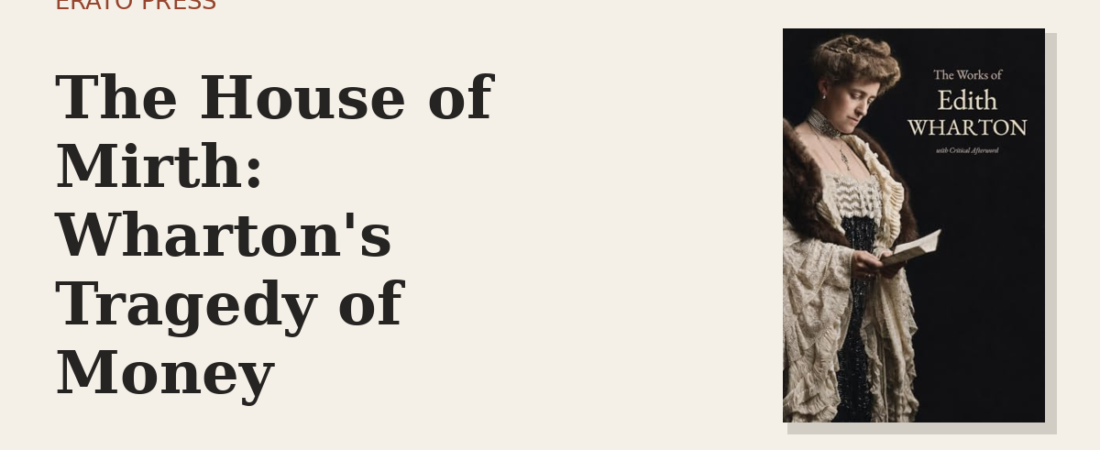
Lily Bart is twenty-nine years old, beautiful past the point of debate, and worth nothing. That is the situation Edith Wharton sets out in the opening pages of The House of Mirth, and the genius of the novel is that it treats the contradiction as an economic fact rather than a sentimental one. Lily has been raised, dressed, displayed, and educated for exactly one purpose: to be acquired by a rich man in marriage. She is, in the brutal language the book never quite lets us forget, a commodity awaiting sale, and the tragedy of the next four hundred pages is the tragedy of a costly object that cannot find a buyer before it goes out of fashion. The thesis to carry through the novel is plain and pitiless: Lily Bart is destroyed not by a villain but by a market, and Wharton means us to understand that the market is the society itself.

A woman with no capital but her looks
The first thing to grasp is how little Lily actually owns. She has taste, charm, a famous profile, and a dwindling allowance from an aunt who disapproves of her. She has no money of her own, no skill she could sell, no respectable means of earning, and no inclination to acquire one—because the whole apparatus of her upbringing has taught her that earning is precisely what a woman of her class must never be seen to do. Her single asset is her appearance, and like any asset it depreciates. Wharton is exact about the arithmetic. Lily is approaching thirty; she has been “out” for eleven seasons; the débutantes coming up behind her are younger, fresher, and backed by larger fortunes. Every year she fails to convert her beauty into a marriage, the beauty is worth a little less and the failure a little more conspicuous.
This is what lifts the novel above the genre of the doomed-heroine romance. Lily’s predicament is not bad luck or a broken heart; it is a balance sheet. She lives among people whose wealth is staggering and whose generosity is conditional, and she has been trained to need their luxuries—the country houses, the gowns, the bridge tables—without being given the income to sustain them. She is, in effect, an expensive habit she cannot afford. When she gambles at cards to keep her place among the rich and loses money she does not have, the slide begins, and Wharton tracks it with the cold attention of an accountant watching a firm fail.
The marriage market as economy
Wharton, who had grown up inside Old New York and married into its money, understood that “society” in her world was not a social pastime but an economic system with its own currency, its own credit, and its own ruinous interest rates. The currency was reputation; the credit was the willingness of the rich to maintain a charming, useful, ornamental woman in their houses; and the interest came due the moment she could no longer pay in beauty, discretion, or amusement. Lily trades on all three for as long as she can. She makes herself indispensable as a guest, arranges flowers and flirtations, soothes the dull husbands and flatters the bored wives, and in return she is lodged, fed, and dressed at the edge of fortunes she will never share.
The cruelty of the arrangement is that it offers no exit that does not also count as a fall. Lily could secure herself by marrying the wealthy, tedious Percy Gryce, but she cannot quite make herself complete the transaction—some fastidiousness in her, some refusal to be entirely a thing for sale, sabotages the sale at the decisive moment. She could marry Lawrence Selden, the one man who sees her clearly, but Selden has no money either, and their attachment is precisely the kind a woman in Lily’s position cannot afford to indulge. Wharton’s irony is merciless here. The only person who values Lily for herself is the one person whose love cannot save her, because love that pays no dividend is, in this economy, worthless.
The slow ruin
What makes The House of Mirth almost unbearable to read is the gradualness of Lily’s descent. Wharton does not destroy her in a single catastrophe; she lets her fall through the floors of her society one by one, each landing lower and harder than the last. A misunderstanding over money borrowed from a friend’s husband ruins her reputation. A packet of compromising letters—not hers, but capable of clearing her if she would use them—sits in her possession as a weapon she is too decent, or too proud, to deploy. She is dropped by the fashionable, taken up briefly by the vulgar rich, then dropped again. She moves from country houses to a boarding-house, from idleness to an attempt at millinery work for which her ornamental upbringing has left her completely unfit. Her hands, trained only to look beautiful, cannot sew a hat well enough to keep the job.
And here Wharton’s social anatomy becomes something deeper. Lily’s ruin exposes the violence underneath the manners. The same people who lounge in her company when she is useful turn away with practiced ease when she is not, and they do it without raising their voices, without a single scene—a cut direct here, an unanswered note there, an invitation that fails to arrive. The machinery of exclusion is soft, smiling, and absolutely lethal. By the end Lily has been reduced from a prized commodity to an unsalable one, and the market simply lets her go. Her final night, the chloral, the unsent reconciliation—Wharton stages it as quietly as everything else, and the quiet is the point. No one is punished. The system continues. A woman has been used up and discarded, and the houses of mirth blaze on without her.
Wharton’s tragedy of money
It is worth insisting on the word tragedy, because Wharton earned it. Lily is not merely a victim; she has the dimensions of a tragic figure, complete with the flaw that seals her fate. Her flaw is a half-formed conscience—an intermittent, unreliable refusal to be entirely mercenary that arrives always at the wrong moment, sabotaging each chance to save herself without ever amounting to a clean moral stand. She is too good to thrive in her world and not good enough to renounce it, and that in-betweenness is fatal. Wharton refuses both available consolations: she will not let us pity Lily as a pure innocent, and she will not let us condemn her as a mere social climber. We are made to watch a real person, with real charm and real failings, ground down by a mechanism that no individual built and no individual can stop.
Wharton returned to this terrain again and again, mapping the cruelties of Old New York from the inside with an irony that never softens into nostalgia. Readers drawn to that anatomy of a closed society should turn to its great companion, The Age of Innocence: Wharton and the Cage of Society, where the cage holds a man rather than a woman and closes by consent rather than by ruin. Together the two novels form Wharton’s complete indictment: one shows the price of being kept out, the other the price of being kept in.
Frequently asked questions
Is The House of Mirth a romance?
No, and reading it as one guarantees disappointment. There is a love story—Lily and Selden—but Wharton deliberately strands it, because the whole argument of the novel is that personal feeling is powerless against economic necessity in this world. The book belongs to the tradition of literary naturalism, in which character is shaped and finally crushed by forces larger than the self. The romance is there to show us what Lily cannot afford to want.
Why doesn’t Lily just use the letters to save herself?
Because using them would mean blackmailing a woman she dislikes and confirming, to herself, that she is exactly the calculating creature her society assumes she is. Lily’s refusal is the clearest expression of her tragic flaw: a scruple too weak to redirect her life but strong enough to ruin her. Wharton makes the choice agonizing precisely because the decent option and the survivable option are not the same.
How autobiographical is the novel?
Wharton was not Lily Bart—she was wealthy, married, and a working writer—but she knew Lily’s world intimately, having been raised in it and chafed against its expectations of women. The novel’s authority comes from that insider’s knowledge: the exact cost of a gown, the precise mechanics of a snub, the way money moves invisibly through a dinner party. Wharton wrote about the cage because she had lived inside its bars.
The Erato Press edition gives Lily Bart’s story the clean text and critical framing it deserves, restoring the novel’s force as a work of social anatomy rather than a period costume drama. If you want to watch a woman valued only for what she is worth—and to feel exactly how the market disposes of her—begin here.
Read the Erato Press edition →
and meet the most quietly devastating heroine in American fiction.Enjoyed this piece?
Get the next one — our essays on the classics and news of each new Erato Press edition — straight to your inbox.