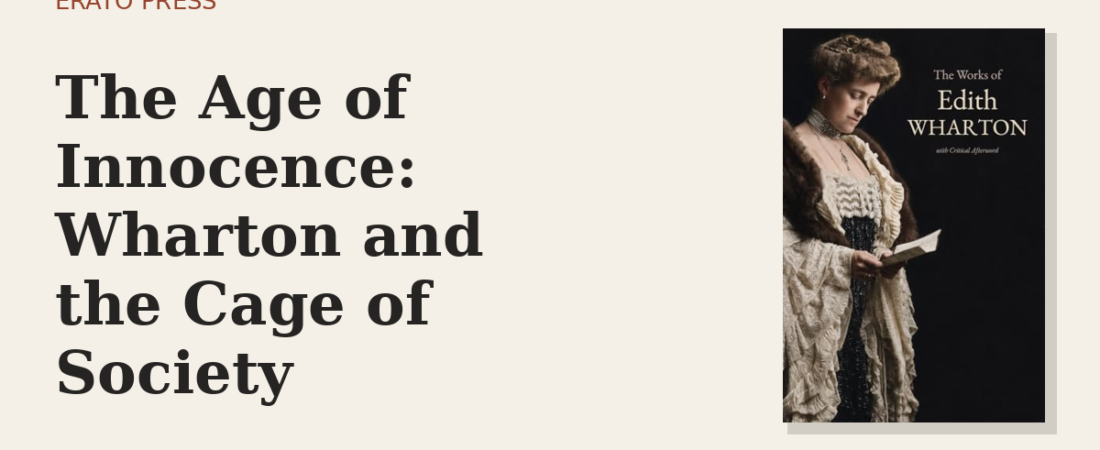
Edith Wharton won the Pulitzer Prize for The Age of Innocence in 1921, the first woman to take it, and she won it for a novel set fifty years in the past, about a world that had already vanished when she sat down to write. That distance is the secret of the book. Wharton had grown up inside the tribe she was anatomizing — the small, intermarried, fanatically respectable society of 1870s New York, the world of brownstone front parlors and inherited pew rents and dinners arranged like military campaigns — and she wrote about it with the cold precision of a defector who still loves the country she has fled. The novel’s great subject is not love thwarted by circumstance. It is the far stranger spectacle of intelligent people who build their own cage, lock it from the inside, and then mistake the locking for virtue. Newland Archer is not kept from the woman he loves by any law, any villain, any sea. He is kept from her by good manners, and he submits.

A society that governs without laws
The first thing to understand about Old New York is that it has no police. It needs none. Wharton’s genius is to show a community that enforces total conformity without ever raising its voice — a place where the most consequential punishments are administered by who is and is not invited to dinner. When the Countess Ellen Olenska returns from a disastrous European marriage, trailing scandal and a foreign sophistication, the tribe does not denounce her. It simply declines, en masse, to attend the dinner her family gives in her honor. Empty chairs are the weapon. A few accepted invitations, a discreet show of solidarity from the van der Luydens at the apex of the hierarchy, and the threat is contained — not by argument but by the silent arithmetic of attendance.
Wharton renders this machinery with an anthropologist’s patience, treating the rituals of her own class as gravely as if they were the kinship taboos of a remote tribe, which in a sense they are. The flowers a man sends, the box he occupies at the opera, the precise degree of warmth in a greeting at the Beaufort ball — each is a signal in a language everyone speaks fluently and no one admits exists. The cruelty of the system is that it never has to declare itself. It works by what is left unsaid, by the things “one does not do,” and its sentences are carried out so smoothly that the condemned often help to carry them. This is what Wharton means by the cage: not a prison imposed from outside but a structure of manners so internalized that the inmates police themselves and each other, and call the policing taste.
Newland Archer and the failure of nerve
Newland Archer believes himself superior to all of this. He reads European books, prides himself on his irony, imagines that he sees through the conventions his neighbors take for granted. He is engaged to May Welland — beautiful, conventional, the perfect product of the system — and at the novel’s opening he is already mildly bored by the very innocence he has been taught to prize, sensing that May’s purity is less a quality of her soul than a thing manufactured by her mother and her aunts to specification. Then Ellen arrives, and Archer discovers that the woman who has lived, suffered, and seen the world is the only person in New York he can actually talk to. He falls in love with her, and with the version of himself that becomes possible in her presence.
What follows is the slow, agonizing demonstration that Archer’s self-image is a fiction. He thinks he is a free man trapped among conformists. He is in fact the most thoroughly conditioned of them all, and the book’s tragedy is that he discovers this only as it is happening to him, too late and too partially to act. Every time he resolves to break free — to leave May, to go to Ellen, to choose the life that would mean something — the soft machinery closes around him. A word from his mother, a look from his future in-laws, the dawning realization that May has quietly, brilliantly outmaneuvered him: each closes a door he believed he had left open. May, whom he had taken for a charming nonentity, turns out to be the system’s most effective agent, capable of the small, devastating maneuver — the announcement of a pregnancy not yet certain, timed to settle the matter — that ends the contest without a single raised voice. Wharton was the supreme analyst of the moment when freedom evaporates while a person is still telling himself he possesses it. She had already mapped the same trap, from a colder angle, in The House of Mirth: Wharton’s Tragedy of Money, where the heroine’s slide is steeper and the floor at the bottom is fatal.
The renunciation that is the whole point
Most novels of adultery move toward consummation or catastrophe. The Age of Innocence moves toward renunciation, and the renunciation, not the passion, is its true climax. Archer and Ellen never run away together. They reach, late in the book, a kind of exhausted understanding: that to take what they want would be to destroy May, to wound the tribe that has shaped them both, to become people they could not respect. Ellen, who has more reason than anyone to despise the rules, chooses to honor them out of a loyalty that the rule-makers themselves could not match. She returns to Europe. Archer stays, marries May in fact as well as in form, has children, becomes a respectable and even useful citizen, and lives out a long, decent, diminished life.
Wharton refuses to tell us whether this is a tragedy or a triumph, and the refusal is the deepest thing in the book. The famous final chapter leaps forward twenty-six years. May is dead; the rigid old world has dissolved into the looser, faster century; Archer, now an old man, travels to Paris with his grown son and stands in the street below Ellen’s apartment, free at last to go up. He does not. He sends his son ahead and sits on a bench, looking up at her lighted window, choosing the memory over the woman. It is the most quietly shattering ending in American fiction, and it can be read two ways at once: as a final failure of nerve, the cage holding even when its bars have rusted away — or as the last act of a man who has decided that some renunciations become, over a lifetime, more real and more precious than the thing renounced. Wharton lets both readings stand. That is her honesty, and her mercy.
Innocence as the cruelest word
The title is the sharpest irony Wharton ever wrote. The “innocence” of Old New York — embodied in May, manufactured in its daughters, prized above intelligence and feeling — is not innocence at all but a willed and weaponized ignorance, a refusal to know anything that might disturb the social order. May’s innocence is precisely what makes her formidable; she does not need to understand Archer’s inner rebellion to defeat it, because the whole apparatus of her upbringing defeats it for her. The word names a virtue and exposes it as a tool of control in the same breath. To be “innocent” in Wharton’s New York is to be safely incapable of asking the questions that would bring the whole structure down. It is the opposite of wisdom, and the system depends on mistaking the two.
This is why the novel survives its vanished setting. The brownstones are gone and the pew rents with them, but the thing Wharton diagnosed — the way a community can enforce conformity through manners rather than law, the way intelligent people collaborate in their own confinement, the way “what one does not do” can govern a life more absolutely than any statute — outlived the gilded cage it grew in. Every closed circle that punishes by exclusion, every person who mistakes the loss of nerve for the keeping of faith, is somewhere in Newland Archer’s bench beneath the lighted window.
Frequently asked questions
Is The Age of Innocence a romance?
Only in the way a great tragedy is a romance — it contains a love story, but its subject is the forces that defeat love rather than the love itself. Readers expecting a satisfying union will be frustrated; readers willing to follow Wharton into the harder territory of what people surrender, and why, will find one of the most emotionally precise novels in the language. The withholding is the meaning.
How does it compare to The House of Mirth?
They are companion anatomies of the same society from opposite ends. The House of Mirth follows a woman destroyed by the marriage market she cannot quite bring herself to win; The Age of Innocence follows a man comfortably inside the system, examining the subtler ruin of a life lived entirely within the rules. The earlier novel is hotter and more pitiless; the later one is cooler, more retrospective, more forgiving.
Why set it in the 1870s when she wrote it in 1920?
The distance gave Wharton both clarity and tenderness. Writing after the First World War, she could see the lost world of her childhood whole, as a closed and finished thing, and judge it without the heat of present grievance. The retrospect also lets the final chapter measure the cost of Archer’s choices against the century that made them seem, in the end, quaint.
Wharton’s effects depend on a reader catching the unspoken signal — the empty chair, the timed announcement, the flowers that say what no one will say aloud — and that is exactly where a careful edition earns its place. Our Erato Press volume frames the novel with an introduction to the vanished social world it maps and notes that gloss the rituals a modern reader would otherwise pass over, so that the silent machinery of the cage becomes visible on the page. and watch a free man lock his own door.
Enjoyed this piece?
Get the next one — our essays on the classics and news of each new Erato Press edition — straight to your inbox.