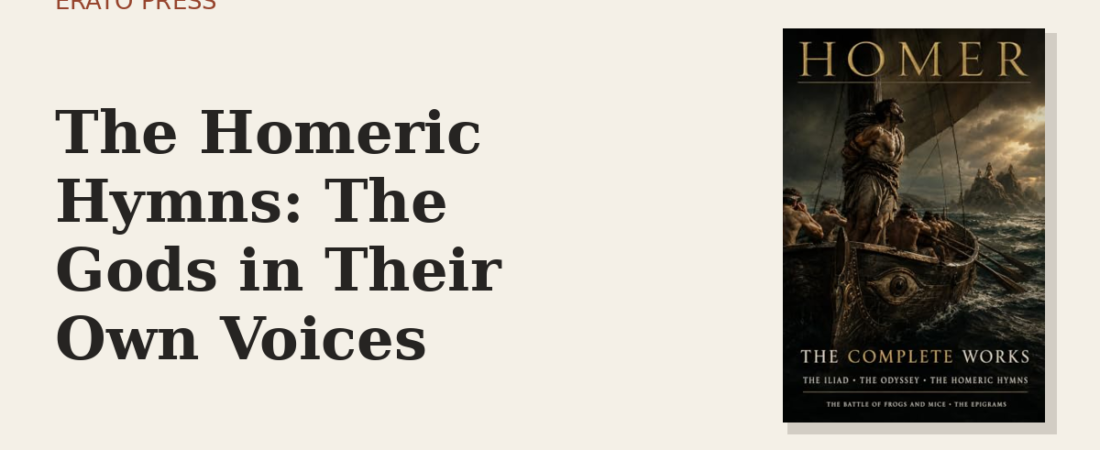
In the Iliad and the Odyssey, the gods are supporting players in a human drama. They lean down out of the bright air to nudge a spear, save a favorite, settle a grudge — but the story belongs to Achilles and Odysseus, to mortals who suffer and die. The Homeric Hymns reverse the camera. Here the gods step into the foreground and get their close-ups, and the result is one of the most underread treasures in Greek literature: a collection of thirty-three poems, composed across several centuries and falsely attributed to Homer, in which each major deity is given a story of his or her own. The thesis of this essay is that you cannot fully understand the epics until you have read the Hymns, because the Hymns tell you who these gods are when they are not interfering with men — and that knowledge changes everything about how the great poems read.

What the Hymns actually are
The word “hymn” misleads modern readers, who expect something churchy and brief. These are not congregational songs. They are narrative poems in the same dactylic hexameter as the epics, ranging from a handful of lines to nearly six hundred, and they appear to have served as preludes — the prooimion a rhapsode would chant to a god before launching into the main recitation of epic at a festival. The longer ones, though, far exceed any merely ceremonial function. Four of them in particular — to Demeter, to Apollo, to Hermes, and to Aphrodite — are fully realized works of art, each telling a foundational story about how a god came to hold the powers and honors the Greeks worshipped them for. They are, in effect, the theology of archaic Greece told as story rather than doctrine, and they sit alongside Hesiod’s Theogony as the indispensable companion to the epics. If Hesiod gives the genealogy — and we trace that family tree in Greek Mythology 101: Hesiod and the Birth of the Gods — the Hymns give the gods their biographies, their moods, their voices.
The Hymn to Demeter: grief at the center of the world
The longest and gravest of them, the Hymn to Demeter, is the great poem of the collection and one of the most moving in all of Greek. It tells the abduction of Persephone by Hades — the girl picking flowers in a meadow, the earth splitting open, the dark chariot — and then it does something the epics rarely do: it stays with the grief. Demeter, the goddess of grain, wanders the earth in mourning for her stolen daughter, refusing to eat, refusing to let anything grow, until the fields go barren and humanity faces extinction. She disguises herself as an old woman and takes service in a mortal household at Eleusis, and there is a scene of almost unbearable tenderness in which she tries to make the infant prince immortal by laying him in the fire each night, only to be discovered by his terrified mother. The poem is, at bottom, about a mother’s refusal to accept loss, and about the bargain that loss forces: Persephone must spend a third of each year below, and so the world has winter.
What makes the Hymn historically priceless is its closing turn. The poem ends by founding the Eleusinian Mysteries — the most important mystery cult of the ancient world, whose initiates were promised a better lot in the afterlife and who kept their secret so faithfully that we still do not fully know what was revealed. The Hymn to Demeter is the closest thing we have to a charter for that rite. To read it is to stand at the source of an entire ancient religion of consolation, and to understand that the Greeks who heard the epics also believed, with their whole hearts, in a goddess who knew what it was to grieve.
The Hymn to Hermes: the gods can be funny
Then, in a register that could not be more different, comes the Hymn to Hermes — and it is a comedy, broad and delicious. Hermes is born at dawn, and by midday this precocious newborn has climbed out of his cradle, invented the lyre by stringing a tortoise shell, and rustled fifty of Apollo’s cattle, driving them backwards so their hoofprints point the wrong way. When the furious Apollo tracks him down, the infant lies in his cradle and brazens it out — how could a baby steal cattle? — in one of the funniest exchanges in archaic poetry. The case goes up to Zeus, who can barely keep from laughing, and the whole thing resolves in a trade: Hermes gives Apollo the lyre, and in exchange is confirmed as the god of thieves, travelers, traders, heralds, and boundaries. The poem is a portrait of divine cunning as charm, and it shows us a Greek imagination perfectly capable of finding its gods hilarious without finding them any less holy. After the Hymn to Hermes, the trickster Hermes of the Odyssey, who guides Odysseus and conducts the suitors’ souls to the underworld, carries an extra dimension of mischief.
Aphrodite, and the cost of desire
The Hymn to Aphrodite performs yet another tonal move: it is erotic, ironic, and quietly melancholy. Zeus, weary of Aphrodite’s habit of making the other gods fall in love with mortals, turns the weapon on her: he fills her with desire for the Trojan herdsman Anchises. The goddess of love, for once, is the one undone. She comes to Anchises disguised as a mortal princess, sleeps with him, and then — in the poem’s most striking passage — reveals her divinity and tells him, with something like bitterness, of the goddess Eos, who begged immortality for her mortal lover Tithonus but forgot to ask for eternal youth, so that he withered into an endlessly aged, chirping husk. The point is the gulf between gods and men, and the grief that desire across that gulf must always produce. From this union, the poem tells us, will come Aeneas — which makes the Hymn a quiet prologue to the whole matter of Troy. Read it, and the divine machinery of the Iliad looks less like caprice and more like the working-out of appetites the gods themselves cannot govern.
How the Hymns change the epics
The cumulative effect of reading the four great Hymns is to repopulate Olympus. In the epics, the gods can seem like a committee of meddlers. In the Hymns, each acquires an interior history: Demeter’s grief, Hermes’s wit, Aphrodite’s vulnerability, Apollo’s terrible glamour. You return to the Iliad and the Odyssey knowing what these beings want and what they fear, and their interventions stop being arbitrary. The Hymns are the missing connective tissue of Greek myth — the place where the gods, freed from the human-centered narratives of epic, speak in their own voices and tell their own stories. They belong in the same volume as the epics not as an appendix but as the key.
Frequently asked questions
Did Homer write the Homeric Hymns?
Almost certainly not, and not all by one hand. The Hymns were composed by various anonymous poets over several centuries, in the same meter and dialect as the epics, and attributed to Homer in antiquity much as countless works were attributed to famous names. The attribution tells us about their style and prestige, not their authorship.
Which Hymn should I read first?
Start with the Hymn to Demeter for its emotional depth, then the Hymn to Hermes for sheer delight. Together they show the astonishing range of the collection, from tragedy to farce, and they are the two finest poems in the group.
Do I need to know the epics first?
No — the Hymns stand on their own as stories. But readers who already know the Iliad and Odyssey will find that the Hymns deepen and explain the gods of the epics, so the ideal is to read them together, which is exactly what a complete edition allows.
This is the argument for reading Homer whole. The Erato Press edition gathers the epics and the Hymns in a single volume, so that the gods of the great poems and the gods of their own private stories stand side by side, illuminating each other. Read the Hymns and Olympus stops being a backdrop and becomes a cast of characters as vivid and contradictory as any in the human story. Read the Erato Press edition and hear the gods, for once, in their own voices.
Read the Erato Press edition →
Enjoyed this piece?
Get the next one — our essays on the classics and news of each new Erato Press edition — straight to your inbox.