Sometime in the late 1940s, a comparative-mythology professor named Joseph Campbell read his way through the world’s stories — the Buddha under the bo tree, the Navajo twins, the labors of every hero he could find — and decided they were all, secretly, the same story. He called it the monomyth, after a phrase he borrowed from Finnegans Wake: a single underlying shape that a hero traces in culture after culture, leaving home, crossing into danger, surviving an ordeal, and returning transformed. The Hero with a Thousand Faces (1949) gave that shape a vocabulary, and George Lucas later gave it a fortune, and a screenwriting consultant named Christopher Vogler turned it into a seven-page studio memo that has shaped more Hollywood films than any single screenwriter alive. The whole apparatus rests, more than on any other text, on Homer’s Odyssey. The poem is the template’s purest specimen — and also the place where you can watch the template fail to capture what it claims to explain.

The poem that fits the diagram almost too well
Lay Campbell’s stages over the Odyssey and the alignment is uncanny. The Call to Adventure: Odysseus is summoned from Ithaca to Troy, then summoned home again across ten years of sea. The Crossing of the Threshold: he leaves the known Greek world for a geography that has no map, where the rules of mortal life no longer hold. The Road of Trials: the Cicones, the Lotus-Eaters, the Cyclops, Circe, the Sirens, Scylla and Charybdis — a serial gauntlet of tests, each demanding a different virtue. The Belly of the Whale, or what Campbell sometimes called the abyss: the descent to the land of the dead in Book 11, the literal journey underground from which the hero returns carrying knowledge he could not have obtained alive. The Magic Flight, the Return, the Master of Two Worlds: Odysseus comes back to Ithaca disguised, crosses the threshold of his own hall as a beggar, endures one final ordeal among the suitors, and is restored — husband, father, king — to a world he now sees doubly, as both the man who left and the man the sea remade.
Vogler’s adaptation of all this, written in 1985 as an internal guide for Disney’s story department and later expanded into The Writer’s Journey, streamlined Campbell’s seventeen stages into twelve and gave each a job a screenwriter could use: the Ordinary World, the Refusal of the Call, Meeting the Mentor, Tests, Allies and Enemies. It is genuinely hard to overstate how completely this took over commercial storytelling. The mentor figure who dies before the third act — Mentor is, not coincidentally, a character in the Odyssey, the elder whose form Athena assumes to counsel Telemachus, which is why we use his name for the role at all. The hero who must “refuse the call” before accepting it. The threshold guardian. If you have noticed that a startling number of films feel like the same film, the monomyth is one reason why, and the Odyssey is the ancestor at the head of that family line.
Why the template caught on — and what it gets right
It would be a mistake to treat the hero’s journey as merely a marketing gimmick that flattened storytelling. Campbell was onto something real. Stories about leaving and returning, about ordeal and transformation, do recur across cultures with a frequency that demands explanation, and the Odyssey earned its place at the center of the canon precisely because it dramatizes, with extraordinary economy, a pattern that maps onto the deepest facts of a human life: we are all called out of childhood, all tested, all changed, all trying to find a way home to a place that has not stood still while we were gone. The poem’s emotional grip — the reason it has never stopped being read in three thousand years — comes partly from this. When Odysseus weeps at the Phaeacian court hearing a bard sing of Troy, weeping at his own story told back to him as legend, Homer has caught the strange doubleness of a person who has survived something large enough to become a tale. That is the hero’s journey working as it is supposed to: the structure carrying real psychological weight.
And the template is useful. A young writer who has never finished a story can use Vogler’s twelve stages as scaffolding, the way a beginning composer uses sonata form. The danger is not that the structure exists; it is mistaking the structure for the thing itself.
Where the monomyth flattens Homer
Here is what the diagram cannot hold. The Odyssey is not, at its core, a story about a hero who grows. Odysseus does not undergo the kind of inner transformation the monomyth promises — he is, at the end, recognizably the man he was at the start: cunning, restless, a teller of lies so fluent he lies to the goddess Athena’s face and she laughs with delight at being out-tricked by a mortal. The Greek word the poem hangs on him is polytropos, “of many turns” — the man of twists and turnings — and it describes a character defined not by arc but by adaptability, by the refusal to be one fixed thing. The monomyth wants a caterpillar that becomes a butterfly. Homer gives us a man who is already, permanently, both.
The template also cannot account for the poem’s most radical structural choice: that the hero does not appear until Book 5, and that the first four books belong to his son. The Telemachy — Telemachus’s own small coming-of-age, his journey to Pylos and Sparta in search of news — is a hero’s journey nested inside the larger one, and the poem’s real subject is arguably the relationship between the two, between a father who has been gone so long he is a rumor and a son who has never known him. No monomyth chart has a box for that. Nor does it have a box for Penelope, whose twenty years of holding the household together against the suitors is an ordeal at least as demanding as anything Odysseus faces, and entirely without sword or sea-monster. The hero’s journey is, structurally, a story about a man going out; the Odyssey is at least as interested in the woman who stays, and weaves, and unweaves, and waits — and whose own cunning, in the test of the marriage bed, finally matches his.
And then there is the strangeness the template sands away. The Cyclops is not just a “test”; the blinding of Polyphemus, and Odysseus’s fatal vanity in shouting his real name back across the water, sets the whole tragic machinery of the homecoming in motion — Poseidon’s wrath, the lost crew, the years added to the exile. The monomyth reads the episode as a trial passed. Homer reads it as a victory that is also a curse, a piece of cleverness that costs everything, which is a far darker and stranger idea than any screenwriting manual will tell you. The poem is full of these: the comrades who survive the war only to drown eating forbidden cattle, the homecoming that requires a slaughter in the dining hall. The hero’s journey is a hopeful shape. The Odyssey is not, finally, a hopeful poem. It knows the cost.
Reading past the template
The practical lesson for a reader is this: the hero’s journey is a useful door into the Odyssey, but a terrible room to stay in. Use it to notice the architecture — the descent, the disguised return, the symmetry of the two journeys — and then put it down, because the poem is doing a hundred things the chart has no language for. It is interested in hospitality and its violation, in the ethics of how you treat a stranger at your door. It is interested in storytelling itself, in lies that are better than the truth. It is interested in what it means to be remembered, and whether being a legend is any consolation for the men who died to make you one. Once you have read it for those things, you find that the descendants of the monomyth — the films built from Vogler’s memo — feel thin by comparison, and you may want to keep going. The same Greek imagination that produced this poem produced the tragedies and the histories that answer it, and the natural next step is laid out in After The Odyssey: Where to Go Next in the Greek Classics.
Frequently asked questions
Did Homer invent the hero’s journey?
No — and this is the useful irony. Homer was working within an oral tradition far older than himself, full of homecoming stories (nostoi) and sea-voyage tales, so the Odyssey is itself a late, sophisticated version of patterns that already existed. Campbell’s monomyth abstracted a shape that the Odyssey happens to exemplify beautifully; it did not derive from Homer alone, and Homer did not “invent” it so much as perfect one instance of it. The poem is the template’s best evidence, not its origin.
Is the hero’s journey a good way to understand the Odyssey?
As a first scaffold, yes; as a final account, no. It correctly identifies the descent to the dead, the road of trials, and the transformed return. It badly misses the poem’s interest in cunning over growth, in Penelope’s parallel ordeal, in the moral cost of victory, and in the nested father-and-son structure. Treat it as a map of the highways and remember that the poem lives in the side roads.
Why do so many movies feel like the Odyssey?
Because Christopher Vogler’s 1985 adaptation of Campbell’s monomyth became the unofficial blueprint of the Hollywood story department, and the Odyssey sits at the root of Campbell’s model. The mentor who dies, the refusal of the call, the threshold crossing — these are Homeric furniture, redistributed across a thousand screenplays. Reading the original shows you how much richer the source is than its copies.
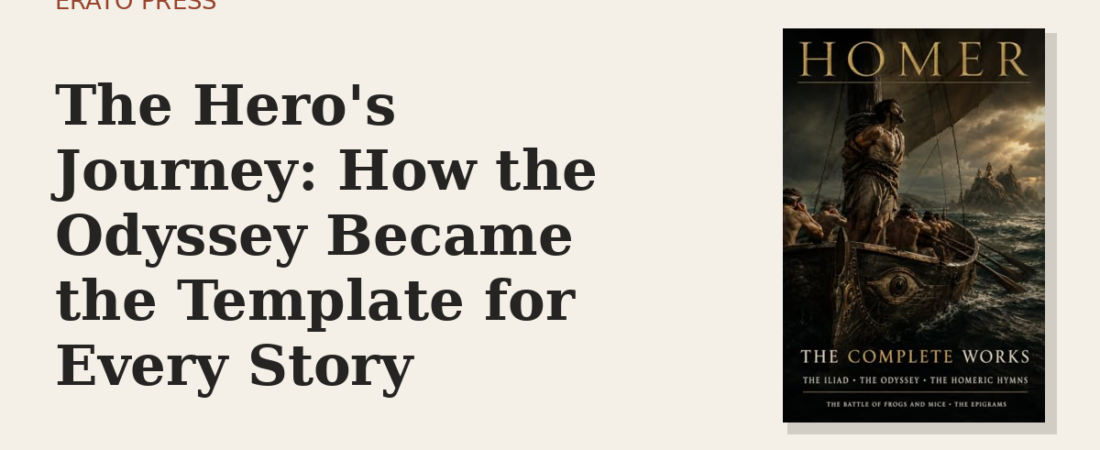
The Erato Press edition gathers the Odyssey alongside the rest of Homer in a single annotated volume, so you can read the poem as the structuralists never let you — for its strangeness, its ethics, and its grief, with notes that flag exactly where the famous template captures Homer and where it quietly betrays him. If you want to meet the source rather than its thousand faces,
Read the Erato Press edition →
.Enjoyed this piece?
Get the next one — our essays on the classics and news of each new Erato Press edition — straight to your inbox.