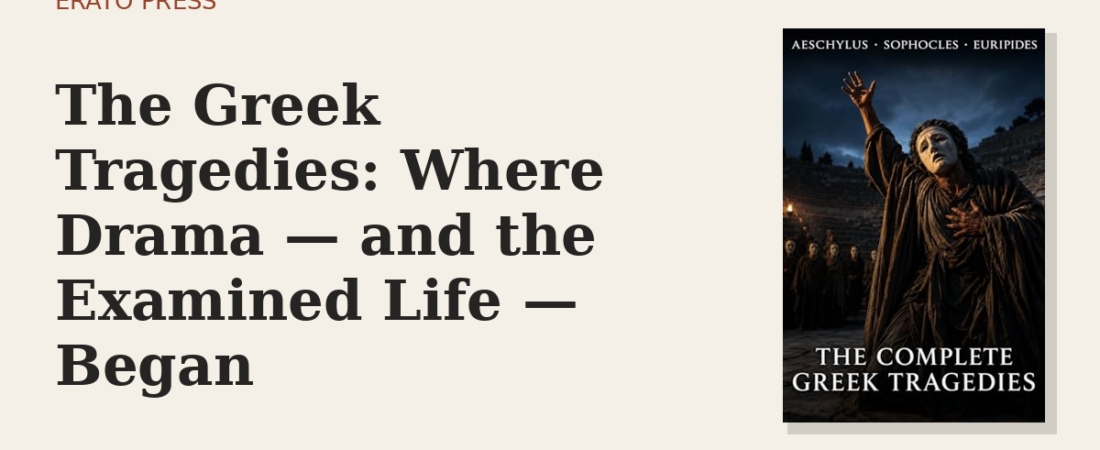
Twenty-five centuries ago, in an open-air stone theatre on the slope of the Athenian Acropolis, something new appeared in the world: drama. Citizens gathered by the thousand to watch actors and a chorus stage the terrible stories of their myths — a king who kills his father and marries his mother, a woman who defies the state to bury her brother, a hero destroyed by the gods — and in watching, they invented the theatre, and something more: the public examination of human suffering, guilt, fate, and justice that lies at the root of Western thought. The tragedies of Sophocles and his rivals are the foundation on which all later drama stands, and they remain, in their terrible clarity, among the most powerful things ever written.

Oedipus, and the trap of fate
The supreme example, and the one Aristotle held up as the perfect tragedy, is Sophocles’ Oedipus the King. A great king sets out to save his plague-stricken city by finding the murderer of the previous king — and, in a plot of pitiless irony, discovers step by step that the murderer is himself, that the man he killed was his father, that the woman he married is his mother, that the fate he fled his whole life to escape he fulfilled by fleeing it. The horror is not that Oedipus is wicked — he is noble, intelligent, determined to know the truth — but that he is doomed, that his very virtues drive him to his destruction, that a human being can do everything right and still be crushed. Sophocles stages the deepest of questions: how much are we the authors of our own lives, and how much the victims of forces — fate, the gods, our own blind nature — we cannot control?
Antigone, and conscience against the state
If Oedipus asks about fate, Antigone asks about justice, and it may be the most politically important play ever written. Antigone defies the king’s edict to bury her dead brother, obeying what she calls the “unwritten laws” of the gods and of conscience against the written law of the state — and she pays with her life. Here, at the very dawn of Western literature, is the great conflict that has never been resolved: between the individual conscience and the power of the state, between higher law and civic order, between the claims of the family and the claims of politics. Every later argument about civil disobedience, about the right to defy an unjust command, stands in Antigone’s shadow. Sophocles gives both sides their full force, refusing to make it easy — which is why the play is still performed wherever people resist unjust authority.
The birth of the examined self
These plays did for the Greeks what they still do for us: they let a community confront, in the safety of art, the darkest possibilities of human life — that we may be guilty without meaning to be, that the gods may be unjust, that doing right may destroy us — and by confronting them, be purged of terror and pity, in the mysterious process Aristotle called catharsis. They stand at the head of the whole Western tradition of taking human suffering seriously as a subject for art and thought, the dramatic counterpart to the epic vision our guide to the Greek and classical epics explores. Drama, philosophy, the very idea of the examined life — all trace back to these few surviving plays.
Why read them now
Because they are the origin of theatre and the permanent statement of the tragic view of life — that human beings are noble and doomed at once — and because their questions (fate and freedom, conscience and law, the justice of the gods) are exactly the questions we have never stopped asking. Short, stark, and overwhelming, they are the foundation, and still among the summits, of Western literature.
Frequently asked questions
Are Greek tragedies hard to read?
Less than you might fear — they are short, focused, and intensely dramatic, without the length of epic. A good translation and a brief note on the myths behind them are all most readers need to be swept in.
Where should I start?
Oedipus the King — Aristotle’s model of perfect tragedy — and Antigone are the essential first plays, followed by the rest of the Theban cycle. This edition gathers the great tragedies with the context to make them immediate.
What is catharsis?
Aristotle’s term for the emotional purging tragedy produces — the release of pity and fear the audience feels in confronting, through art, the darkest possibilities of life. It is why watching terrible events staged can be strangely ennobling rather than merely painful.
Read the Erato Press edition →
and return to the place where drama, and the examined life, began.
Enjoyed this piece?
Get the next one — our essays on the classics and news of each new Erato Press edition — straight to your inbox.