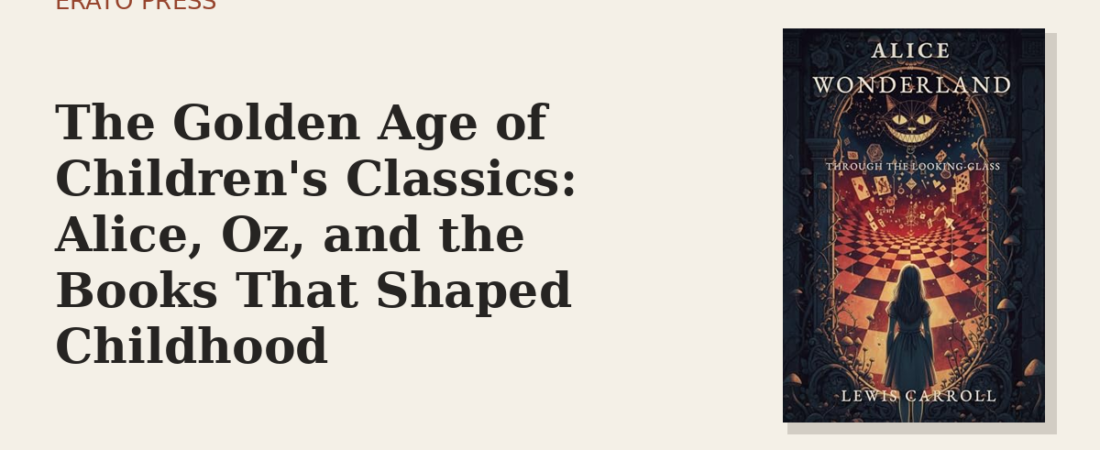
Sometime in the half-century between 1865 and 1911, childhood acquired a literature of its own, and the books written in those years have never been displaced. A child today still falls down the rabbit hole, still follows the yellow brick road, still moves into the house with the locked garden, still meets the red-haired orphan stepping off the train at Bright River. We call this stretch the golden age of children’s literature, and the phrase is not nostalgia. Something genuinely happened in those decades, a convergence of social change, publishing economics, and a few extraordinary writers, that produced more durable children’s classics than any comparable span before or since. The books survive because they were the first to take the child seriously as a reader rather than a pupil.

The argument here is that the golden age was made possible by a single shift in attitude: the Victorians stopped writing at children and began writing for them. Before this, the literature handed to the young was overwhelmingly instructional, designed to improve, to warn, to moralize. The golden age discovered that a child’s imagination was worth addressing on its own terms, that wonder and nonsense and adventure were not distractions from a child’s education but the deepest part of it. Once that lock turned, the door opened onto a country we have never left.
What made roughly 1865 to 1911 the golden age
The dates are not arbitrary. The era opens, by common consent, with Alice’s Adventures in Wonderland in 1865, the first masterpiece of children’s literature with no moral to teach and no lesson to impart, a book whose entire purpose is delight, and it runs through to The Secret Garden in 1911, with Peter Pan, The Wind in the Willows, and a shelf of others falling in between. Several forces converged to make the moment possible. Mass literacy was spreading, and compulsory schooling created, for the first time, a vast population of children who could read. Cheaper printing and the rise of illustrated books made children’s titles commercially viable. And a sentimental, child-centered conception of family, itself a Victorian invention, created a market of parents who wanted to give their children books that were joys rather than medicines.
Underneath these material causes lay a philosophical one. The Romantics, Wordsworth and Blake above all, had revalued childhood, recasting it not as an imperfect adulthood to be corrected but as a state of special vision, closer to nature, to wonder, to truth. By the second half of the nineteenth century that idea had filtered into the culture deeply enough that writers could treat a child’s inner life as a serious subject. The golden age is what happens when Romantic reverence for childhood meets Victorian publishing capacity. The result was a literature that, almost for the first time, was on the child’s side.
Nonsense as liberation: Alice opens the door
It is hard to overstate how strange and how new Alice was. Lewis Carroll, the Oxford mathematician Charles Dodgson, wrote a book in which logic runs riot, in which a world operates by rules that are rigorous and absurd at once, in which a little girl confronts a parade of tyrannical adults, the Queen of Hearts, the Duchess, the Hatter, and survives by keeping her own counsel and refusing to be intimidated. There is no improving moral. The Caterpillar does not teach Alice a lesson; he is rude to her and vanishes. The book’s genius is that its nonsense is a kind of freedom, a holiday from the relentless instruction of Victorian childhood, and children recognized it instantly as theirs.
What Carroll grasped, and what we explore in Alice in Wonderland: The Logic of Nonsense, is that nonsense is not the absence of logic but its liberation, the play of a powerful mind released from the obligation to make sense. Children, who spend their days being told what things mean, find this intoxicating. Alice proved that a children’s book could be pure imaginative play and still, perhaps especially, become immortal. Every later writer in the golden age worked in the space that Carroll cleared, the space where a book for the young is permitted to be wonderful for its own sake.
America builds its own fairyland: Oz
Thirty-five years after Alice, L. Frank Baum gave America something it had never had: a homegrown fairy tale. The Wonderful Wizard of Oz (1900) was a deliberate act of literary independence. Baum wrote in his introduction that he wanted a “modernized fairy tale,” one that kept the wonderment and joy but dispensed with the old European apparatus of heartache and nightmare, the genii and dwarfs and fairies of Grimm and Andersen. His fairyland would be American: practical, democratic, optimistic, with a heroine who is sensible rather than royal and a wizard who turns out to be a humbug from Omaha working levers behind a curtain.
The result, as we argue in The Wizard of Oz: America’s Own Fairy Tale, is the most important American contribution to the golden age and a book whose imagery, ruby slippers, emerald city, the man behind the curtain, has become national mythology. Where Carroll’s Wonderland is a dream of pure nonsense, Baum’s Oz is a dream of competence and kindness, a country where a scarecrow, a tin man, and a cowardly lion discover they already possessed the brains, heart, and courage they sought. It is a fairy tale for a young, confident, can-do nation, and it remains the founding text of American fantasy.
The orphan and the garden: the emotional core of the age
If Alice and Oz are the golden age’s experiments in wonder, its other great strain is the literature of the orphan and the healing home, and here the books reach an emotional depth that the fantasies, for all their charm, do not attempt. Anne of Green Gables (1908) gives us an orphan girl sent by mistake to an aging brother and sister who wanted a boy, and the whole novel is the slow, funny, aching process by which Anne talks and imagines and loves her way into belonging. L. M. Montgomery understood that a child’s deepest hunger is not for adventure but for a place to be irreplaceable, and Anne’s triumph is that she becomes, to the prickly Marilla and shy Matthew, exactly that. We make the case for her enduring power in Anne of Green Gables: Why Montgomery’s Orphan Still Matters.
The same year and the same impulse produced Frances Hodgson Burnett’s The Secret Garden (1911), in which a sour, neglected orphan and a sickly, tyrannical boy are healed by a walled garden brought back to life, and Pollyanna (1913), whose orphaned heroine disarms a whole town with her relentless “glad game.” These books share a structure and a faith: that a damaged child placed in the right soil will grow, that love and air and useful work can mend what loss has broken. It is the most hopeful proposition in all of children’s literature, and the golden age believed it utterly.
Why these books refuse to age
The deepest reason these particular books survive while thousands of contemporaries are forgotten is that their authors refused to condescend. They wrote with full craft, real wit, genuine feeling, and a willingness to let darkness in, the Queen’s “Off with her head,” the loneliness of the orphan, the death that shadows The Secret Garden, so that the eventual joy is earned rather than assumed. A great children’s book, the golden age discovered, is not a simplified adult book but a different thing entirely, one that honors the child’s capacity for wonder and the child’s equal capacity for fear, loss, and longing. The sentimental ones are not saccharine because their happiness is hard-won; the fantastical ones are not trivial because their nonsense is rigorous.
That is the inheritance of those five decades. The writers of the golden age established, once and for all, that the books we give children are not a lesser literature but a foundational one, the first stories that teach us a story can be a home. We never stop returning to them because some part of us never leaves.
Frequently asked questions
Why does the golden age start with Alice in 1865?
Because Alice’s Adventures in Wonderland was the first widely loved children’s book written purely to delight rather than to instruct, breaking decisively with the moralizing tradition that preceded it. Earlier children’s literature existed, but Carroll’s book is conventionally taken as the threshold because it proved that wonder and nonsense, with no lesson attached, could be the entire point. Everything in the golden age builds on that permission.
Are these books too old-fashioned for children today?
Not at the level that matters. The language can take a little settling into, and a good edition helps, but the underlying needs the books address, for wonder, for belonging, for the courage to face a confusing adult world, have not changed at all. Children still recognize themselves in Alice’s exasperation, Dorothy’s homesickness, and Anne’s longing to be loved.
What ended the golden age?
No single event, but the First World War broke the optimism and the settled, child-centered domestic world these books assumed. The Secret Garden in 1911 is often taken as the late boundary; the war that began in 1914 made the era’s confident sweetness suddenly belong to a vanished world, which is part of why these books carry, for adult readers, such a powerful charge of lost innocence.
The Erato Press edition of Alice’s Adventures in Wonderland gives you Carroll’s text with a critical apparatus that places it at the head of the golden age and explains how a mathematician’s nonsense opened the door to a whole literature of childhood. It is the ideal place to begin, or to begin again, with the books that taught us a story could be a home.
Read the Erato Press edition →
Enjoyed this piece?
Get the next one — our essays on the classics and news of each new Erato Press edition — straight to your inbox.