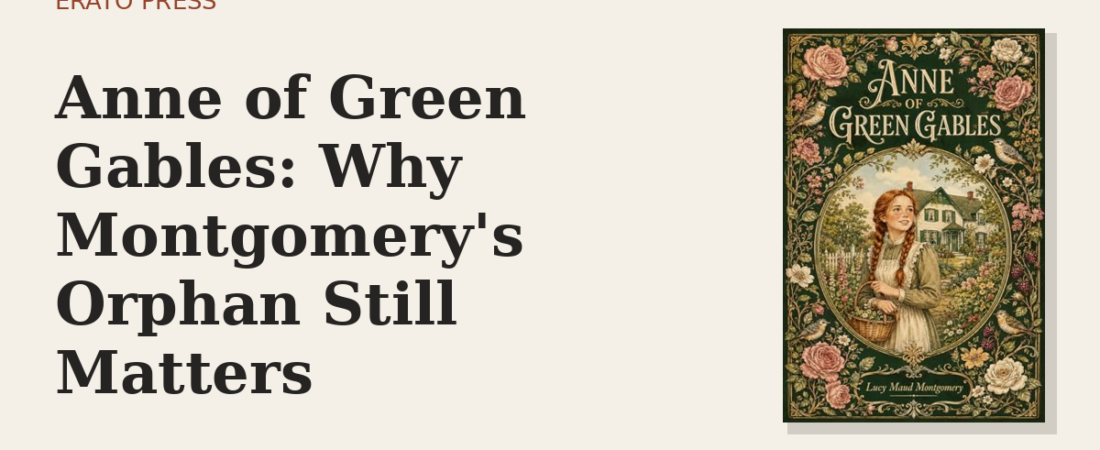
When Marilla and Matthew Cuthbert send to the orphan asylum for a boy to help work their Prince Edward Island farm, what arrives instead, in the spring of an undated 1870s, is a thin, freckled, red-haired girl of eleven who never stops talking. The clerical error that opens Anne of Green Gables — the wrong child, the unwanted girl — is the whole novel in miniature, and it is why L. M. Montgomery’s 1908 book has outlived almost every other children’s classic of its era. The argument worth making about Anne Shirley is not that she is charming, though she is, but that Montgomery used a sentimental orphan-story formula to do something quietly radical: she put a poor, imaginative girl’s inner life at the center of a serious novel, shifting fiction’s attention from action and external conflict to psychology and belonging. That shift is what keeps Anne alive. She is the orphan who is rescued, and then turns out to be the one doing the rescuing.

Montgomery, and the island that made her
Lucy Maud Montgomery, born in 1874 and a thoroughgoing product of late-Victorian culture, knew her heroine’s loneliness from the inside. She grew up on Prince Edward Island, educated and ambitious but constrained by the narrow roles available to women of her class; she attended Prince of Wales College, took a teacher’s license, taught school, and spent the 1890s publishing poems and stories in periodicals before Anne brought her sudden, unexpected fame. Her own life was harder than her sunlit fiction lets on — a marriage that proved fraught and unhappy, and decades of private struggle behind the public success. She read deeply in the Victorian novelists, the Brontës and George Eliot and Thackeray, and she carried their moral seriousness into a book that looks, on its surface, like a story for girls.
The Prince Edward Island of Anne is not mere scenery. The island functions as a character in its own right, a landscape that shapes consciousness and values — its red roads and apple blossoms, but also its hard economic facts. The settler culture is Scottish-Irish and Presbyterian, prizing education, hard work, and moral seriousness, and carrying with all of that a certain severity, a restraint in the expression of feeling against which Anne’s overflowing speech registers as something close to scandal. Green Gables itself sits at a moment when small-farm agriculture was already becoming anachronistic, pressured by the larger farms of the Canadian west and the American Midwest. Montgomery records, without sentimentalizing it, a way of life beginning to pass.
Imagination as a force, not a decoration
What makes Anne unforgettable is that her imagination is not a quaint accessory; it is the engine of the book and the instrument by which she remakes a world that did not want her. She renames the places around her — the Avenue becomes the White Way of Delight, Barry’s pond becomes the Lake of Shining Waters — because naming is how she takes possession of a landscape and a family that arrived to her by accident. The famous comedy of the early chapters grows directly out of this temperament. There is the slate brought down over Gilbert Blythe’s head when he dares to call her “Carrots,” beginning a feud and a love story in the same stroke. There is the bosom friend Diana Barry accidentally served currant wine instead of raspberry cordial and sent home tipsy. There is the green hair — Anne, desperate to be rid of her red, buys a dye from a peddler that turns her head a ghastly emerald. There is the longing for puffed sleeves, the fashionable extravagance Matthew secretly buys her, in one of the tenderest scenes in the book, because he cannot bear that she should go without. And there is the near-drowning when Anne, playing the dead Lady of Shalott in a leaky flat, has to be hauled off a bridge piling by, of all people, Gilbert.
Each of these episodes is funny, and each is also a small experiment in the cost and value of a vivid inner life. Montgomery’s tone is the secret of her durability: she writes with genuine warmth and an unembarrassed romanticism, but tempers both with a knowing irony and a sharp eye for the hypocrisies of a small community. Her dialogue is witty and frequently acerbic — Marilla’s dry severity and Mrs. Rachel Lynde’s officious gossip are drawn with the precision of a satirist.
A bildungsroman of belonging
Anne of Green Gables is, structurally, a classic bildungsroman — the novel of a young person’s education and maturing — but with a particular shape. Its arc is one of integration: the lonely, imaginative outsider gradually becomes embedded in a community that learns it cannot do without her. Education is presented almost as a form of salvation; it is through school, through her rivalry and eventual partnership with Gilbert, through her triumph in the entrance examination to the county academy, that the orphaned girl secures her worth in the eyes of Avonlea and in her own. When she takes the highest marks, the victory matters less as intellectual accomplishment than as vindication — proof that the unwanted child belongs.
And Montgomery refuses to let that belonging come cheap. The death of Matthew Cuthbert, the shy, kind old man who loved Anne first and most simply, is the novel’s great rupture, and it transforms the book in its closing chapters from a comedy of girlhood into something graver. Anne gives up her scholarship to the wider world and stays to teach at Avonlea so that Marilla, going blind and alone, need not lose the farm. The girl who arrived as a burden chooses, at the end, to become the one who carries others. That integration of small, domestic sorrows into the ongoing life of a community is precisely the modern emotional realism Montgomery brought to a children’s book — and the reason adults keep returning to it.
Why she still matters
To center a working-class orphan girl — not a man wrestling with the frontier, the traditional subject of Canadian fiction, but a girl discovering her interior life and her place among others — was a quiet act of literary rebellion, and it took the feminist criticism of later decades to restore Montgomery to her standing as a serious artist rather than a writer for children only. Anne became an international bestseller almost at once and has been beloved across the world, with a devotion in Japan that has long puzzled and delighted its admirers, different cultures reading their own preoccupations into Montgomery’s island. Anne herself is something of a “New Woman” figure, alive with ambition the period was busy narrowing — and the five sequels that followed, from Anne of Avonlea (1909) through Rilla of Ingleside (1921), trace with real ambivalence what the world did with girls like her.
Frequently asked questions
Is Anne of Green Gables only a children’s book?
No, and that has always been its strength. It operates on several registers at once — as children’s literature, as a historical portrait of rural Canada at the turn of the century, as a meditation on imagination and reality, and as a subtle, often ironic commentary on the possibilities open to women. Mark Twain admired it; generations of adults have reread it. Treating it as merely a girls’ book underrates the moral and psychological seriousness Montgomery folded into its comedy.
Do I need to read the sequels?
The first novel stands complete on its own; its arc from arrival to Matthew’s death and Anne’s decision to stay is self-contained and fully resolved. But the sequels deepen the picture, following Anne into teaching, marriage, motherhood, and, in Rilla of Ingleside, the First World War. They carry a more ambivalent, sometimes sorrowful awareness of how the world narrows a spirited girl’s options, and reward readers who have come to love her.
Why has the book lasted when so many of its contemporaries have not?
Because Montgomery anchored a sentimental formula in genuine psychological observation. Anne’s imagination, her hunger for beauty and belonging, her grief at Matthew’s death — these feel true rather than decorative. The book bridges nineteenth-century domestic fiction and a more modern interest in consciousness, and that combination of warmth, wit, and emotional honesty does not date the way pure sentiment does.
To meet Anne Shirley as Montgomery wrote her — the green hair and the puffed sleeves, the broken slate and the broken heart — in an edition that situates the novel in its Prince Edward Island world and its literary moment, the Erato Press text is the place to begin.
Enjoyed this piece?
Get the next one — our essays on the classics and news of each new Erato Press edition — straight to your inbox.