Science fiction has no founding charter and no single birthday, but it has a remarkably tight gestation. In a span of roughly eighty years — from a rainy summer on Lake Geneva in 1816 to the London of the 1890s — a new way of telling stories came into being, one that took the machinery of the age and asked the oldest question in literature in an entirely new key: what if? What separates this from the fantastic tales that preceded it, the voyages to the moon and the philosophical romances, is that the new form insisted on plausibility. Its marvels were not granted by gods or genies. They were extrapolated from the laboratory, the workshop, and the lecture hall. The genre was born, in other words, not from imagination unmoored but from imagination disciplined by science — and it was born because, for the first time, science had begun to remake the world fast enough to frighten people.

This is the thread worth following: science fiction is the literature the Industrial Revolution wrote about itself. It arose when machines stopped being curiosities and became the visible engine of history, and when a new biology suggested that humanity itself was not fixed but contingent, the product of forces that might be hurried, reversed, or unleashed. Trace the line from Frankenstein through Jules Verne to H.G. Wells and you watch a culture learning to think in the future tense — to treat the consequences of its own knowledge as a subject for narrative rather than prophecy.
1818: the monster in the laboratory
It begins, by near-universal agreement, with a teenager. Mary Shelley was eighteen when she conceived Frankenstein during the famous ghost-story contest at the Villa Diodati, and twenty when it was published anonymously in 1818. What makes the book the first true science fiction, rather than another Gothic shocker, is the precise location of its horror. Victor Frankenstein does not summon his creature with incantations or pacts. He assembles it from dead tissue and animates it through a process the novel pointedly declines to specify but clearly grounds in the contemporary science of galvanism — the experiments, electric and unsettling, in which a current made dead frogs’ legs twitch and dead men’s faces grimace. The terror is not supernatural. It is technological. The monster is what happens when a man acquires a power his moral imagination has not caught up to.
That displacement — from magic to method — is the genre’s original gesture, and Shelley’s novel established the template for nearly everything that followed. The subtitle, The Modern Prometheus, names the recurring anxiety exactly: knowledge stolen from the gods, and the punishment that attends the theft. Every later story of the scientist who creates what he cannot control, from the chemist’s hubris to the atomic physicist’s, is working a vein that Mary Shelley opened. Our companion essay, Frankenstein: Mary Shelley and the Birth of Science Fiction, follows that single novel deep into its sources and its long afterlife; here it is enough to mark it as the cornerstone. The form had its founding myth before it had a name.
The Verne interval: engineering as adventure
If Shelley gave the genre its conscience, Jules Verne gave it its hardware. Across the 1860s and 1870s, in the sequence he and his publisher called the Voyages extraordinaires, Verne perfected a different mode — not the cautionary fable but the technological adventure, lovingly, almost obsessively detailed. Twenty Thousand Leagues Under the Sea (1870) does not merely send its characters beneath the waves; it furnishes the Nautilus with a plausible account of how a submarine might be powered, provisioned, and navigated, complete with the figures of pressure and depth. From the Earth to the Moon (1865) launches its travelers with a giant cannon and a straight-faced ballistics calculation. Verne’s imagination was that of the engineer: he wanted the machine to work on paper, and the wonder in his books comes precisely from the conviction that it just might work in fact.
Verne represents the genre’s optimistic phase, the moment when the Industrial Revolution still looked mostly like deliverance — faster, deeper, higher, a planet shrinking under the steamship and the telegraph. His Captain Nemo is a darker figure than the surface adventure admits, a man in flight from empire and grief, but the dominant register is exhilaration. Technology is a key that opens the world. It would take a writer of the next generation, working in the long shadow of a new and far more disturbing science, to turn the key the other way.
Darwin’s shadow and the Wellsian turn
The decisive event between Verne and Wells happened not in a workshop but in a book of natural history. Darwin’s On the Origin of Species (1859) and, more pointedly, The Descent of Man (1871) had detonated under the Victorian self-image. If humanity was the product of blind variation and ruthless selection, then it was not the fixed crown of creation but a momentary arrangement — descended from the ape, kin to the worm, and subject, like every other species, to change, divergence, and extinction. This was the intellectual atmosphere H.G. Wells breathed at the Normal School of Science in South Kensington, where he studied under Darwin’s great champion T.H. Huxley. Wells took from Huxley not reassurance but vertigo: the sense that the human story was a chapter, not the whole book, and that the chapter could end.
Everything that distinguishes Wells from Verne flows from that lesson. The Time Machine (1895) does not celebrate progress; it stages its defeat, projecting the class divisions of industrial England forward across hundreds of thousands of years into the childlike Eloi and the subterranean, cannibal Morlocks — and then forward again to a dying Earth on a cold beach under a swollen red sun, one of the bleakest passages in the language. The War of the Worlds (1898) turns the imperial gaze around, subjecting comfortable England to the same casual annihilation that England had visited on Tasmania and the Congo. The Island of Doctor Moreau (1896) takes the Frankenstein theme and soaks it in Darwin, asking whether the difference between man and beast is anything more than a surgeon’s labor, painfully maintained and always slipping. Wells called these books “scientific romances,” and the phrase is exact: romance in the old sense of imaginative adventure, harnessed to a science that had stopped flattering its readers. The fuller arc of his achievement is the subject of H.G. Wells: The Man Who Invented the Future; for the history of the genre, his importance is that he gave it its grown-up subject. After Wells, science fiction could be about consequences.
Why the genre needed the nineteenth century
It is no accident that this all happened when it did. Earlier writers had imagined journeys to the moon and encounters with strange peoples — Lucian in antiquity, Cyrano in the seventeenth century, Swift in the eighteenth — but those were satires and philosophical entertainments, using the marvelous as a mirror for present folly. What they lacked was the conviction that the marvelous might actually arrive, and arrive soon, as the predictable output of human ingenuity. That conviction is a nineteenth-century invention. It required a world in which a person could watch the landscape of their own lifetime transformed by railway, factory, photograph, and anaesthetic, and could reasonably extrapolate that the transformation would continue, accelerate, and reach into the body and the mind themselves.
Science fiction, then, is best understood not as a perennial human impulse but as a specific historical response — the imaginative organ a civilization grew when it found itself, for the first time, changing faster than it could comprehend. Shelley gave it the moral question, Verne the technical confidence, Wells the evolutionary depth and the political bite. By 1900 the form possessed its full repertoire: the artificial being, the voyage to other worlds, the journey through time, the alien invasion, the future society held up as warning. Everything since — the pulps, the Golden Age, the New Wave, the screen — has been elaboration and variation on a genre that the long nineteenth century had already, in its essentials, completed.
Frequently asked questions
Was Frankenstein really the first science fiction novel?
It is the most defensible candidate, and the consensus choice. Earlier fantastic voyages exist, but they treat their marvels as satire or fable rather than as plausible products of natural law. Frankenstein is the first major work to ground its central wonder in contemporary science — the galvanic experiments on animation — and to take seriously the human consequences of a genuinely new power. That combination of scientific premise and moral inquiry is what the genre would be built on.
Why are Verne and Wells so different if they worked the same form?
Temperament and timing. Verne, the elder, wrote in the confident heart of the industrial century and treated technology as adventure and deliverance; his pleasure is in making the machine work. Wells, shaped by Darwinian biology and Huxley’s teaching, wrote in the anxious 1890s and treated science as a force that could expose, degrade, or extinguish humanity. One looks at the future and sees engineering; the other sees evolution, and evolution has no obligation to be kind.
Did the Industrial Revolution really cause science fiction?
“Cause” is strong, but the connection is structural, not incidental. The genre depends on the assumption that the world is being remade by human knowledge and will go on being remade — an assumption that only became commonplace once people had lived through the visible, accelerating transformations of the nineteenth century. Add Darwin’s unsettling of humanity’s place in nature, and you have the exact conditions under which writing about the future stopped being fantasy and started feeling like forecast.
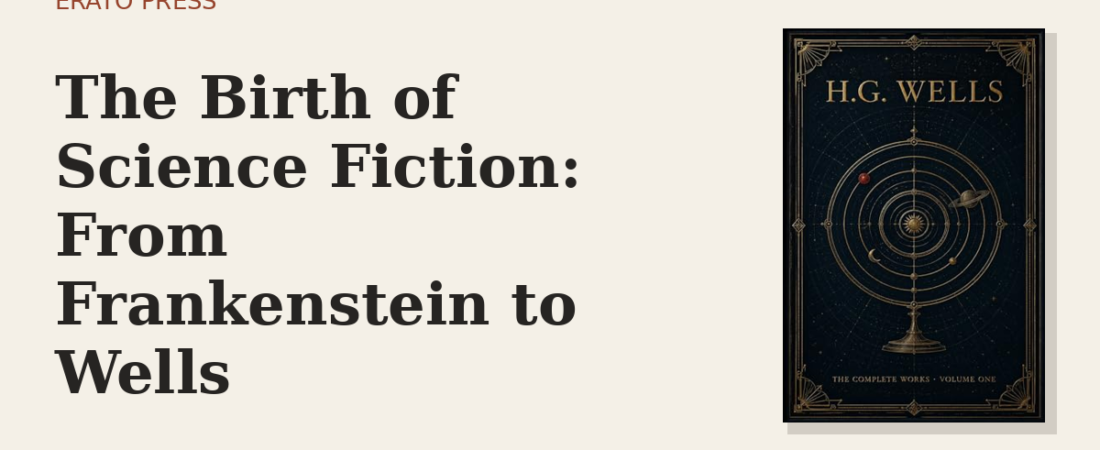
Our Wells collection gathers the scientific romances that brought this lineage to its first maturity, with editorial apparatus tracing the Darwinian and political currents that run beneath the adventure — the South Kensington classroom, the imperial anxieties, the long argument with progress that Wells never stopped having. To read these books together is to watch a genre arrive at self-awareness.
Read the Erato Press edition →
and follow the line from the monster in the laboratory to the Martians on Horsell Common.Enjoyed this piece?
Get the next one — our essays on the classics and news of each new Erato Press edition — straight to your inbox.