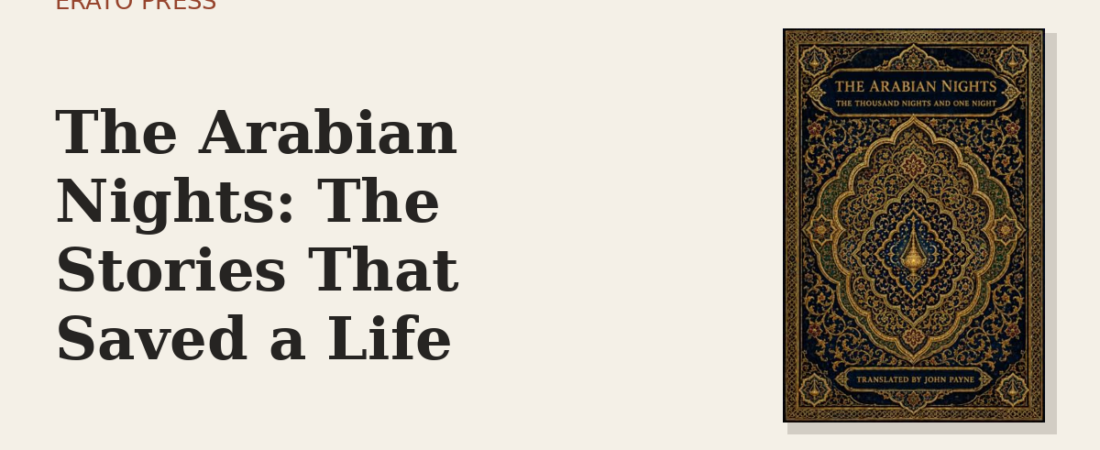
A king, betrayed by his wife, resolves to marry a new bride each night and execute her each morning, so that no woman can ever betray him again. To end the slaughter, the vizier’s daughter Scheherazade volunteers to marry him — and each night tells him a story so enthralling that she breaks it off at dawn, unfinished, so that the king spares her one more day to hear the ending. A thousand and one nights later, she has told him the greatest treasury of stories in the world, borne him children, and cured him of his cruelty. From that immortal frame comes The Arabian Nights (or The Thousand and One Nights) — Sinbad and his voyages, Aladdin and his lamp, Ali Baba and the forty thieves, the fisherman and the genie, and hundreds more — the fountainhead of storytelling itself.

Storytelling as survival
The frame is one of the profoundest images in all literature, because it makes literal what stories have always secretly been: a way of staying alive. Scheherazade tells tales to postpone death, night after night, and in doing so she becomes the patron saint of every storyteller, every writer who spins narrative against the dark. The suspense she uses — the cliffhanger, the story broken at its most gripping moment, the tale nested inside a tale so that ten endings are always pending at once — is the origin of narrative technique itself, the ancestor of every serial, every “to be continued,” every plot that makes you turn the page. And her deeper achievement is moral: through a thousand nights of stories, she does not merely survive but transforms the murderous king, curing his cruelty by the slow humanizing work of narrative. It is literature’s greatest claim for itself — that stories can save us, and even mend us.
A world of wonders
The tales themselves are a bottomless treasury of the human imagination — genies and flying carpets, enchanted cities and talking birds, merchants and thieves and caliphs walking Baghdad in disguise, voyages to islands of monsters and mountains of diamonds. They gathered over centuries, from Persia and India and Arabia and Egypt, a great sea of stories into which whole cultures poured their dreams, and they entered European literature in the eighteenth century like a burst of color, shaping the Western imagination of “the East” and giving world literature some of its most enduring characters. To read them is to touch the oldest pleasure literature offers — the sheer delight of “what happened next” — undiluted by any later sophistication.
The root of the tree
The influence of the Nights is almost immeasurable. The nested tale, the frame story, the cliffhanger, the fantastical journey — these techniques flowed from Scheherazade into the whole tradition of the novel and the tale, from Boccaccio and Chaucer through to modern magical realism, which openly claims her as an ancestor. Every storyteller who ever left an audience desperate for the next installment is her heir. The Nights stands with the great foundational story-cycles of the world, a wellspring like the epics our guide to the classical epics maps — the place where the pure narrative imagination runs closest to its source.
Why read it now
Because it is the origin and the celebration of storytelling itself, and because its central image — the woman spinning tales against death, mending a broken soul one night at a time — is the deepest thing ever said about why we tell stories at all. Dip in anywhere; each tale is a doorway. Few books offer more pure delight, or more reason to believe that a good story is worth staying alive for.
Frequently asked questions
Do I have to read all thousand and one nights?
Not at all — the collection is meant to be dipped into. Each tale stands on its own, and even a selection gives you the wonder, the variety, and the genius of the frame. Start with the famous ones and wander from there.
Are Aladdin and Sinbad really in it?
They became attached to the collection through its European translators and are now inseparable from it, alongside Ali Baba. The Nights grew over centuries by accretion, absorbing tales from across the medieval world.
Why is the frame story so important?
Because Scheherazade telling stories to postpone her execution makes literal the deep truth that narrative is a form of survival — and her use of suspense and nested tales founded techniques the whole tradition of storytelling still relies on.
Read the Erato Press edition →
and let Scheherazade keep you, too, turning the page.
Enjoyed this piece?
Get the next one — our essays on the classics and news of each new Erato Press edition — straight to your inbox.