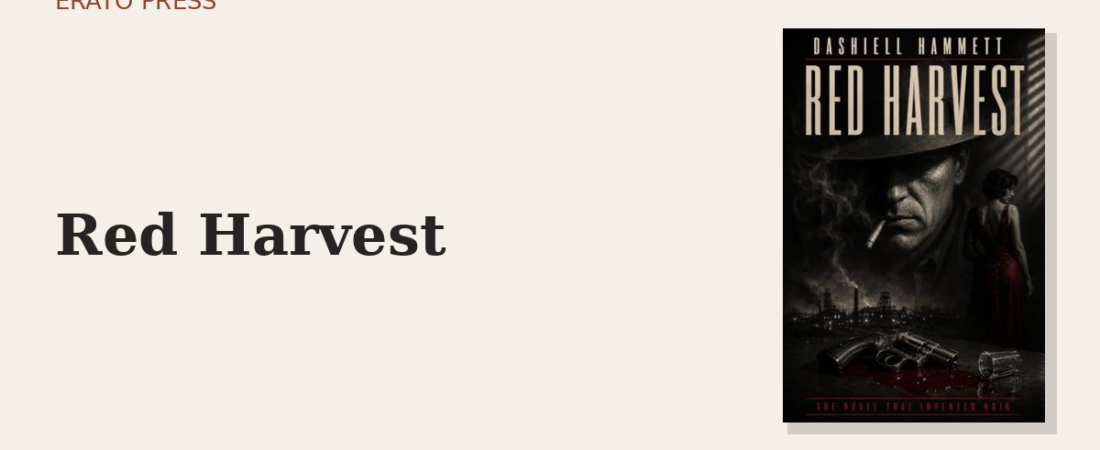

In 1929 Dashiell Hammett published a novel about a nameless detective who walks into a corrupt mining town, sets its rival gangs against each other, and watches them slaughter one another until the streets run red. It had no romance, no gentleman sleuth, no drawing-room confession. It had corruption, exhaustion, and a body count. The detective story would never be the same.
Red Harvest is where crime fiction grew up and got its hands dirty. Hammett had been a real Pinkerton operative, and he wrote what he knew: that crime is not a puzzle solved by a genius over tea, but a business, tangled up with money and power and the police themselves. His prose is stripped to the bone — flat, fast, and cold as a gun barrel.
Its influence is almost impossible to overstate. Kurosawa turned it into Yojimbo; Sergio Leone turned that into A Fistful of Dollars. The lone stranger who plays both sides of a rotten town is Hammett’s invention, laundered through a hundred later films.
Read it beside our essay on Hammett and the birth of hard-boiled crime, and next to its opposite number in the cosy tradition. This is the raw source.
Read Red Harvest — the Erato Press edition →
Enjoyed this piece?
Get the next one — our essays on the classics and news of each new Erato Press edition — straight to your inbox.