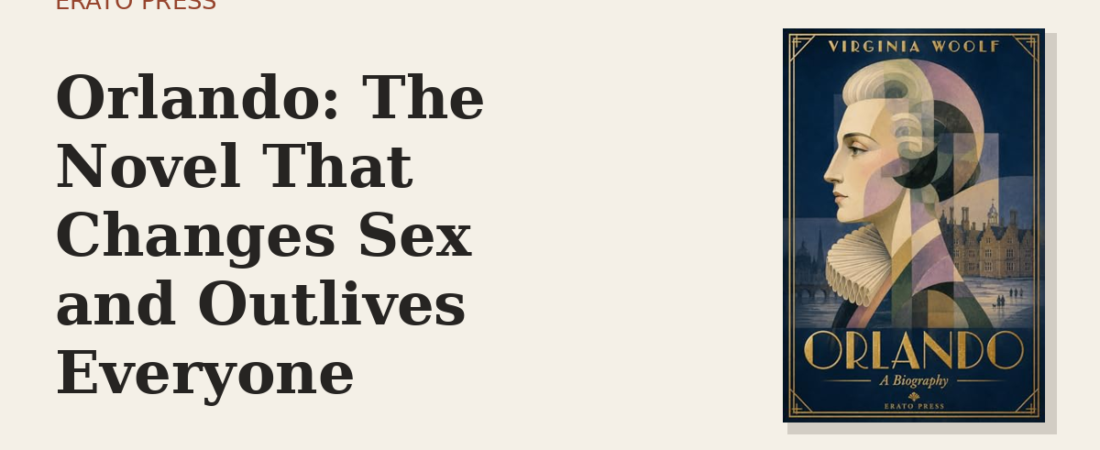
A young Elizabethan nobleman named Orlando lives for more than three hundred years without aging past thirty-six, changes one morning, without fuss, from a man into a woman, and carries on. Virginia Woolf’s Orlando (1928) is her most exuberant, playful, and mischievous book — subtitled “A Biography,” it is a mock-biography that gallops across four centuries of English history and literature — and it is also, under the fun, one of the most radical things she wrote: a sly, joyful demolition of the idea that we are fixed forever in one sex, one self, one age. Written as a love letter to Vita Sackville-West, it remains a landmark, playful and profound at once, of writing about gender and identity.

The joke that is also serious
Woolf presents Orlando’s sex change with deliberate, comic casualness: “Orlando had become a woman — there is no denying it. But in every other respect, Orlando remained precisely as he had been.” The refusal to make a drama of it is the argument. The same person continues, with the same soul, the same memories, the same loves — only the world’s treatment changes, as Orlando discovers the absurd new rules that govern a woman’s life (the clothes, the constraints, the sudden loss of rights over property and self). By making the change of body a non-event and the change of social role an outrage, Woolf lets us see that what we call the difference between the sexes is largely a costume society imposes — a wardrobe, not a nature. It is one of the wittiest and most quietly revolutionary passages in modern fiction.
A romp through English literature
The book is also a giddy tour through the history it inhabits. Orlando meets Queen Elizabeth, skates on the frozen Thames in the Great Frost, encounters the poets of each age, endures the buttoned-up Victorian era (which descends on the novel as a literal, oppressive damp), and arrives, breathless, in Woolf’s own 1928. It is Woolf on holiday from the intense inwardness of Mrs Dalloway and To the Lighthouse — parodying the pompous conventions of biography, satirizing the literary establishment, having enormous fun — and yet the play is in earnest. Underneath the costume-changes runs Woolf’s serious conviction that the self is not one thing but many, that a person contains multitudes of selves across a life, and that no single label — man, woman, one age, one identity — can hold a human being still.
The love letter
Orlando was Woolf’s gift to the aristocratic writer Vita Sackville-West, with whom she was in love — Vita’s son called it “the longest and most charming love letter in literature.” Orlando’s ancestral house is Vita’s family estate; Orlando’s fluid, adventurous nature is Vita’s; the whole book is an act of imaginative homage, freeing the beloved from the limits of a single sex and a single lifetime and letting her range across the centuries. That personal warmth is what keeps the book from being merely clever: it is a work of love as much as of ideas, and it glows with the pleasure of its own making.
Why read it now
Because it is Woolf at her most delightful and, on the subject of gender and the fluid self, decades ahead of her time — a book that our own moment has rediscovered as astonishingly current. Shorter and far more accessible than her other major novels, funny and sparkling and wise, it is the perfect place to fall for Woolf before tackling the deeper works.
Frequently asked questions
Is Orlando a good introduction to Woolf?
Yes — it is her most fun and most accessible major work, a fast, witty romp rather than a dense interior novel. Many readers who find Mrs Dalloway daunting fall in love with Woolf through Orlando first.
Why does Orlando change sex?
Woolf uses the transformation to expose how much of “male” and “female” is social costume rather than fixed nature: Orlando’s soul is unchanged, only the world’s rules change. It is a witty, radical argument about the fluidity of identity, remarkable for 1928.
Who was it written for?
Vita Sackville-West, the writer Woolf loved — her family’s history and character run all through it. It is often called the greatest love letter in literature.
Read the Erato Press edition →
and meet the hero who outlives every age and belongs to none.
Enjoyed this piece?
Get the next one — our essays on the classics and news of each new Erato Press edition — straight to your inbox.