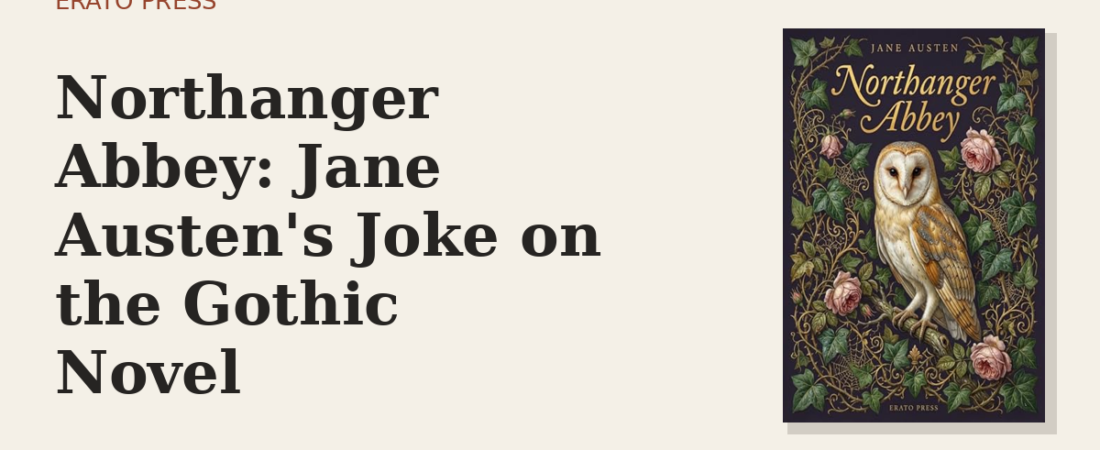
Catherine Morland, seventeen and addicted to horrid gothic novels, is invited to a real ancient abbey and promptly convinces herself that its owner has murdered his wife and hidden her in a secret chamber — a fantasy the ordinary reality of the place comically explodes. Northanger Abbey (written first, published posthumously in 1817) is Jane Austen’s most purely funny novel, a loving parody of the gothic thrillers that were the guilty pleasure of her age, and at the same time a sly, spirited defense of the novel itself against the snobs who dismissed it. It is Austen young, playful, and delighting in her craft — the lightest of her books and, in its wit, one of the most charming.

The dangers of reading too much
Catherine’s comic flaw is that she has read too many novels — specifically, the wildly popular gothic romances of Ann Radcliffe, full of gloomy castles, murdered wives, and mysterious manuscripts. Arriving at Northanger Abbey, she projects those thrilling horrors onto a perfectly ordinary English gentleman’s house, snooping for evidence of the murder she is sure General Tilney committed, until the young man she loves gently, mortifyingly corrects her: this is England, not a gothic romance; look around you. Austen is affectionately mocking the fashion for sensational fiction and the reader who confuses it with life — but her mockery is double-edged, because the General does turn out to be a genuine villain, if a mercenary and ordinary one rather than a gothic monster. Real cruelty, Austen suggests, wears a duller face than the novels promise, and is no less dangerous for it.
Austen defends the novel
The book contains one of the most spirited defenses of fiction ever written by a novelist. Interrupting her own story, Austen rounds on the fashionable contempt for novels — the pose of the reader who is ashamed to admit to enjoying them — and insists that the novel is a form in which “the greatest powers of the mind are displayed,” that a good novel offers more wit and knowledge of human nature than the pompous non-fiction the snobs pretended to prefer. It is a manifesto, delivered with laughter, for the very thing she was perfecting, and it makes Northanger Abbey a book about books — about how we read, what we owe fiction, and the difference between using novels to understand life and using them to escape it.
The lightest Austen
Because it was her first-written novel and a parody besides, Northanger Abbey is the most youthful and high-spirited of Austen’s books — its heroine ordinary and endearing rather than dazzling, its tone closer to comic romp than to the deep social comedy of her mature work. It lacks the profundity of Emma or Mansfield Park, and gains in sheer fun what it yields in depth. It is the perfect Austen for a reader who wants to laugh, and a delicious companion to the gothic tradition it so lovingly teases.
Why read it now
Because it is Austen’s funniest book and a timeless comedy about the reader who confuses fiction with life — a temptation our binge-watching, doom-scrolling age knows better than hers. Short, sparkling, and warm, it is both a delightful parody and a heartfelt defense of the pleasure of reading, from the pen of the writer who did most to make the novel respectable.
Frequently asked questions
Do I need to know gothic novels to enjoy it?
No — the parody works even if you have never read Ann Radcliffe, because Austen makes the conventions clear as she teases them. Knowing the gothic tradition adds a layer of pleasure but is not required.
Is it a good first Austen?
It is the lightest and funniest, which makes it a delightful entry, though it is less deep than her mature novels. Many readers enjoy it early for its charm, then return to appreciate its clever defense of fiction.
Why was it published after her death?
Austen wrote it early but it was not published until 1817, after she died, paired with Persuasion. It thus reached readers as a posthumous work, though it was among the first she completed.
Read the Erato Press edition →
and laugh with Austen at the reader who mistook a novel for life.
Enjoyed this piece?
Get the next one — our essays on the classics and news of each new Erato Press edition — straight to your inbox.