“I am going to take a heroine whom no one but myself will much like,” Jane Austen said of Emma Woodhouse — “handsome, clever, and rich,” spoiled, self-satisfied, and wrong about nearly everything. It was a daring wager: to build a comic masterpiece around a heroine who is a snob and a meddler, who nearly ruins the lives of the people she means to help, and to make us love her anyway. Austen won the wager completely. Emma (1815) is her most perfectly constructed novel, a flawless comic machine in which every misunderstanding is planted in plain sight and every re-reading reveals new artistry — and the deepest study she ever made of self-deception and the slow, humbling growth into wisdom.

The comedy of a clever fool
Emma’s problem is that she is the cleverest person in her small world of Highbury and has never been checked. Convinced of her own insight, she appoints herself matchmaker and remakes the pretty, humble Harriet Smith into a project — steering her away from a worthy farmer toward gentlemen far above her, misreading every signal, and causing a cascade of embarrassment and near-disaster. The genius of the novel is that Austen lets us see, on a careful reading, everything Emma cannot: the true state of every heart is laid out in the open, and Emma, for all her cleverness, misinterprets it at every turn. We are inside her flattering self-image and above it at once, wincing and delighting, watching a bright, good-hearted young woman blunder because she has mistaken her own vanity for perception.
The education of the heart
Presiding over the comedy is Mr Knightley — older, honest, the one person who tells Emma the truth — and the novel is, among other things, the story of Emma’s slow discovery that the man who has been correcting her all along is the man she loves. Her growth is real and hard-won: the mortifying moment on Box Hill when she is cruel to poor, harmless Miss Bates, and Knightley’s quiet rebuke (“It was badly done, indeed”), is one of the great turning points in Austen — the instant a clever girl feels genuine shame and begins to become a good woman. Austen’s comedies are always secretly educations of the heart, the same moral seriousness beneath the wit that our essay on Pride and Prejudice traces; in Emma the lesson is the hardest and the most tenderly taught.
The perfection of the form
Critics who care about craft often name Emma the most perfectly plotted novel in English. Every detail is functional; every seeming triviality of village life is a clue; the mysteries of who loves whom are fair puzzles the attentive reader can solve and the vain heroine cannot. Austen confines herself to a tiny world — “three or four families in a country village” — and finds in it the whole comedy of human self-regard. It is the novel that most repays re-reading, because the second time through, knowing the secrets, you watch the machinery work with a pleasure close to awe.
Why read it now
Because it is the funniest and most flawless of Austen’s novels, and because Emma herself — clever, privileged, sure she knows best, and gently schooled by life into humility — is a heroine for every age that overvalues its own cleverness. Come for the comedy of errors; stay for the most artful plot in English fiction and the tender wisdom under the wit.
Frequently asked questions
Is Emma a good first Austen?
Pride and Prejudice is the usual and easiest entry, but Emma is the connoisseur’s favorite. Its comedy is broader on the surface and its construction deeper; readers who already love Austen often name it her best.
Why is Emma called unlikable?
Austen deliberately made her a privileged, meddling snob to test whether she could keep the reader’s affection — and succeeded, because Emma is also warm, self-aware by the end, and genuinely good-hearted. Her flaws are what make her growth moving.
What happens at Box Hill?
At a picnic, Emma publicly mocks the kind, tedious, poor Miss Bates, and Mr Knightley rebukes her privately — the moment of shame that begins Emma’s moral awakening. It is one of the most quietly powerful scenes Austen wrote.
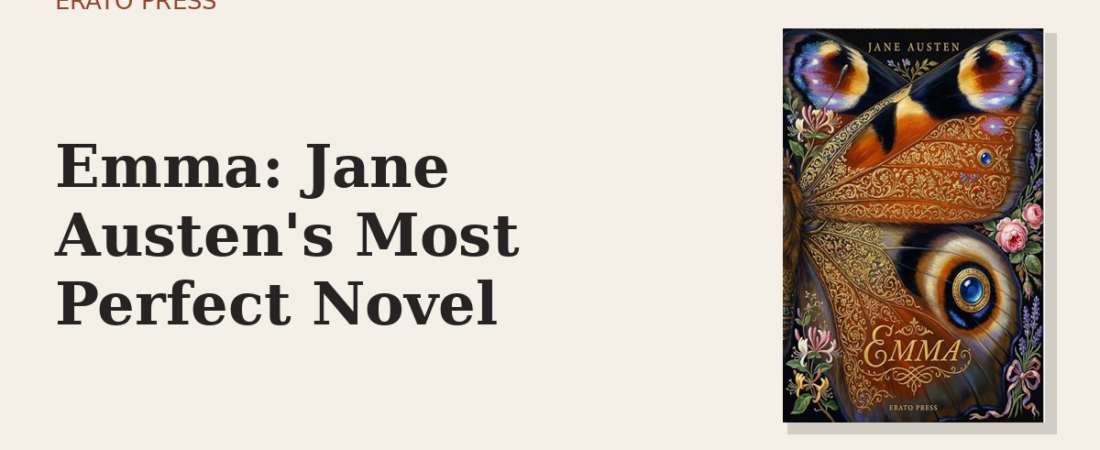
Read the Erato Press edition →
and watch the cleverest girl in Highbury learn the one thing she didn’t know.
Enjoyed this piece?
Get the next one — our essays on the classics and news of each new Erato Press edition — straight to your inbox.