The Greek gods are immortal. The Norse gods are doomed. Everything else — the temperament, the humor, the moral weather, the kind of hero each world can produce — flows from that single, staggering difference. Zeus will reign forever; Olympus does not have a last day on its calendar. Odin knows the precise manner of his own death: he will be swallowed by the wolf Fenrir at Ragnarok, the twilight of the gods, when the world burns and the sea rises and the very powers who hold creation together go down fighting a battle they already know they will lose. To compare these two mythologies is not to rank two pantheons of broadly similar deities. It is to compare two fundamentally opposed answers to the oldest question a culture can ask: what is it like to be a god, and what does that tell us about being a person?

A mythology that ends
Begin with the fact that defines the whole Norse imagination: it has an ending built into it. The Poetic Edda and Snorri Sturluson’s Prose Edda, our two great sources, do not merely permit the gods to die — they make divine death the structural climax of the entire cosmos. The Voluspa, the seeress’s prophecy that opens the Poetic Edda, narrates creation only to march steadily toward annihilation: Odin devoured, Thor felled by the world-serpent’s venom even as he kills it, Freyr cut down, the sun darkened, the stars gone, the earth sinking into the sea. The gods know this is coming. They spend their existence preparing for a war they are fated to lose. Odin gathers slain warriors into Valhalla not for glory but as an army for the last day — an army he knows will not be enough.
Nothing in Greek myth resembles this. The Olympians have anxieties — prophecies that a son will overthrow a father, the long shadow of the Titans they imprisoned — but the system itself is stable, perpetual, victorious. Zeus is the end of cosmic history, not a stage on the way to its collapse. The Greek universe, as it comes down to us through Hesiod, is the story of order finally and permanently established, the subject I take up in Greek Mythology 101: Hesiod and the Birth of the Gods. The Norse universe is the story of order valiantly maintained against a doom it cannot escape. One mythology is built around a victory; the other is built around a defeat that has not happened yet.
Two kinds of fate, two kinds of courage
Both cultures believed in fate, but they believed in different fates, and the difference shapes their entire ethics. Greek moira is a constraint — a limit the hero pushes against, sometimes tragically, sometimes magnificently. Oedipus runs from his prophecy and runs straight into it; the tragedy lies in the gap between what he wants and what is decreed. Fate in Greece is the thing that defeats you when you were trying to win.
Norse fate is something colder and, in a way, more bracing. The Norns have already woven it; the gods themselves are subject to it; and crucially, everyone knows the outcome in advance. This produces a wholly distinct heroic ideal. If you cannot change the ending, then the only thing within your power is how you meet it. The Norse hero — and the Norse god — is judged not by whether he wins but by how he conducts himself in the face of certain loss. Courage detached from any hope of success becomes the supreme virtue. This is why the sagas are full of men who, told they will die, simply adjust their grip on the sword. It is a heroism for a world that has read the last page and goes forward anyway. The Greeks gave us the tragedy of the man who didn’t know his fate; the Norse gave us the strange dignity of the man who did.
The gravity of Olympus, the gallows-humor of Asgard
You can hear the difference in the jokes. Greek myth has comedy — the gods commit adultery and get caught in nets, Hermes is a trickster, Dionysus brings chaos — but its comedy tends toward the sensual, the operatic, the divine misbehaving on a grand scale. Norse myth has a drier, sharper, more dangerous wit. Loki is not a charming rogue; he is a figure of genuine menace whose mockery curdles into the betrayal that triggers Ragnarok. Thor dresses as a bride to recover his stolen hammer in the Thrymskvitha, and the scene is broadly funny, but the humor sits on a foundation of doom. This is gallows-humor in the most literal sense — the laughter of people who know the gallows is coming and have decided to be sardonic about it. Snorri’s gods trade insults, get outwitted by giants, lose their wagers. The comedy of a doomed world has a particular flavor: it is funny precisely because nothing finally matters except how you carry yourself, and carrying yourself well includes the ability to make a grim joke at the end of the world.
What each mythology lets a hero be
Put the two heroic worlds side by side and the philosophies become unmistakable. The Greek hero — Achilles above all — confronts mortality as the central fact, but he confronts it as an exception: he is the mortal man among gods who do not die, and his greatness is purchased by accepting a death the gods will never face. Mortality is what makes the Greek hero more than the gods in a sense, because only he has skin in the game. The Norse hero has no such distinction available, because in his world even the gods have skin in the game. Odin will die. Thor will die. The hero’s mortality is not a tragic exception to a deathless order; it is a small instance of a universal condition that reaches all the way up to the throne of heaven.
This is why the two mythologies feel so different in the chest. Greek myth offers the consolation of permanence: the gods abide, beauty abides, the order of things survives every individual death. Norse myth offers the harder consolation of solidarity: the gods are in it with you, they will fall as you fall, and the universe asks of Odin exactly what it asks of you — to fight the wolf knowing the wolf wins. There is even, faintly, in the Voluspa, a green earth rising again from the sea after the fire, a hint that the cycle is not pure nullity. But it is a whisper, not a promise. The dominant note is the courage of the doomed, and no other mythology of the ancient world strikes it so purely.
Frequently asked questions
Are the Norse and Greek gods related, since both are Indo-European?
They share deep linguistic and structural roots — a sky-father, a thunder-wielder, a pattern of divine functions — and scholars since Georges Dumezil have traced the kinships. But the theology diverged radically. The presence of Ragnarok, an eschatological end in which the gods themselves perish, is the great Norse innovation that has no real Greek counterpart and makes the two systems feel philosophically opposed despite their family resemblance.
Why do the Norse gods accept their doom instead of trying to escape it?
Because in the Norse conception fate is genuinely fixed, even for gods, and the heroic response is not evasion but composure. Odin spends his existence preparing for Ragnarok not to avert it — he knows he cannot — but to meet it well. The ethic prizes how you face the inevitable over whether you can change it, which is precisely the ethic the sagas pass to their human heroes.
Which should I read first, the Eddas or Greek myth?
If you want the foundations of the Western literary imagination, Greek myth and Hesiod come first historically and shape almost everything after. But the Eddas reward a reader who already knows the Greek pattern, because the contrast is where the meaning lives — you appreciate the audacity of a mythology that kills its gods far more keenly once you have seen one that never does.
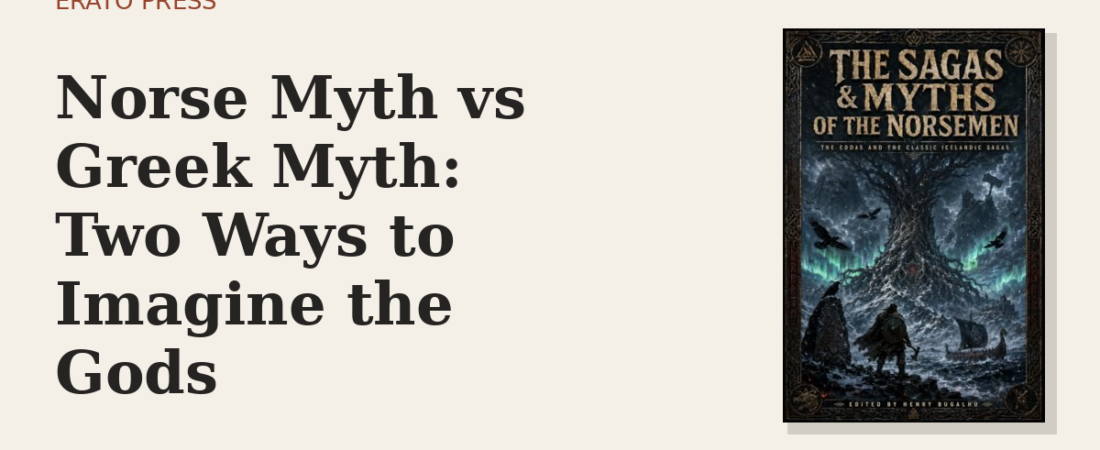
The Erato Press edition brings the Poetic Edda and Snorri’s Prose Edda together with an apparatus built for exactly this kind of comparative reading — tracing the structure of Ragnarok, the logic of Norse fate, and the heroic code of the doomed across the primary texts rather than summarizing them at a distance. It is the edition for the reader who wants to feel why a mythology that ends imagines the gods so differently from one that does not.
Enjoyed this piece?
Get the next one — our essays on the classics and news of each new Erato Press edition — straight to your inbox.